Archive for the ‘transportation’ Category

Fire Destroys LH Landmark near Ligonier, PA

February 24, 2008

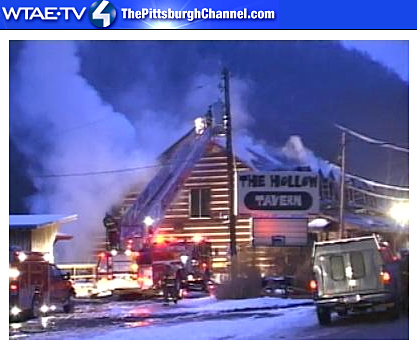
US 30 eastbound was closed for 8 hours overnight as fire destroyed the Hollow Tavern in Unity Twp, Westmoreland County, just west of Ligonier, and about 40 miles east of Pittsburgh, Pennsylvania. Built 1939-40 as a restaurant and hotel along the Lincoln Highway in the Loyalhana Gorge, it was perhaps best known for a small concrete causeway across the water. The 2-lane LH ran past its door, but when westbound lanes were moved to the other side of the water in the 1950s, half their customer base disappeared. They fought for, and won, the small access crossover.
PA Sleepy Hollow

The location, popular for its view, had housed a gas station and sandwich stand since the 1920s. The area was known as Kelley’s Hollow but acquired the Sleepy Hollow moniker from one of the owners’ habit of dozing in his rocking chair. The building resembled a big log cabin, and its old wood construction made fighting the fire difficult. Click HERE for no-narrator 1-minute video of the blaze from KDKA-TV (after a 15-second commercial).

PA_HollowTav_WTAE

Also, click on the image above for a brief text report from WTAE-TV.

LHA's spring 2008 state meetings set

February 23, 2008

Here are some upcoming Lincoln Highway Association chapter meetings.

LHA banner

Iowa will hold a membership meeting on Saturday, April 12, 2008, in Denison, Crawford, County.

California’s spring meeting also will be held April 12, in East Castro Valley/Hayward.

The Ohio Lincoln Highway League will hold 14th annual state meeting on Saturday, April 26, at the Elks Club in Galion. It will be hosted by the LHA Mid-Ohio Chapter. Tours of local attractions will follow.

LHA’s Indiana chapter will host a lunch meeting, to be joined by Illinois, May 10 in Schererville that will include a ceremony honoring Art Schweitzer, leading expert on the Ideal Section.

Follow the links for more information.

Proclamations honor LH's favorite Boy Scout

February 22, 2008

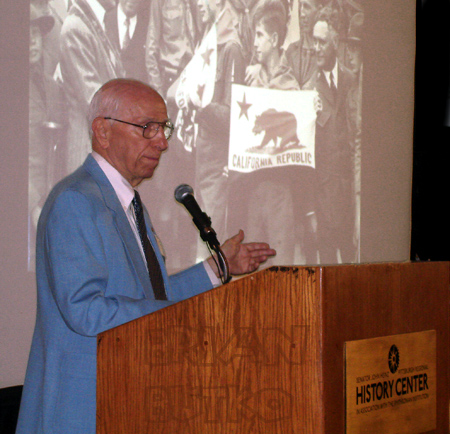
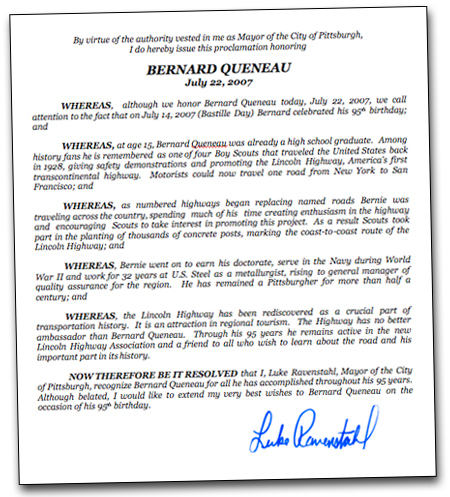
One of the highlights of the Summertime Fun event I arranged last year at the Senator John Heinz History Center was to award Bernie Queneau with a proclamation from the mayor of Pittsburgh. It mentions not only Bernie’s participation in the cross-country safety demonstration tour along the Lincoln Highway in 1928, but also his earning a doctorate, service with the Navy in WWII, and his expertise in metallurgy. He also received a proclamation from the LHA, presented by Rev. John Harman. The occasion for all this was his 95th birthday on July 14 – Bastille Day, Bernie likes to remind us! Also attending was his wife, LHA past president Esther M. Queneau.

Bernie Queneau 7/07
Above: Bernie in front of a photo of himself holding a CA flag at the end of the LH, 1928.

Recently, mayor Luke Ravenstahl hosted a ceremony for some of the proclamation recipients, including Bernie. Here’s part of the mayor’s intro to the recent event:

For many years, Pittsburgh Mayors have been recognizing outstanding citizens and organizations by issuing them proclamations.

It is my goal to highlights some of our most unique Pittsburgh citizens and organizations, by presenting their proclamation in person.

It gives me great pleasure to be familiar with all of the important activities Pittsburghers are involved with.

I say it all of the time, but I truly believe that Pittsburgh is America’s most livable City because of its people.

We are people of superb nature, who will always reach out a hand to help others—we are Pittsburgh proud.

Today, I have looked through a number of recently issued proclamations, and it is my pleasure to meet those outstanding individuals, and personally present them with their proclamation.

QueneauProc

You can see a video of Proclamation Thursday on the City of Pittsburgh’s Cable Station, channel 13, at 3:00 a.m., 8:30 a.m., 12:30 p.m. and 9:30 p.m. through February and March.

A poem lamenting change along the road, in life

February 21, 2008

On OpEdNews.com, an entry by Vi Ransel will sound familiar themes to many Lincoln Highway News readers.

IL_barn_62505_0003
Above: Another farm sprouts housing along the Lincoln Highway, west of Chicago, June 2005.

In Memoriam

The place I grew up in the 50s is gone now.
Oh, the land is still there,
but the quilt-like farm fields blanketing the rolling hills,
the deciduous forests and the meandering streams
have been overtaken and replaced by an invidious, invasive species
of four-lane byways with a broad, medial stalk of conquering concrete
sprouting small, almost identical malls like profligate weeds dispersing seeds
every mile or so along the length of the Lincoln Highway.

One last dairy farm remains, attached to the Route 30 vine.
Contained by concrete, cows graze in green pastures
as fossil fuel-burners blindly whiz by emitting a life-exhausting fog.
The farm, a delicate anachronism, is out of place in its own place,
a symbol of a sustainable way of life set like a jewel
on the artificial energy-sustained existence
clinging tenuously to the grid by an electrical thread
generated by the last drops of once living,
long dead bodies of the plant and animal ancestors
of those same dairy cows.

Vi’s works appear widely both in print and online. She conducts Poetry Workshops and gives readings in Central New York. Her latest chapbook is “Sine Qua Non Antiques (an Arcanum of History, Geography and Treachery).

http://www.opednews.com/maxwrite/diarypage.php?did=6021

Lincoln Memorial: monument was almost a road

February 20, 2008

A detailed and engrossing story in The Washington Post recalls the tumultuous genesis of the Lincoln Memorial, including how the monument that we know was instead almost a road named for the President. It was referred to then as the Lincoln highway, the Lincoln Memorial Highway, or simply Lincoln Way – all years before the Lincoln Highway of this blog was proposed or its association incorporated in 1913. The article is titled, “The Lincoln Conspirator: Illinois Congressman Joe Cannon was determined to stop the Lincoln Memorial from rising on the Mall. He almost succeeded.”
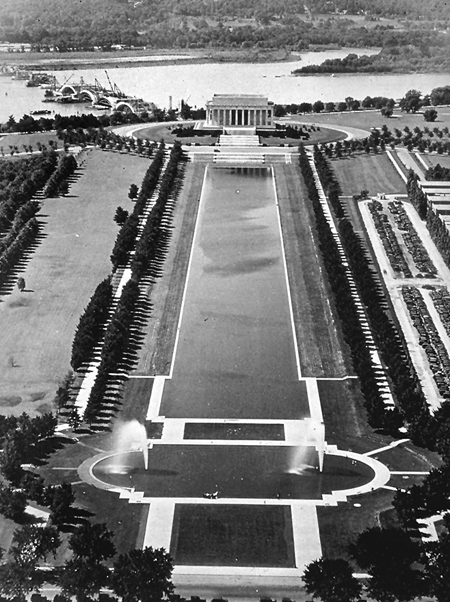
LOC_Lincoln Memorial

Above: An aerial view of the Lincoln Memorial, with Memorial Bridge under construction, c. 1930, courtesy LOC, Images of America: Lantern Slide Collection, from the Harvard University Graduate School of Design, Frances Loeb Library, Cambridge Mass.

A national monument to honor Lincoln in Washington, D.C., was proposed soon after his assassination, but the idea foundered until 1901 when the Senate Park Commission proposed the current monument as part of a plan to remake the Mall.

Here are excerpts that mention the idea of a highway:

What had most impressed [former congressman James] McCleary during his tour of Europe was the Appian Way, the ancient road in southern Italy built by Roman censor Appius Claudius. “Who has not heard of the Appian Way?” he wrote in the article. “What a fitting memorial to Lincoln would be a noble highway, a splendid boulevard, from the White House to Gettysburg.”

“The Lincoln Way” would include one roadway for automobiles and one for horse-drawn carriages and wagons; plus two electric railway tracks: one for express trains, the other for local trains. Stately rows of trees would border the highway. Down the middle would be a well-kept lawn 40 to 50 feet wide, with beautiful fountains and monuments at intervals along the way. Given “the possibilities of electrical illumination, the beauty of this boulevard when lit up at night may be left to the imagination,” McCleary wrote….

Rep. William Borland, the Missouri congressman who led the highway effort, predicted an easy win for the road. He believed cars would become more popular, though he didn’t drive one himself. Many congressmen found the prospect of obtaining federal dollars for road projects in their own districts tempting. Road supporters, backed by the auto industry, were well-organized. They flooded Congress with telegrams and petitions. Architect Glenn Brown’s campaign in favor of a Greek temple was no match. Everyone knew that a House victory for the Lincoln highway would create a stalemate and indefinitely postpone the creation of any memorial because the Senate wouldn’t agree to the road….

Highway advocates attacked the memorial plan as foreign and not representative of Lincoln, according to the Congressional Record. “There is nothing in this Greek temple . . . that even suggests . . . the character . . . of Abraham Lincoln,” said Rep. Isaac Sherwood of Ohio….

A highway is “nearer to expressing the epoch of American history than any other form of memorial,” said Borland, who emphasized that a road was unanimously endorsed by the Grand Army of the Republic, whose members were Union veterans. The Greek temple is the most hackneyed form of architecture known, he added…

Knowing that aesthetic arguments weren’t likely to sway members, [architect] Brown had prepared a cost estimate for the Lincoln highway, which Rep. Lynden Evans of Illinois used effectively during the debate. “It will cost at least $20 million to build a really distinctive road,” he said, and pointed out that it could be used only by those who could afford a car. “If a trolley line was placed upon it so that the plain people could use it, it would be valuable and useful . . . But it would not be a memorial of Abraham Lincoln.”

There were accusations at the time that road advocates tended to be those who would benefit from that project. Accordingly, one commenter to the article has written, “The ‘Road to Gettysburg’ sounded like the ‘Road to Nowhere’ considering Gettysburg was not a commercial center like, say Philadelphia or NYC. The practical value of a highway can’t have been a totally futuristic concept.” Of course, the Lincoln Highway proposed by Fisher would encounter some of the same arguments as the original Lincoln Way. Washington D.C. leaders would even advocate for Fisher’s coast-to-coast road to bend their way. Only after repeated pleas would the city get an official feeder – from Philadelphia through D.C. to Gettysburg, just as they had sought earlier.

Classic cafe being razed in Grand Island, Nebr.

February 19, 2008

The Grand Island Independent reports that the Nebraska city is widening it’s main street – aka Lincoln Highway/US 30 – and in the process demolishing a vintage cafe. The Conoco motel and cafe at 2109 W. Second Street trace their roots to about 1940 when the tile-roofed Conoco Service Station opened. The cafe had a Polynesian redo in the 1960s but only the motel will survive (featuring a swimming pool and cable) as will a new convenience store. The cafe is seen in the upper right photo of the postcard below, which on back is titled, “Conoco Motel, Cafe & Service Station.”

NE_Conoco_GrdIsld

According to the news report:

A total of 18,400 vehicles travel daily on Second Street between Broadwell and Greenwich Street. To better accommodate that volume, the state will install a fifth lane a turning lane from Grant Street to Greenwich….

The right-of-way needed for the fifth lane simply brought the roadway too close to the Conoco Cafe, which the state acquired more than a year ago through condemnation. The last restaurant to operate there, Pam’s Cafe, closed Jan. 31, 2007, and relocated to South Locust Street.

Last week, an environmental firm removed asbestos from the cafe. This week, a construction company is starting demolition. Road work will commence March 17 and wrap up in October, then next Spring, sidewalks, lighting, and landscaping will be completed.

New video on Alice's Drive 2009 commemoration

February 18, 2008

Richard Anderson reports that he and daughter Emily Anderson have produced and posted a new video about the 2009 journey Emily will take commemorating Alice Ramsey’s groundbreaking drive across the US in a rebuilt 1909 Maxwell. LH fans will note Lincoln Highway book state guides author and LHA Forum editor Gregory Franzwa about 50 seconds in and remaining a major voice in the 5:46 video.

Alice was the first woman to drive across the US, following a route that a few years later would be used by the Lincoln Highway in many places (though notably not across the Allegheny Mountains through PA or OH). Emily hopes to follow Alice’s original route as closely as possible, but will deviate somewhat due to roadway changes and the safety concerns.

AliceMap

Learn more at their web site aliceramsey.org about the route, and about a film that Emily’s brother Bengt Anderson is producing about the event and women’s history, Alice’s Drive – Women Who Drove The Century. Richard also reports that the car body is finished and being painted, and that the engine needs only a few parts before being started, they hope in March. The most recent challenge was needing an exhaust manifold; not finding one, Richard modeled and cast one based one a 1908 Maxwell that he owns.

Centennial of Great Race Honored with Exhibit

February 17, 2008

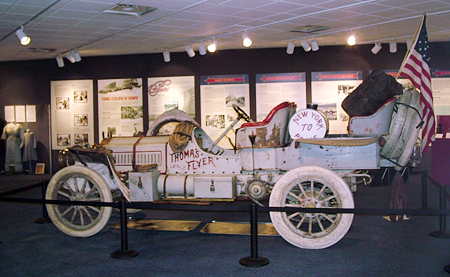
February 12 marked 100 years since the launch of the longest and perhaps craziest auto race ever – around the world from New York to Paris. Six cars (seven more never showed up) departed Times Square, at times following the future Lincoln Highway to San Francisco. The American entry, a 1907 4-cylinder Thomas Flyer roadster, would win, driven most of the way by George Schuster, who would later write about his adventures in The Longest Auto Race. The 1965 comedy The Great Race (Jack Lemmon, Tony Curtiss, Natalie Wood, Peter Falk), loosely based on the race, barely touched on the hardships faced by the real racers.

Thomas_exhibit

The 1908 race has been honored with a 14-month exhibit at the National Automobile Museum in Reno, Nevada, a few blocks off the Lincoln Highway. Through next January, visitors can see the 1,400-pound trophy, the American flag carried the whole way, and most impressively, the restored Thomas Flyer (seen above, in a photo courtesy the museum). Then starting May 30, up to 40 teams will again depart New York City for Paris, covering 22,000 miles, though only half of that driven. A summary of the race and exhibit can be found in the San Francisco Chronicle.

Schuster Book

Another group is rebuilding a 1908 White and plans to retrace the route and pffering educational programs, but their hopes to launch the February 12 have been delayed.

Schuster never did get paid the $10,000 (he thought was proper for a half-year’s work) by the Thomas company – they said the race had cost them too much already. And The New York Times delayed paying him the $1,000 prize for 60 years. Schuster, then 95, was appreciative but noted that a grand was not worth nearly as much in 1968 as in 1908.

Changes at Summit Garage atop Altamont Pass

February 15, 2008

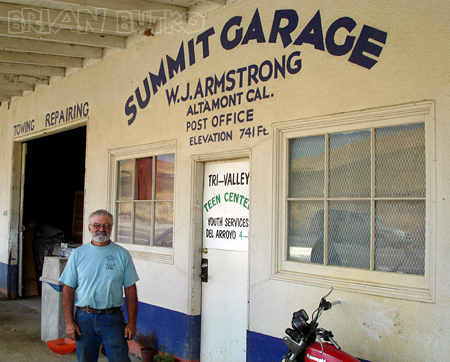
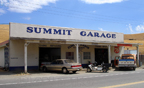
When I visited the Summit Garage in July 2006, Dan Silviera showed me around the shop. Among his many efforts to help youth, he managed Tri-Valley Youth Services, and the garage was serving as the Tri-Valley Teen Center for teaching youths to restore classic cars. There was an assortment of cool old cars on lifts and along the road. The only dark cloud was that a utility company wanted to demolish the old place for a right-of-way.

CA_SumDan

I recently checked on the garage with Gary Kinst, editor of LHA newsletter The Traveler for California. I was looking for news about the utility but was sadly surprised to hear that the teen center lost its lease July 1, 2007, and Dan Silveira (above) passed away July 30. Click here to read Dan’s obituary from the Boy Scouts, where he was a scoutmaster for 17 years; that and his many other accomplishments are an inspiration.

Click the images below from my visit to see larger versions on Flickr – then click the Flickr pics to see them REALLY BIG. The T-Bird, one of the youth projects, was across the road.

Butko_CA_Tbird
10 x 10 white square
Butko_CA_SumGar

A local rancher has purchased approximately 240 acres that include the Summit Garage and a dwelling. Gary reports that LHA member Mike Kaelin is working with the Alameda County Board of Supervisors and their State Representative to have the garage preserved as a historical site and the pass as a historic corridor. The new tenant, a former member of T.V.Y.S., has plans to open a antique/gift shop in the old garage. A “Historic Lincoln Highway” sign was recently dedicated there too.

Auburn Cord Duesenberg to host sculptures

February 14, 2008

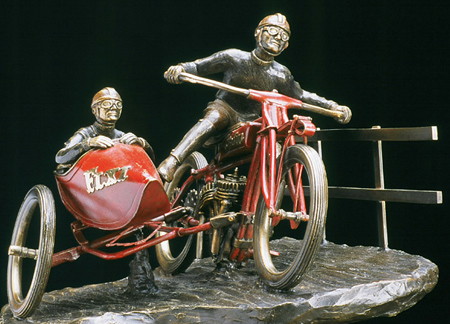
The Auburn Cord Duesenberg Automobile Museum, 25 miles north of Fort Wayne in Auburn, Indiana (off the Lincoln Highway but a popular diversion), will exhibit automotive bronze sculptures created by nationally acclaimed artist Alexander Buchan, and his grandchildren Alex, 11, and Adeline, 6, from March 14 through April 12. Buchan worked as Chief Design Sculptor at General Motors for 38 years.

BuchanIndianBike

Above: This painted bronze sculpture by Alex Buchan (edition of 35) depicts a 1920 Indian motorcycle with a side car called the ‘Flexi’ being driven by Pop Dwyer.

The public is invited to attend the free exhibit opening on Friday, March 14 at 7 p.m. at the museum, where Buchan and his grandchildren will be on-hand to discuss their work. Included in the exhibit will be a very rare 1910 American Underslung automobile and a customized Buchan sculpture of the car and its owners.

The Auburn Cord Duesenberg Automobile Museum houses more than 120 antique and special interest cars plus related exhibits on three floors. The museum is in the 1930s headquarters of the Auburn Automobile Company and is a National Historic Landmark. Group and family rates are available. The museum is open daily from 9 a.m.-5 p.m. year round.

IN_ACDMuseum

Auburn Cord Duesenberg Automobile Museum
1600 South Wayne Street
Auburn, IN 46706
(260) 925-1444 x30
http://www.acdmuseum.org