Automobile magazine copy editor Rusty Blackwell bought a 1967 MGB/GT Special through Craiglist this past fall. The challenge was getting it from San Francisco back to Ann Arbor, Michigan. His adventures with early snows and faulty fuel pumps are fun reading, even if much of it is along I-80. He does detour onto the Lincoln Highway briefly, such as Soda Springs, California; Rawlins, Wyoming; and Sidney and Gothenburg, Nebraska. He also took lots of photos. In all, his 2,300-mile trek that he hoped would take 4 days took 8. Click HERE for the first of his 9 posts. Here’s a screen shot of the opening page:
A story in the Southtown Star of suburban Chicago, Illinois, reports that the Lincoln Highway through New Lenox south of Chicago, will be remade over the next 18 months:
“This is the biggest news of the year. This is incredibly good news. This is the big one we have all been waiting for,” New Lenox Mayor Tim Baldermann said….
Upgrades include left-turn lanes at cross streets from Marley Road to Joliet Highway and in front of Lincoln-Way Central High School, plus temporary signals at Marley and new signals at Schoolhouse Road. [See Google Maps aerial view below.]
The work, which will greatly alter the Lincoln Highway roadscape, is in preparation for a Wal-Mart plaza across from Cooper Rd/Roberts Rd/Williams St. It looks like the development will fill one of the last large pieces of land along the LH there: note the house and surrounding fields on the north side of the road.
Oddly, this is just preliminary until permanent upgrades can be done:
All work is compatible with IDOT’s ultimate $80 million plan to make Lincoln Highway a fully improved five-lane road. Money for that massive construction project is not included in any budget at this time, said New Lenox village administrator Russ Loebe.
But these interim improvements “should buy the community quite a few years of smooth cruising” on Lincoln Highway, he said.
An insightful article also was published in Chicago Business News about the real estate deal. McVickers Development bought 73.5 acres from two sellers for a combined price of $18.9 million, then will sell it to Wal-Mart, Menards home improvements, Petco, Staples, Aldi, and other retailers. McVickers will likely lose money on the sale to Wal-Mart:
Typically, an anchor tenant such as Wal-Mart demands better financial terms because the company knows the developer can make it up by charging higher rents to the smaller tenants.
“In general, developers almost never, ever make money on the big boxes, and very often they lose money,” says Matthew Silvers, a principal in the Midwest brokerage arm of Northbrook-based Next Realty LLC, who represented McVickers in the acquisition.
Mr. Silvers says major retailers like Wal-Mart dictate how much they are willing to pay for land based on their forecast of a store’s profitability.
“They’ve got their own economic analysis, and that’s just going to be what they can pay for the land, and the developers have to deal with it,” Mr. Silvers says.
A 189-year-old tollhouse along the Lincoln Highway/US 30 west of Chambersburg, Pennsylvania, will be donated to the local historical society for offices and a museum. According to an article in the Chambersburg Public Opinion, the tollhouse is owned by the developer of a limestone quarry that has just won a 3-year battle to quarry 89 acres of surrounding land. St. Thomas township supervisors unanimously approved the general plan, and directed St. Thomas Development to the township planning commission, which will make a formal recommendation to the supervisors. The company plans to subdivide the land around the tollhouse and donate it the Franklin County Historical Society-Kittochtinny. Access and parking will have to be added.
The small stone house just west of Campbells Run Rd was listed in the National Register of Historic Places in 1978. It served as was Tollhouse No. 2 on the Chambersburg & Bedford Turnpike (named for the its termini). Such turnpikes covered Pennsylvania in the early 1800s but fell into disrepair with the rise of canals and railroads. Bicycling, auto travel, and the Lincoln Highway revived them, though the LH worked to eliminate all tolls. Rehabbing the site also would add another tourist attraction to the 6-county Lincoln Highway Heritage Corridor.
A news staff editorial supports the developer’s plan: “The more legitimate attractions Franklin County boasts along the Heritage Corridor, the more attention it will get from the state in terms of grant money and tourism development.”
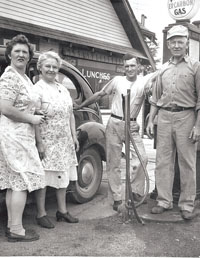
The Times Bulletin of Van Wert, Ohio, ran a nice story about Webb’s one-stop that once served travelers north of Convoy in the far western part of the state. The story focuses on Larry Webb, whose family owned it. Larry is active in the LHA and Ohio LH activities.
At left, L-R, are the owners of the business around the time of purchase: Jenny Webb (Larry’s mother), Ola Wherry (grandmother), Myron Webb (father), and Harry Wherry (grandfather). Courtesy Larry Webb
Webb’s Hi-Speed Service Station, Restaurant, and Tourist Cabins actually had opened in 1931 under different owners, then in 1946, Webb’s parents and grandparents bought the business. They lived in the restaurant building along with Larry and his sister. When the road was widened in the 1960s, it took out the pumps, and with business already declining, they closed. The cabins are gone too, but the garage remains as does the restaurant, now a private home at the corner of Lincoln Highway and Convoy-Heller Road.
As described yesterday, here’s last year’s Christmas light display at the home of Eric Rodemeyer in Marshalltown, Iowa, synchronized to the tune of fast-paced rock version of “Joy to the World”:
This year, the display was moved to the Marshall County Courthouse as a fundraiser for the Marshalltown Optimist Club. Here’s a story about it from Radio Iowa. The song is “Christmas Eve/Sarajevo 12/24” (an instrumental of “Carol of the Bells” with a bit of a bit of “God Rest Ye Merry Gentlemen”) performed by the Trans-Siberian Orchestra.
Marshalltown, Iowa, has a Christmas display in front of its courthouse—with lights timed to rockin’ versions of holiday tunes—as a fundraiser for the Marshalltown Optimist Club. The display began last year at the 7th Avenue residence of Eric Rodemeyer: 14,500 lights controlled by 96 computer channels timed to 7 repeating songs, each requiring up to 150 hours of programming, then were broadcast on 96.3 FM in front of his house. This video from last year features a serene version of “Silent Night” at his house.
This year’s display at the Marshall County Courthouse includes 21,620 lights controlled by 176 computer channels set to 8 repeating songs likewise on 96.3 FM. Lights are strung on eight 20-foot-tall trees, thirty 4-foot-tall spiral trees, plus strobes and a snow flake arch. Check the Marshalltown CVB web site for hours. Here’s the opening night introduction followed by a hard-rockin’ version of “Sleigh Ride,” then some views from a street cam.
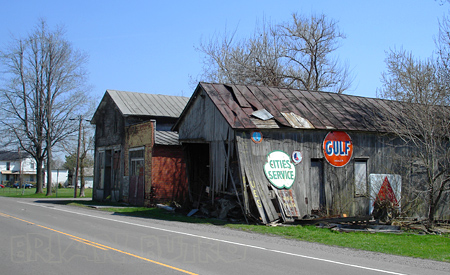
Can you name the location of this barn along the Lincoln Highway/US 30? Most fans photograph a sign a few miles east but speed past this interesting landmark. Looks like a store or two were adjacent. Need more clues?
The Pittsburgh Post-Gazettereports that the Lincoln Highway Heritage Corridor has been awarded $49,340 to build giant roadside attractions along its 200 miles of the Lincoln Highway. The projects will be designed and built by vocational/technical school students in themes that honor the 250th anniversary of Pittsburgh and its region. This and another article in Pop City calls them “roadside giants,” and in fact, the LHHC’s Kristin Poerschke tells me they hope to give each of the vo-tech schools a copy of my and Sarah’s Roadside Giants and Roadside Attractions books as part of the grant to help them with their designs.
The LHHC is one of 100 regional and grassroots organizations and artists who received a total of $1 million in grants to help celebrate the anniversary. LHHC director Olga Herbert says they are honored because only 12 were selected from the 230 regional applications.
LHHC will collaborate with four career and technical schools in Greensburg/Hempfield, Latrobe/Ligonier, Somerset, and Bedford/Everest as well as with four communities along the Lincoln Highway, giving studens a chance to be creative and contribute something permanent to the communities:
The project envisions the sculptures to include items like vintage motor vehicles, historical figures like George Washington, images from popular culture like Texaco gas attendants and diner waitresses, old fashioned bicycles and gasoline pumps. The project will call upon graphic arts students to design the super sized metal sculptures. Other students will weld the metal, and design and printmaking students will be in charge of the brochures. Not to be left idle, the culinary arts students will bake gigantic models of the sculptures.
The LHHC, one of 12 such heritage areas in the state, promotes economic development through tourism along the historic route of the Lincoln Highway in Westmoreland, Somerset, Bedford, Fulton, Franklin and Adams counties.
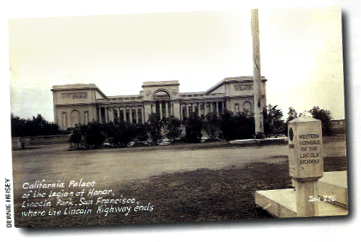
A couple interesting blog posts by John P. O’Grady recall how Lincoln Park, the western terminus of the Lincoln Highway, was once a graveyard. In fact, it still is! His first posting explains that the thousands who were buried in San Francisco’s City Cemetery were simply landscaped over a century ago so that a golf course could be built. (Yikes, don’t take any deep divots!) Over time, the rest of the area was cleared too. What happened to the thousands of wooden markers and granite monuments? They were tossed over the bluff known today as Lands Fill! (More disconcerting, the practice of discarding tombstones while leaving the bodies is apparently not at all uncommon.) The second posting explains that scavengers, under cover of night, search through the debris for treasures, and one of them, Dominic Camposanto, recently found a 1928 Lincoln Highway concrete post.
Above: The view from the Palace of the Legion of Honor, Lincoln Park, toward the Golden Gate Bridge.
Here’s the story from O’Grady’s blog:
Just recently, after an unexpected heavy rain, he discovered an original Lincoln Highway marker sticking out of the woody hillside like a phallus busted off an old Greek statue. Dom had no idea how that marker wound up in so unlikely a spot, nor did he care. He seldom takes interest in any stories attached to the articles he’s trying to unload, unless it can help make a sale. Anyway, with a prize like a Lincoln Highway marker, he didn’t need any story—all those collectors out there already had one. What they desperately lacked—and he could now supply—is the marker to go with that story. Thus Dom found an eager buyer over at the local university, a famous professor of climatology with a passion for Lincoln Highway memorabilia. The climatologist is very pleased with his purchase and has set it up in his backyard in the neighborhood around Rossi Playground. Now here’s where he could have used another story, one that might have revealed a little something about the history of this particular marker and—more importantly—something about the land upon which his own house is built. [Apparently, another graveyard.]
This could be any one of the 2,400 concrete posts placed along the Lincoln Highway in 1928, but don’t you think there’s a good chance that a LH post dumped over the hill from where the “Western Terminus” LH post once sat would be the same LH post??
Any California LH fans want to look up a climatologist living near Rossi Playground and ask to see the right side of his concrete post?
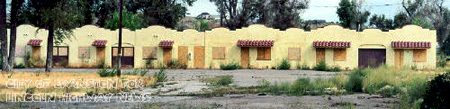
One of the stops during the 2008 Lincoln Highway Association conference in Evanston, Wyoming, will be the remains of the Sunset Motel. The string of six rooms—three with built-in garages—are on Bear River Drive, the LH on the east end of town near WY-89. Built in 1932 in Mission or Spanish Colonial Revival style, this portion of the motel has been saved—the question now is what to do with it.
I asked Jim Davis about the motor court. He’s Director of Administrative Services for Evanston and also on the Advisory Board for the Wyoming Main Street Program, on the Advisory Board for the National Trust for Historic Preservation, a staff member for the Evanston Historic Preservation Commission, and a founding member and past chair of Tracks Across Wyoming.
The good news about the Sunset Cabins is that they are still standing. Bad news, we still haven’t figured a new use for them and they remain threatened. The Evanston Preservation Commission had them listed as locally significant; however this does nothing to protect them as Evanston does not have a demolition ordinance or any such preservation ordinance. The cabins remain with the ownership of the city and we are still trying to figure a way for us to find adaptive reuse in order to secure their future. A little over a year ago we placed a restored Lincoln Highway marker at the site in order to draw attention as to the significance of this site.
One of the problems with any restoration effort is how to adapt and reuse. Jane Law, City of Evanston Urban Renewal Coordinator (and who kindly arranged for these photos), says, “We have heard artist studios, concessions, but nothing that gets everyone stirred up enough to get something done…. It would truly be a shame to ever lose them, they are quite unique and really pretty cute. The state is restoring some motor cabins in Ft. Bridger, so maybe we can get some more interest there for them to come a little further west.”
Another issue is having the resources for every worthy project:
At present we really have our hands full restoring, rehabilitating, and preserving our wonderful and unique roundhouse and railyards site…. We are also trying to rehabilitate a historic hotel in our historic downtown; that has been a very long process with years of delay. Our Renewal Agency just purchased what remains of our downtown theater. That will be quite a project in itself. There was a terrible fire there in May and the building is just a shell now, but not wanting a hole in the block or a mini parking lot, we stepped up and will try to make that a viable business for our downtown. So we have our hands full, BUT the Sunset Cabins are something our Historic Preservation Commission should address. I do think those coming next year [to the LHA conference] will like them and could play a big part in thinking of a reuse. [my emphasis]
Jane also sent a detailed and fascinating hisstorical survey of the site that I’ll review soon in a separate post.
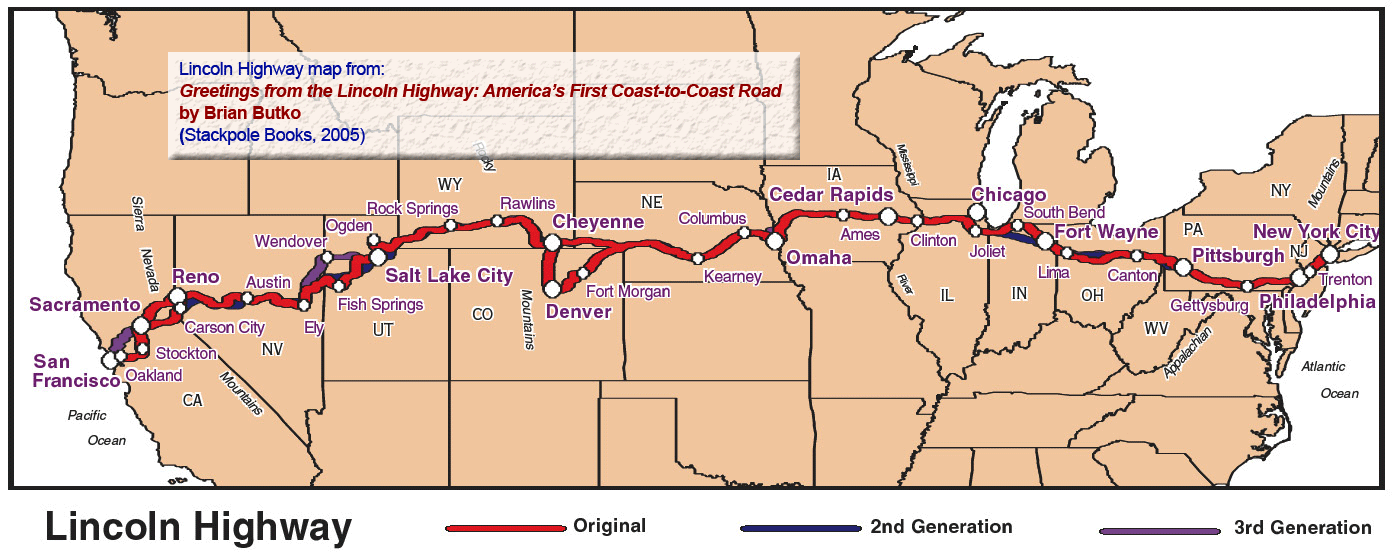
Click the map above for a full-size view of the Lincoln Highway.
Like this blog? You'll LOVE my books!Lincoln Highway Companion features detailed maps and places to eat and stay. Click the book to buy it on Amazon.
Click the Greetings book below to purchase the ultimate guide to the history and route of the Lincoln Highway!
Another fun book! The Ship Hotel: A Grand View along the Lincoln Highway recalls the greatest roadside attraction along the coast-to-coast road.
And for those who LOVE diners, click the book below to purchase our completely updated guide to the history, geography, and food of Pennsylvania's Diners!


 The Times Bulletin of Van Wert, Ohio, ran a


 The LHHC, one of 12 such heritage areas in the state, promotes economic development through tourism along the historic route of the Lincoln Highway in Westmoreland, Somerset, Bedford, Fulton, Franklin and Adams counties.




 Lincoln Highway News