With more snow falling today, few cars are crossing the Allegheny Mountains near me in Western Pennsylvania
Here’s a view from University of Michigan showing the snowy Lincoln Highway west of Stoystown in 1924.

With more snow falling today, few cars are crossing the Allegheny Mountains near me in Western Pennsylvania
Here’s a view from University of Michigan showing the snowy Lincoln Highway west of Stoystown in 1924.
 Chicago Public Radio’s Gianofer Fields is traveling the Lincoln Highway through Iowa. On her way to the western end of the state, she stopped in Eldon (65 miles due south of Belle Plaine, a favorite stop for LH travelers) to visit the house made famous by artist Grant Wood. His 1930 American Gothic painting, on display at the Art Institute of Chicago, is one of the most parodied, portraying a farmer and his daughter (usually thought to be his wife—though each were models and never met) in front of a white farm house with a distinctive upper window. Visit the CPR web page for a transcript or listen to the audio version.
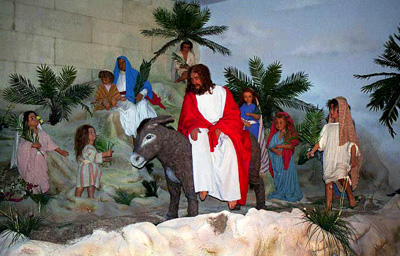
 When Gianofer arrives at the western edge of Iowa, she makes her next entry at the Iowa Visitors Center (above, from its website) and its 1853 log cabin, located between Logan and Missouri Valley. She gets a less-than-enthusiastic welcome (not good news for LH boosters). She then heads northeast to the nearby non-profit Museum of Religious Arts along US 30 just south of Logan and has a friendlier experience, though as she finds, it is only Christian exhibits despite the more inclusive name.Below (from the MRA website) is one of its King of Kings displays: life-size wax figurines that portray nine Biblical scenes such as the annunciation, the nativity, Palm Sunday, the last supper, the crucifixion, and resurrection. They were sculpted by Leone Chaney in the 1960s for Sunken Gardens in St. Petersburg, Florida, then in the late 1990s, they were moved to the Museum of Religious Arts.
Many towns along the Lincoln Highway woke up to severe weather today, including snow and wind in the East and Midwest.
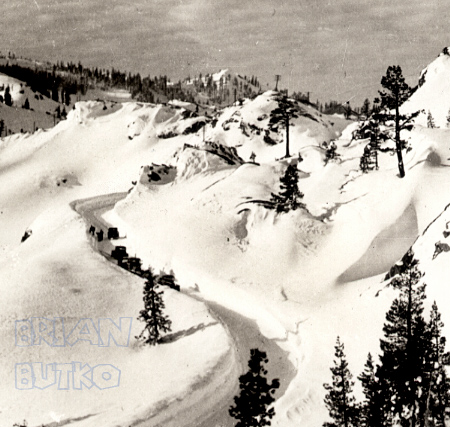
The image above shows cars struggling to climb snowy Donner Summit about 1930. This was of course where the Donner party of emigrants got caught in the early snows of early November 1846. An excellent recounting of their story that puts the reader there is The Donner Party Chronicles: A Day-by-Day Account of a Doomed Wagon Train, 1846-47 by Frank Mullen Jr. The well-researched book makes it simple and intriguing to follow their journey through the use of maps, diary excerpts, images of artifacts, modern photography, and archaeological debates.

While it will only be the 20s the next few days where I am in PA, it’s will reach the 50s in Truckee, the area where many from the Donner party camped to wait out the winter. You can check my web site’s LH Weather page to see conditions at a dozen locales from coast to coast.
The S.S. Grand View Ship Hotel was perhaps the best-known, most-visited landmark along the 3,300+ miles of Lincoln Highway. The famous roadside attraction was 17 miles west of Bedford, Pennsylvania, but unfortunately burned in 2001. With my Lincoln Highway Companion book ready for the editors, I’m starting on my next book, a fun look at the Ship. I first wrote about the Ship in 1989 and have been gathering information, recollections, and photos since then.
People took lots of snapshots there, and though they probably took movies, few of those surface, so it’s exciting to see this rare film from 1972! (Total time 3:32) Roger Shaulis shoots out the back window as they speed east on the Lincoln Highway through the Seven Mile Stretch, passing coal trucks. About 45 seconds in, they arrive at the Ship and go to the deck for the view and some goofing. The family jumps on the Turnpike for the final minute, passing through three tunnels on their way to New Jersey.
The folks who sent this card in 1951 from the Weeden Motor Hotel wrote, “Not many motels along this route so far. Lucky we stopped when we did, got the last one and the next one is 25 miles…. When we got to Dwight [Illinois, on Route 66] Randy wanted to know if we were in Calif.”
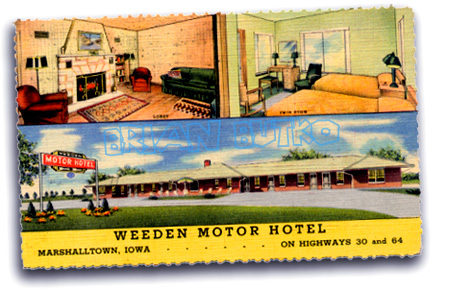
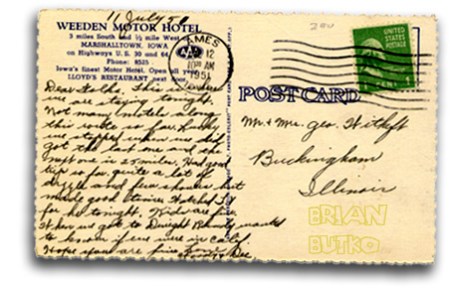
The original Lincoln Highway went through downtown; this was on a US 30 bypass (itself now bypassed). The card says the motel was 3 miles south and 1/2 mile west of town. I think it later became the Weeden Holiday Motel with a bigger c. 1970 sign at 2569 240th Street/Iowa Avenue. Any readers know its history? Or about Lloyd’s next door, which claimed to be Iowa’s most beautiful restaurant?
The Charles Weever Cushman Collection at Indiana University, Bloomington, Indiana, consists of ten cubic feet of materials, including 2,200 b/w negatives and prints. Just three of those cubic feet are slides, but what a collection — more than 14,400 color Kodachrome slides shot from 1938 to 1969. Cushman’s photos have been digitized through Indiana University’s Digital Library Program and the Indiana University Archives and are now online.

Cushman and his trusty 1940 Lincoln Zephyr at San Francisco, 1958, at 202,000 miles by then.
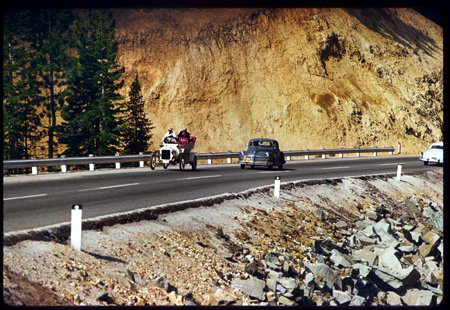
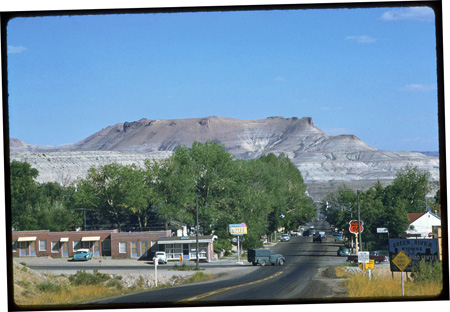
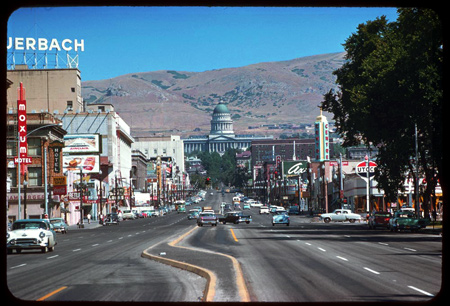
An amateur photographer, most of Cushman’s images are scenic, many are from such countries as from Lebanon, Germany, Austria, England, and Mexico. There are few roadside or industrial sites, but roads and cars do make it into many of the slides. Here are some from along the Lincoln Highway or close to it—click the links to see larger views.
The old Lincoln Highway snakes under the railroad at Donner Summit, CA, 1958.

Along Lake Tahoe at Tunnel Rock, NV, 1953.

An antique car climbing Spooner Summit, NV, 1958.
Check out Green River, Wyoming, in 1958, or another view in 1963 showing the Husky Truck Stop Cafe.

A clear day in Salt Lake City, 1958, looking north on State Street toward the capitol.
There’s lots else to see plus essays about Cushman and his collection. Photos reprinted here with the kind permission of Indiana University, Office of University Archives & Records Management, with special thanks to Curator Bradley D. Cook.
 One of my favorite stops along the Lincoln Highway is Fort Cody Trading Post in North Platte, Nebraska. Since moving closer to I-80, it’s now a few blocks south of US 30 through town, though the original LH actually followed the Gothenburg Stairstep that came into town from the south on Locust (now Jeffers) Street, so Fort Cody actually overlooks the 1913 LH.
The Henline family has operated numerous businesses along the Lincoln Highway and elsewhere, so they are preparing a booklet detailing their history. Leigh Henline told me, “We are having a company make us a 24 page souvenir book to sell. We are hoping it will be ready in February. It will tell a little bit about the history of Fort Cody, a bit on the Sioux Trading Post and Buffalo Bill Trading Post. Some on the museum, LOTS on the little Buffalo Bill Wild West show (he took hundreds of photos!), and some on the Muffler Man! We are very excited about all this. This guy is also doing a bunch of photo magnets for us on the little Wild West show, due any day.”

Teen-aged Chuck Henline points to the new Muffler Man Indian in the 1970s.
Here are the places the family has operated along the Lincoln Highway:
• Sioux Trading Post, Ogallala, 1952-1969.
• Buffalo Bill Trading Post, US 30 W, North Platte, 1950-1954.
• Fort Cody, US 30 W, North Platte, 1963-1969.
• Present Fort Cody, I-80 Hwy 83, North Platte, 1968 to present.
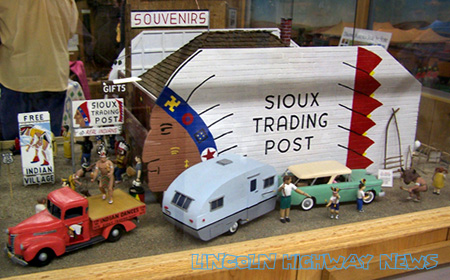
Chuck Henline crafted an animated display of their Sioux Trading Post.
The family also operated the Wigwam in Atlanta, Nebraska, and the Seminole Trading Post and Indian Village near Miami. They have some photos displayed on their office walls:
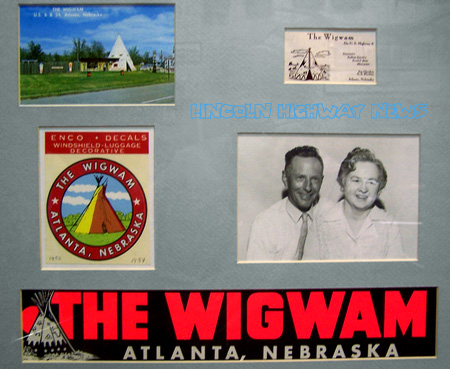
I’ll be writing more about their roadside adventures soon, and will post an update when their booklet is published.
I’m once again on the Lincoln Highway Association board. I was a founding director in 1992, representing Pennsylvania, then left to raise kids and write books. I’m still doing those but will be filling a vacancy in an At-Large position. For the full list of directors, visit the LHA’s web site: www.lincolnhighwayassoc.org/about.

Plan to attend the LHA conference in Evanston, Wyoming, June 17-21, 2008.
John and Lenore Weiss are well-known to Route 66 fans for the work they’ve done to help preserve, promote, and document that road, especially in Illinois. Lincoln Highway fans are starting to hear about them too, most noticeably leading the acquisition from IDOT of a 1928 concrete LH post, then John served as Master of Ceremonies at its dedication on Veterans Day 2006 at the Joliet Historical Museum. Their newest project merges 66, the LH, and even the Dixie Highway.

Traveling the … Historic Three is a 74-page spiral-bound guide to traveling those three highways in a 110-mile, triangle-shaped route south of Chicago. John and Lenore freely give credit to the conceptual idea of combining these three roads into one road trip to Elaine Egdorf who administers Drivin’ the Dixie, a web site devoted to that road. The booklet has an intro, then tabs divide each section, and there’s a page of related organizations at the end. Narration is casual in the way a good friend would lead you on a tour, with instructions for when to turn, what to see, where to park, and recommended places to eat and visit. Lincoln Highway fans will be pleased to discover much that they may not have noticed until slowed down to a tour on the local level.
Lenore told me a little bit about their work:
The unique aspect of the triangular tour is that you can start at any of three locations and end up exactly where you started! With any road trips, folks travel say 100 miles, then they must return. This results in an extra 100 miles.
In this area, the Lincoln Highway and especially the Dixie Highway communities and businesses are not very accustomed to tourism. This is an interesting aspect when compared to those on Route 66. On the Lincoln, the town of Frankfort wants to get involved. On the Dixie, the town of Homewood is equally as excited.
Since we already had the Route 66 portion, and have lived on that particular section of the Lincoln Highway for 30 years, only the Dixie needed some real investigation. And that, too, was a rewarding experience.
And she notes that every time they drive it, as recently as last week, they keep discovering new things.
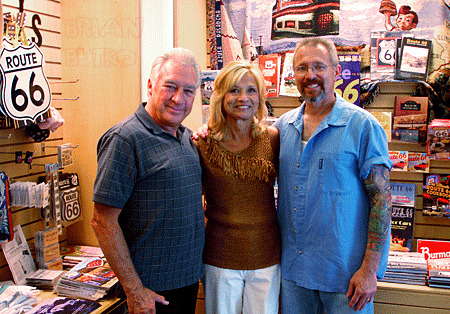
Above: John and Lenore Weiss with Route 66 tattoo man Jim Bush in the souvenir-filled gift shop at the Joliet Area Historical Museum, a must-stop for road fans.
Highlights at the intersections include the Art Institute of Chicago at Jackson Avenue and Columbus Drive in Chicago, where 66 and the Dixie launch; the Joliet Area Historical Museum where 66 and the LH meet, at Cass and Ottawa streets in Joliet; and the Arche Memorial Fountain where the LH and Dixie meet, built 1916 as part of a rest park for travelers of the two roads in Chicago Heights. As you can see, the three roads offer lots to see for fans of old roads. This and other books by the Weisses are available at gift shops such as the Joliet Museum or through the couple’s web site. An autographed copy of Traveling the … Historic Three is $9.95 + $4.60 postage and handling.
 A lengthy article on Cindy’s Diner (830 S Harrison St, Fort Wayne) was published Sunday in the Toledo Blade. Anyone traveling the Lincoln Highway in eastern Indiana will want to visit the diner for excellent food and a fun, friendly experience—and a Lincoln Highway logo near the door. Owner John Scheele (below) can always be found cooking for 15 patrons and handing the take-out orders.
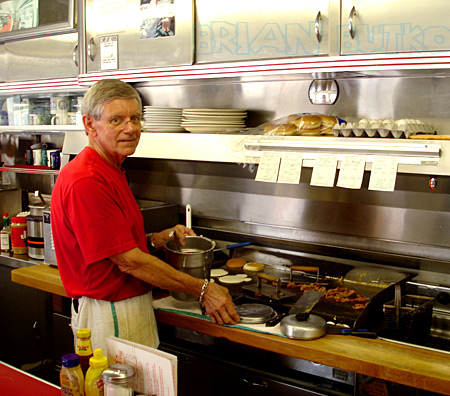
After recounting the diner’s history (a 1952 Valentine), the article discusses its clientele:
A large number of the diner’s patrons are regulars – “Probably 85 percent of them we know by their first names,” Cindy said – and they include students, businessmen, cops, lawyers, construction workers, and researchers using the nearby library’s world-class genealogical collection.
Plenty of out-of-towners find their way to Cindy’s, too. A dog-eared guest book has been signed by patrons from every state, as well as foreign countries from China to Iran to South Africa to Russia.

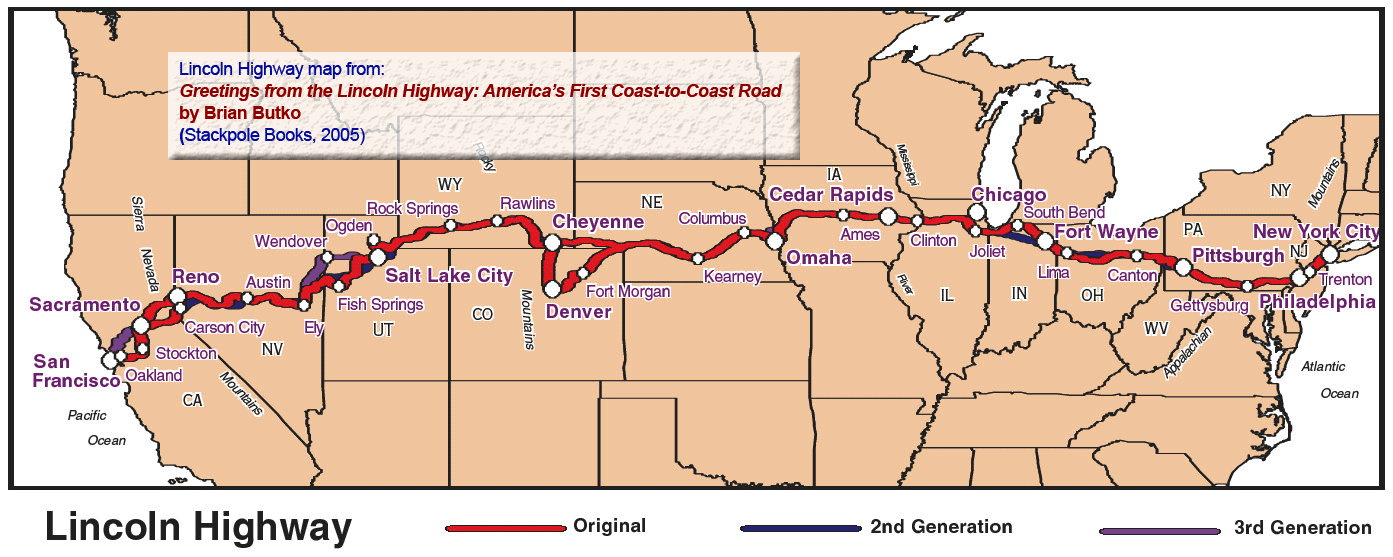 Click the map above for a full-size view of the Lincoln Highway.
Like this blog? You'll LOVE my books!Lincoln Highway Companion features detailed maps and places to eat and stay. Click the book to buy it on Amazon.
Click the map above for a full-size view of the Lincoln Highway.
Like this blog? You'll LOVE my books!Lincoln Highway Companion features detailed maps and places to eat and stay. Click the book to buy it on Amazon.
 Click the Greetings book below to purchase the ultimate guide to the history and route of the Lincoln Highway!
 Another fun book! The Ship Hotel: A Grand View along the Lincoln Highway recalls the greatest roadside attraction along the coast-to-coast road.
 And for those who LOVE diners, click the book below to purchase our completely updated guide to the history, geography, and food of Pennsylvania's Diners!

 Route 66 News


