As reported here previously, Idlewild Park along the Lincoln Highway in Ligonier, Pennsylvaia, will be sold as part of Kennywood Entertainment to Parques Reunidos of Spain, the third-largest European operator of amusement parks. The company only entered the U.S. market two months ago by purchasing 33 water parks. A British private equity firm acquired the company in January 2007 for $1.22 billion—such corporate entanglements worry fans of Idlewild and the other old-fashioned parks currently owned by parent park and company Kennywood.
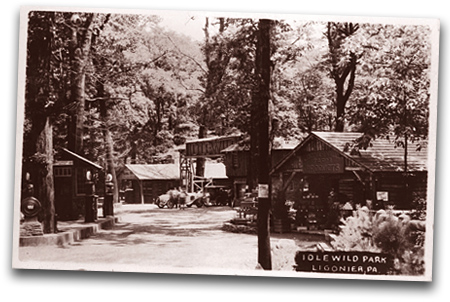
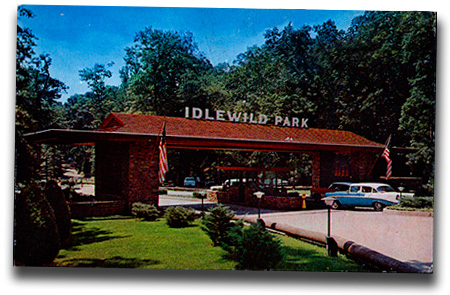
Here are some vintage postcards showing how Idlewild’s entrance changed over time (the first is from Cy Hosmer). The same round building can be seen in the first two views. This area still serves as an exit but the entrance was moved to the east years ago so that waiting cars would not back up onto the LH/US 30.
In our review of Traveling the … Historic Three by John and Lenore Weiss (which follows the Lincoln and Dixie Highways and Route 66), I mentioned Elaine E. Egdorf. Not only does she manage the Drivin’ the Dixie website, but as chairman of the Village of Homewood Heritage Committee, she got a Dixie Highway marker for Homewood, south of Chicago. The committee and the Homewood Historical Society (she was founding president) paid for the marker, which was dedicated in 2003 with a large ceremony. It was re-dedicated in 2005 as part of the kick-off for Illinois State Historical Society Markers week. The Dixie Highway communities also were recognized with a Superior Achievement Award from the ISHS for the unique way they pulled together towns, historical societies, and chambers of commerce to promote Illinois history.
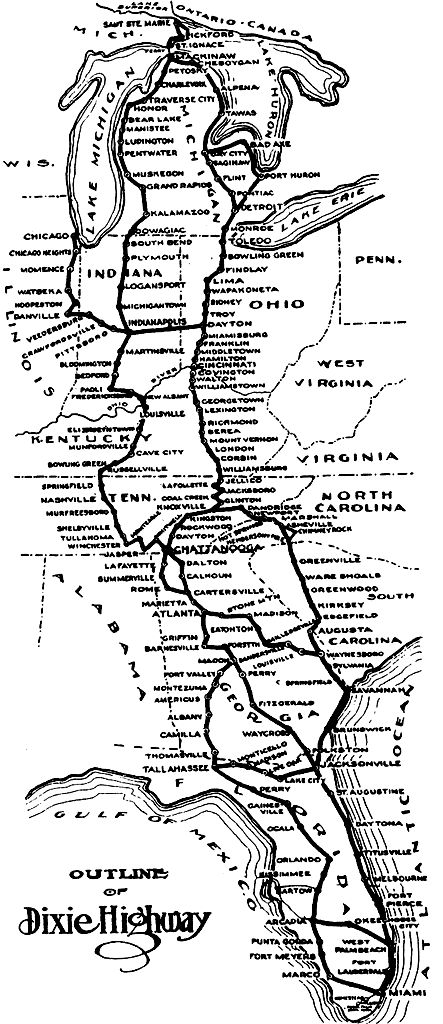
The Dixie Highway was another idea of Lincoln Highway founder Carl Fisher. His north-south path was said to have been created so his wealthy auto-industry pals could more easily travel south to Fisher’s Miami Beach land developments. The Dixie was not as direct as the Lincoln, but rather a braid of roads from Sou. Ste. Marie, Michigan, to Miami, Florida. The route is now identified throughout Illinois (except Chicago) with red, white, and blue metal street signs, street pole banners, and state markers. One of at least six intersections of the Lincoln and Dixie Highways is at Chicago Heights: the roads run together for almost two miles there and their meeting is commemorated by the Arche Memorial Fountain.
Above: Redd Griffin, Oak Park; Elaine Egdorf, Homewood; Arthur Martin, Chicago, at the rededication in 2005. All are on the Board of Directors of the Illinois State Historical Society.
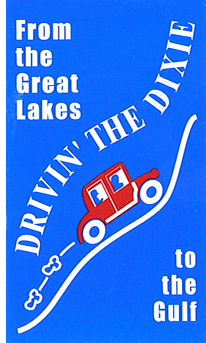
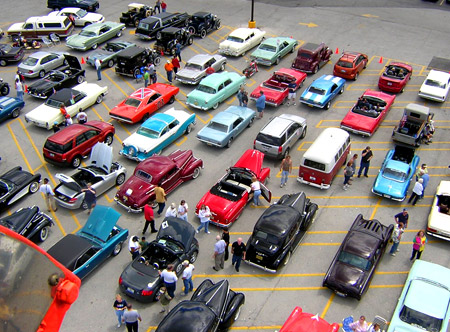
This group’s Triangle Tour has actually evolved into Drivin’ the Dixie, a moving car show and tour from Blue Island to Momence. A passport listing events in towns along the route can be stamped at historic sites; each town donates two prizes, and for each stamp, participants get a free raffle ticket. Last year about 200 cars total participated, mostly vintage cars. It’s nice to see such support for a road that played such a big role in early auto history.
The Illinois Lincoln Highway Coalition (ILHC) recently received $443,000 in federal grants for its National Scenic Byway program, a designation the Lincoln Highway through Illinois received in 2000. The funds will be used over the next 3 years to produce interpretive murals in 40 communities along the 179-mile route through the state. Each mural will interpret the history and heritage of the highway and its impact on the communities, and a companion brochure will summarize their locations and messages.
Diane Rossiter, Associate Director of ILHC, says, “We are excited to begin this new project! This money, plus the $40,000 we just received from the state and the Illinois Bureau of Tourism will make it all happen. Our hope is that visitors will be compelled to travel Illinois Lincoln Highway and discover all that it has to offer.”
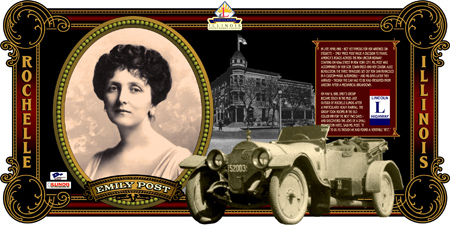
Three murals are already complete: Creston was unveiled in May 2006, DeKalb in October ’06, and Rochelle in May ’07 (see photo and closeup above, courtesy ILHC). Some of the communities slated to receive a mural are Ashton, Byron, Cortland, Dixon, Genoa, Oregon, Rock Falls, Sterling, and Sycamore, not all of which are directly along the LH, but are considered withing the “corridor.” That can generate broader interest and awareness but may lead to some confusion.
ILHC will start work on 20 interpretive gazebos in the Spring in such communities as DeKalb, Dixon, Oregon, and Rochelle. Rossiter says,
“Our intent is to place a historical mural in each community that lines the highway and those along the corridor also. The communities will be charged with finding a building location and researching possible story ideas. Each mural will be painted on substrate material and will be mounted to the side of the building. This works much better than painting on the building itself, because it can be taken down for upkeep or if the building needs repairs. When all are completed, a brochure will be created detailing each mural and its location along with the location of the interpretive gazebos. There are no gazebos completed as of yet, but our hope is to begin construction in the spring.”
Visit www.drivelincolnhighway.com or phone (815) 547-3854 for more information on the Lincoln Highway through Illinois.
Idlewild & Soakzone, a family-style amusement and water park along the Lincoln Highway in Ligonier, Pennsylvania, is set to be sold to Parques Reunidos, a Spanish company that manages 61 parks in Europe and America. Starting as a picnic grove for the Ligonier Valley Railroad in 1878, rides were added in 1931, and Story Book Forest fairy tale park in 1956 (a rare survivor of that era). It also includes an official Mister Rogers’ Neighborhood Of Make Believe trolley ride and a Lincoln Highway-themed photo-op created by the Lincoln Highway Heritage Corridor (as seen below in their photo):
Idlewild has been operated since 1983 by Kennywood Entertainment, a family-owned company that also operates two vintage parks in New England and two properties not far from the Lincoln Highway near Pittsburgh: a water park and Kennywood Park in West Mifflin. Kennywood Park itself is an institution; starting as a trolley park in 1896, it was purchased in 1906 by F.W. Henninger and Andrew McSwigan, whose familes have owned and operated it since. It’s also within walking distance of where I’ve lived my entire life, so friends are quite impassioned about the surprise announcement. Both parks are full of vintage rides such as Kennywood’s Auto Ride at left.
Commentors to the Pittsburgh Post-Gazette are overwhelmingly concerned about the changes a large corporation might bring, and that the cherished American sites will be owned by an overseas firm. The Pittsburgh Tribune Review likewise reports that people in the Ligonier Valley have mixed emotions, hoping that promises to maintain Idlewild’s atmosphere will prevail over corporate cost-cutting. Kennywood’s current owners assure the public that the new company is committed to maintaining everything that people love about the parks.
Another Trib article says that half the new owner’s parks (in fact, the 33 US locations) were just bought in October:
Parques Reunidos has grown quickly since its acquisition in January by the London-based Candover private equity investment fund for $1.22 billion. Kennywood said the Spanish company approached its owners with an offer as part of a plan to expand its ownership of family entertainment venues worldwide.
Remember those great gift shops and souvenir stands with all kinds of wacky stuff to buy? And how little (if anything) your parents let you get?? Well you’re grown up — you can stop now and stock up. BUT WAIT! Where’d they all go? Yes, very few survive, so when you do see one, it’s even more important you stop — to satisfy your souvenir craving and to help keep the place in business.
Thankfully in the 20 years I’ve been stopping at Mister Ed’s Elephant Museum, it’s only gotten BETTER. Ed Gotwalt received his first elephant as a wedding gift in 1967 and began collecting anything related to the animal. When his collection outgrew the house, he opened a general store to display them. The current location has old-fashioned candy, wacky new candy creations, elephant-themed gifts, and of course, roasted peanuts. The museum holds more than 6,000 elephant collectibles. (Miss Ellie, the talking elephant outisde, says 4,000 in the video below, but I think they forget to tell her the most recent figure.)
Mister Ed’s is located at 6019 Chambersburg Road (between old and new Lincoln Highway routes) between Gettysburg and Chambersburg. It’s open daily 10 am – 5 pm, and admission is FREE.
Try out this video — my first on YouTube! — taken in October with my still digital camera’s video option. It’s only 20 seconds long but you’ll hear the fiberglass Miss Ellie Phant talk a bit about the place.
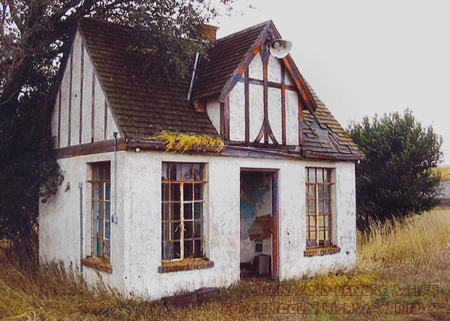
Another interesting shot from John and Lenore Weiss is this distinctive but abandoned gas station located somewhere in the middle of the US – that’s all I’ll say to start since RoadDog guessed the last one pretty quickly! Know where it’s at? Please leave your guesses by clicking Comments below the picture.
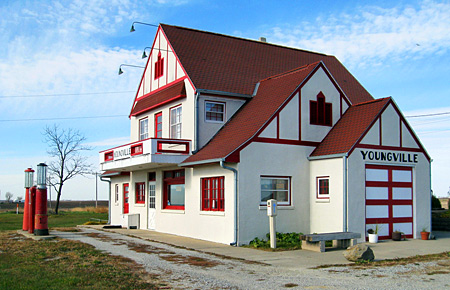
Above: Youngville Station, a beautiful restoration effort on the Lincoln Highway west of Cedar Rapids. When it’s open, visitors will find great pie and a historical display. The photos here show places NOT in the radio tour. Photo courtesy of G. Januska.
Gianofer Fields of Chicago Public Radio has completed her Lincoln Highway tour, but after 5 entries (plus a launch segment), she stopped along the Lincoln only 1 of those 6 days. As she admitted on the third day, ” I’m starting to rethink my whole Lincoln Highway plan. Maybe I should forget my linear route and think of the highway as a springboard.” Here are her topics:
Launch: Burlington’s Crookedest Street
1: Eldon’s American Gothic house
2: Missouri Valley’s Welcome Center and Museum of Religious Arts
3: Elkhorn’s Danish Windmill
4: Amana Colonies
5: Le Claire’s Buffalo Bill Museum
All very interesting, but only #2 is along the Lincoln Highway. What did she miss?
Trying to think of a list as quickly as possible, I came up with:
• Smith Brothers General Store in Clinton
• Cedar Rapids Museum of Art and Grant Wood Studio
• Youngville Station (top photo)
• Lincoln Cafe and Preston’s station in Belle Plaine
• King Tower Cafe (above) and LH bridge in Tama
• Shady Oaks Tree House east of Marshalltown
• Niland’s Cafe in Colo
• Three concrete bridges on the old road near Grand Junction
• Lincoln statue and carillon tower in Jefferson
• Moss markers with Lincoln busts north of Scranton (below)
• Spanish-deco Park Motel in Dennison
• Woodbine’s brick streets and Brick Street Station
• Loess Hills winding road across from Omaha
There’s lots more, from great old signs and garages to wonderful people in the diners and coffee shops along the way. What is your favorite?
On Tuesday, Chicago Public Radio’s Gianofer Fields reported from her LH trip that her reception at the Harrison County Historical Village and Iowa Welcome Center along the Lincoln Highway in western Iowa was not very welcoming. She has even subtitled that day’s entry, “What happens when the welcoming center isn’t so welcoming?”:
FIELDS: Tell me about this place that we are standing in.
HEIM [center employee]: Well, this is the welcome center that we are standing in.
I suppose that I should have taken that massive silence as a sign that the welcome center lady wasn’t in the mood for company. When I saw the old cabin perched on a small hill by the highway; I thought it had, “Stop here roadside attraction,” written all over it. So I did in hopes of learning more about it.
HEIM: Well, it has a wealth of information and antiques in it and it takes about an hour to go through, self guided usually.
Did I just get the bums rush? Clearly, I am on my own.
Above: Half the operational expenses for the village/welcome center are covered by sales in the Iowa Products Store and village admission fees.
I asked center coordinator Kathy Dirks about the two things that seemed to bother Ms. Fields—the lack of enthusiasm and the self-guided tour. Here is her response:
I wish I would have been here and that I could be here everyday to guarantee every person’s experience that steps through our front door would be stellar and involve the highest level of customer service. Unfortunately, it’s not humanly possible because we are open 361 days a year. So on many weekends and other days when I’m unable to be here due to meetings, vacations, etc., we pay some of our volunteers to man the facility. Almost all are elderly because the hours are limited and the pay low due to our limited budget. (My opinion would be almost all of them would be totally intimidated by a surprise microphone interview as well.)…
Not to make any excuses for what happened because there are none, but it can also be somewhat of a challenge to work at this particular facility because of the volume of knowledge the volunteers/workers are expected to know about Iowa – from everything tourism-related, to agriculture, to state laws, to about anything else that could cross your mind. I’ve worked here 13 years and still get questions I’ve never been asked before. I would have hoped though that everyone working here could have answered questions about this facility. I see much more intensive training needs to happen.
Our goal at the Harrison County Historical Village and Welcome Center has always been to supply the best service possible. I believe that on many occasions we do succeed in achieving that goal based on comments from customers and the amount of repeat business we receive. I absolutely hate when it doesn’t happen. Unfortunately, I can’t repeat Gianofer Fields experience here and make everything perfect. I can only learn from it and do whatever possible so it isn’t repeated….
We only offer self-guided tours on a regular basis and state that in our brochure. Unfortunately, we don’t have enough business, nor large enough income, to offer guided tours on a regular basis. The facility sits on 17 acres and the museum is in five different buildings covering about 4 1/2 acres. On many days, we only have one person that works the entire facility – beginning people on museum tours, answering welcome center questions, waiting on people in the gift shop, sweeping the floor, etc. If I had been here by myself, I would not have been able to give Gianofer Fields a guided tour of the museum either without locking the door to the welcome center/gift shop.
It’s obvious Ms. Dirks cares an awful lot about customer satisfaction while struggling with limited staff and resources. And Ms. Fields (who has not responded to my emails, though the station’s Director of Communications did one time) would probably understand these points too if she had known or been told in a more positive manner. Maybe Ms. Fields can return some day and give us all an update.
Waymarking is like a scavenger hunt for interesting places. Using a GPS locator, waymarking not only means marking a location using latitude and longitude coordinates, but categorizing it and adding unique information for others to learn about it. That’s why those of us who only see the results online can still follow along in the fun. There are more than 70 Lincoln Highway markers of all sorts on Waymarking.com, from murals to brick monuments in Ohio, and especially the 1928 concrete posts (originals and reproductions). Waymarkers post an image or two at each location and supply a description. Here are some nice examples, all used with permission.
This marker painted on a pole just east of Central City, Nebraska. was located by plainsdrifter358, aka Barbara and Bill.
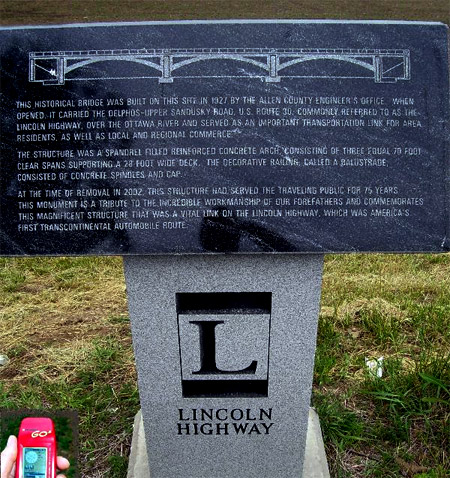
The marker below comemmorates the 1927 concrete bridge that carried the LH/Delphos-Upper Sandusky Road over the Ottawa River near Gomer, Ohio, taken by Stephen Shepherd.
The interesting monument below, probably overlooked by LH fans, was found at 1600 Plainfield Road in Joliet by a member cldisme.
According to the plaque at its base, this
life-size cold cast bronze sculpture of a 1915 Joliet road worker, seated on a hand-cut ceramic mosaic column, represents the historic Lincoln Highway and the birth of our modern day highway system. Also, included in the mosaic is an image of Abraham Lincoln medallion. The sculpture is dedicated to the men and women of the Will-Grundy Counties Building Trades Council and the construction companies of the Contractors Association of Will & Grundy Counties who make our roads possible.
On July 1, 1913, a group of automobile enthusiasts and industry officials led by Carl Fisher, created the Lincoln Highway Association (LHA), “to procure the establishment of a continuous improved highway from the Atlantic to the Pacific, open to the lawful traffic of all description without toll charges” and to be a lasting memorial to our 16 th president, Abraham Lincoln. Prior to the Lincoln Highway, the existing roads were nothing more than dirt paths, which became impossible to traverse even after the lightest rain. There were very few filling stations along the proposed route, few places to eat, and even fewer places to find lodging.
Since highway maps and signage did not exist, a uniform way of marking the highway became a necessity. A design was created that consisted of a concrete post, a blue arrow, and Lincoln’s image on a medallion. On July 8, 1928, the Boy Scouts of America installed the concrete sign posts next to 3,100 miles of roadway at all important turns and junction points from New York to San Francisco.
Check out the site for dozens more Lincoln Highway markers along (and sometimes far from) the road.
Colo, Iowa, city clerk Scott Berka told me today that construction is progressing well at the Colo Motel, part of a wonderful “one-stop” restoration project in central Iowa. Painting is done and carpenters will start trimming next week, but furniture was just ordered today so it looks like it will be the first of the year before the motel reopens. Sounds like it will be ready in time for Springtime road trips!
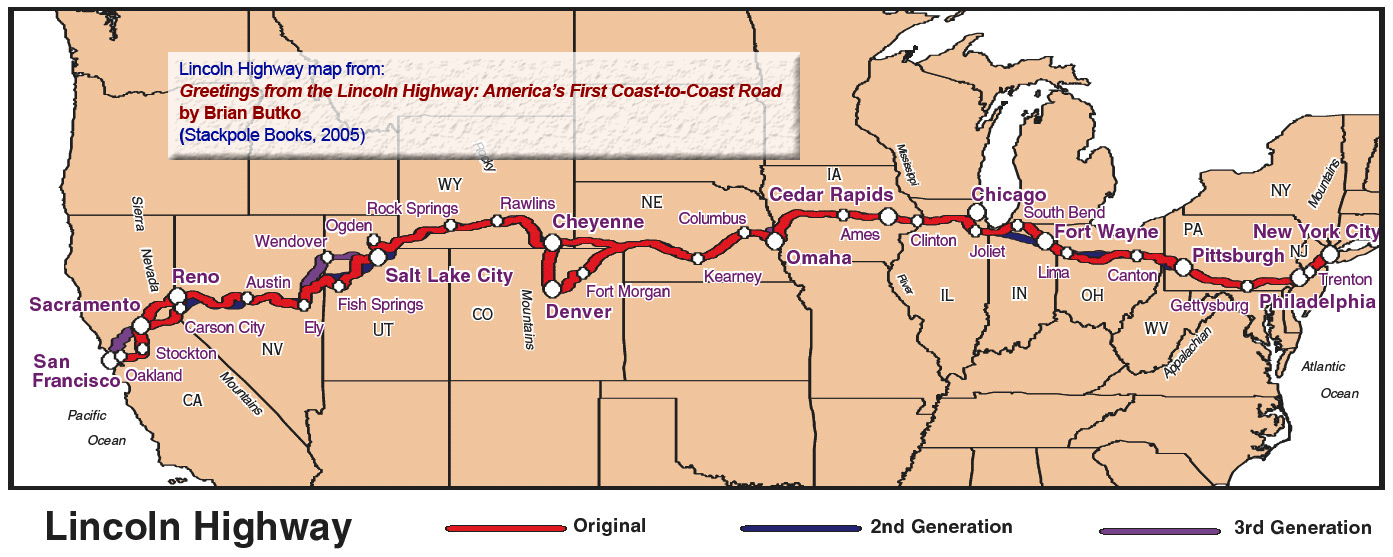
Click the map above for a full-size view of the Lincoln Highway.
Like this blog? You'll LOVE my books!Lincoln Highway Companion features detailed maps and places to eat and stay. Click the book to buy it on Amazon.
Click the Greetings book below to purchase the ultimate guide to the history and route of the Lincoln Highway!
Another fun book! The Ship Hotel: A Grand View along the Lincoln Highway recalls the greatest roadside attraction along the coast-to-coast road.
And for those who LOVE diners, click the book below to purchase our completely updated guide to the history, geography, and food of Pennsylvania's Diners!

 In our review of Traveling the … Historic Three by


 Idlewild & Soakzone
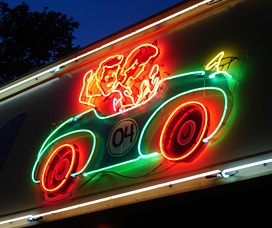 It’s also within walking distance of where I’ve lived my entire life, so friends are quite impassioned about the surprise announcement. Both parks are full of vintage rides such as Kennywood’s Auto Ride at left.





 Colo, Iowa, city clerk Scott Berka told me today that construction is progressing well at the Colo Motel, part of a wonderful “one-stop” restoration project in central Iowa. Painting is done and carpenters will start trimming next week, but furniture was just ordered today so it looks like it will be the first of the year before the motel reopens. Sounds like it will be ready in time for Springtime road trips!