Archive for the ‘roadside’ Category

Queneaus + markers = quite an 80th anniversary

September 2, 2008

Last summer, we honored Bernie Queneau here at the Heinz History Center with a proclamation from the mayor of Pittsburgh and the LHA. That same day, PBS producer Rick Sebak launched the filming of his LH special by capturing Bernie’s remarks about traveling the Lincoln Highway in 1928 (below, in front of his 16-year-old self holding the CA flag).
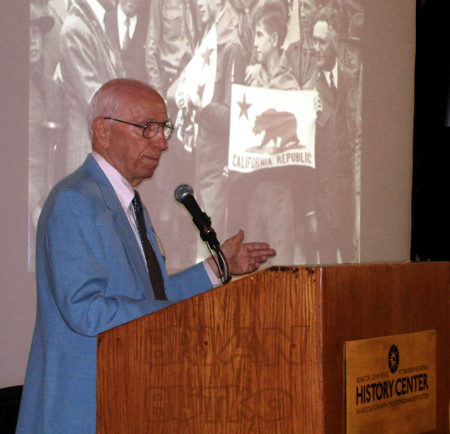
Bernie — now 96 years old — is the Lincoln Highway’s most prestigious ambassador, having been on the Boy Scout safety tour of 1928, which also served to promote the Lincoln Highway and the forthcoming marking of the coast-to-coast road with concrete posts/markers.

Yesterday, Rick and crew met Bernie and wife Esther, herself a former president of the LHA. It was 80 years to the day that Boy Scouts across the US fanned out to plant the concrete posts into the ground at corners and main intersections along the Lincoln. Rick recounts it best himself….

We had a great day on the Lincoln Highway with Esther and Bernie Queneau. I realized it was 80 years since Bernie made his cross-country promotional tour for the Lincoln Highway. Meanwhile, we tried to agree on a day when we could go for a ride, and today, Monday, Labor Day, was the only day when Bob and Glenn and I were all available as well as Esther and Bernie.

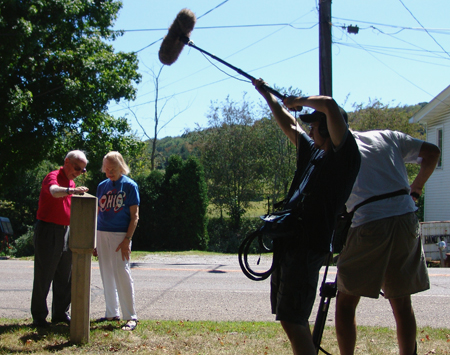
Then in Hanoverton, when we pulled to look at the replica marker, Esther mentioned that the markers had been erected on the same day, September 1, 1928. That was 80 years ago today! By chance, we were observing the 80th anniversary of the concrete posts with a drive into Ohio. It was glorious.
We actually had great luck all day. We met Bernie and Esther at the Teapot in Chester, WV, at 10 AM, and while getting a few shots, a car pulled over and Susan Badgley who helps take care of the landmark got out and offered to show us inside. How could we pass up the opportunity? Susan’s mother remembered the pot back 65 years.

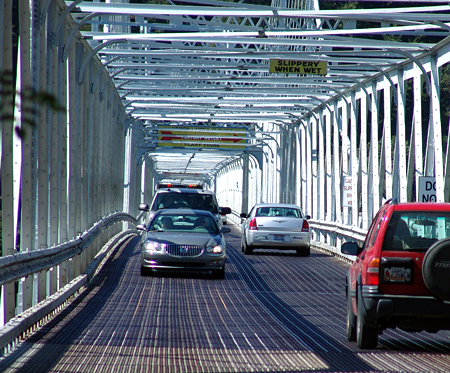
Susan’s husband Tom is a toll taker on the Newell Bridge, and she offered us some free tickets to make several crossings, trying to get some shots of Esther and Bernie crossing the river into Ohio. [That’s Bernie below driving his Buick.]
We ended the day driving back and forth on Baywood Street west of Minerva. What a beautiful old stretch of red brick road! We thought we had driven into an Edward Hopper painting. Several nice old painted markers on telephone poles, and two quick interviews with our subjects. They are amazing.
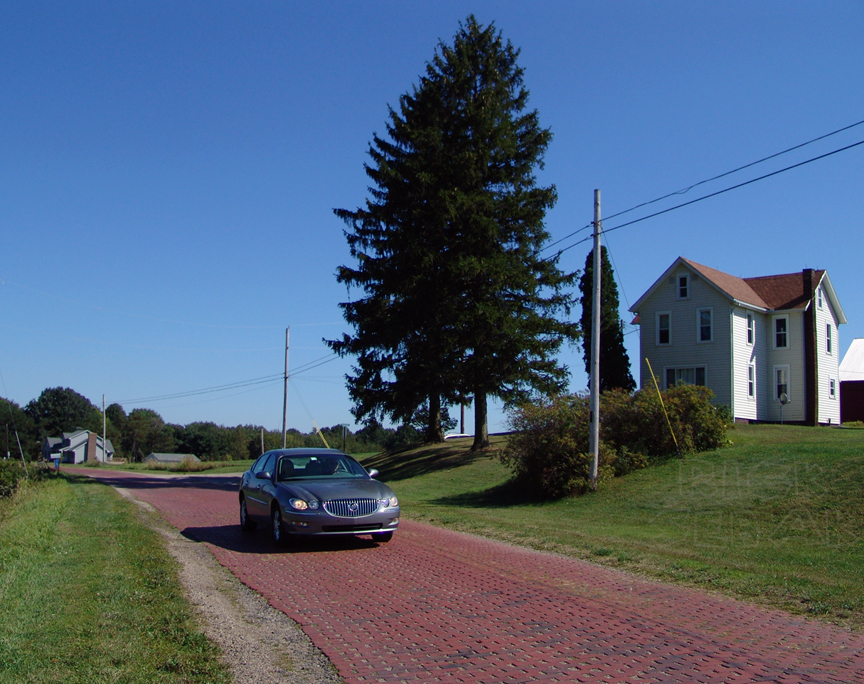
Above: Rick Sebak photographed Bernie Queneau driving the LH via Baywood Street in eastern Ohio – CLICK to see it larger.
Picking top 5 Lincoln Highway sites not so easy

August 29, 2008

In response to our story about PBS producer Rick Sebak filming at the Shoe House, good friend Jess asked what were the top 5 Lincoln Highway sites in PA mentioned by LHA director Mindy Crawford? Glad you asked!

1. Grandview Point, site of Ship Hotel, between Bedford and Ligonier
2. The Shoe House, York
3. Dunkle’s Gulf, Bedford
4. Lincoln Motor Court, Mann’s Choice
5. Poquessing Creek Bridge, near Langhorne
6. Dutch Haven, Lancaster

Yep, six! Mindy said couldn’t bear to leave out any of them.

If I had to cut one, it would be Grandview Point, even though I’m writing a book about it and the Ship Hotel there (due out Spring 2010). But if I could replace it, I’d go for Mister Ed’s Elephant Museum between Chambersburg and Gettysburg — Rick is not as enthusiastic about it, but for me it’s a rare throwback to  old-time museum and candy shops. And I’d plead to group two in Bedford and add the Coffee Pot to Dunkle’s since it’s just down West Pitt Street.

When Rick filmed me in Pittsburgh, he asked me about my top 5 around the city. Hmm, I think they were:
1. Lincoln bronze statue, Wilkinsburg
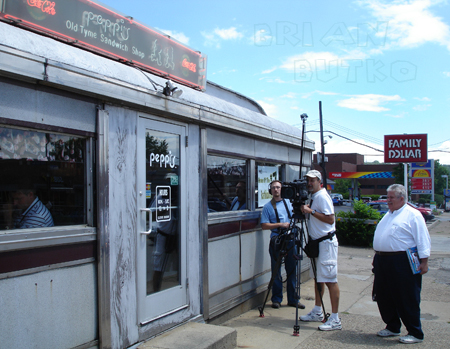
2. Peppi’s Diner, Wilkinsburg/Pittsburgh line
3. Gulf building, art deco skyscraper, downtown
4. Manchester Bridge abutment, North Side, next to Heinz Field
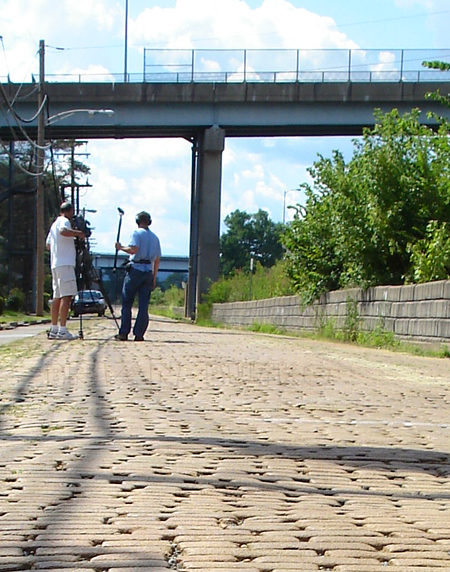
5. Yellow brick road, Glenfield

OK Jess, you have two weeks — can you see them all? Maybe we’d better just make a lunch run to Peppi’s!

How about the top 5 must-see LH sites in the US? Dunkle’s must be one, and maybe the nearby Lincoln Motor Court too. It’s tough but I can pick three more (two of them also very close to each other in the Midwest). Send your top 5 and we’ll gather them into a post next week.

PA road widening to affect LH & turnpike markers

August 21, 2008

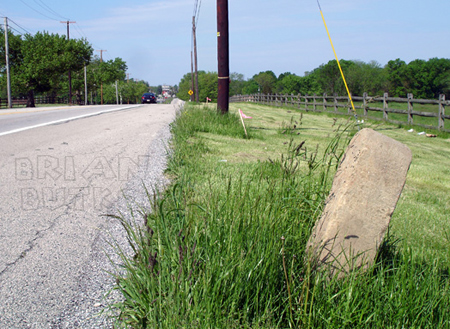
LHA member Bill Spoon called to say the Lincoln Highway is being widened between Gettysburg and New Oxford, Pennsylvania. He worried about a couple markers by the roadside – one a LHA 1928 concrete post, and one a c. 1820 turnpike marker incised with mileages to Gettysburg, York, and Philadelphia.

LHA state director Mindy Crawford contacted the state; Steven A. Moore, Senior Project Manager
for PennDOT Engineering District 8-0, reported back that both are scheduled to be removed, stored, and replaced according to these specifications:

ITEM 9000-0100 – REMOVE AND RESET CONCRETE MARKER
DESCRIPTION – This work is the removing and resetting of existing historic concrete markers.
CONSTRUCTION – Survey and record the existing marker location. Remove marker prior to the start of construction and store in a secure location. Reset marker near the original location as directed after adjacent construction is complete. Care should be taken to avoid damage to the existing markers during removal, storage, and resetting.

It’s good to see highway departments becoming aware of historic resources related to roads themselves.

PBS visits Mindy and the Shoe House (& NYC)

August 19, 2008

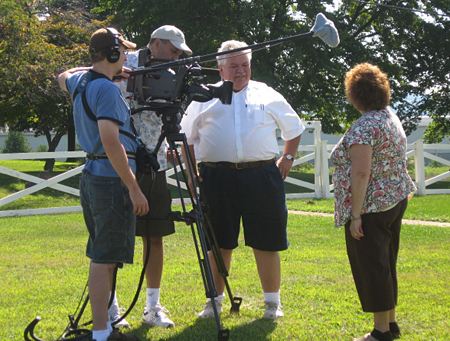
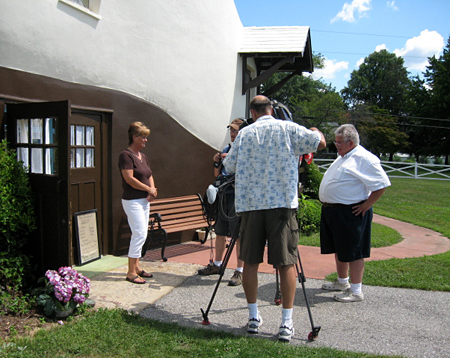
PBS producer Rick Sebak made his way to New York City last week to catch the eastern end of the Lincoln Highway. One of the stops on their way back to Pittsburgh was at the famous Haines Shoe House near York, Pa., where he met LHA board member and long-time roadside researcher Mindy Crawford, who sent these photos of her interview:


She also described the day:

Just got home from a great day with Rick, [and crewmembers] Bob and Glenn. We spent the morning at the Shoe House. I did an interview on my top 5 “must see places’ in Pennsylvania as well as some general comments about the Lincoln. Then they interviewed Carleen Farabaugh (below), the owner of the Shoe House. They got a great shot of her husband, Ron and her grandson, Austin mowing the lawn and watering flowers. Then Carleen and I did a brief “preservation segment” on the care and upkeep of the Shoe. Even my husband Rodney got involved by being a “tourist” during Carleen’s tour.

We took a break mid-day to have the most amazing Thai food. Everything was delicious but it was almost as much fun photographing everyone taking photographs of the food before we ate. When we left the crew, they were headed back to do a few more approach shots at the Shoe House.

A couple days before, Rick and crew filmed at the eastern terminus of the highway – but as the site is not marked as the start/end of the LH, they spent time with its leading champion, LHA board member Jerry Peppers, whose office overlooks Times Square. Here’s a shot from Rick of Jerry – click HERE to read all about their day in NYC.

Denny visits Terminus on West Coast adventure

August 12, 2008

Well-known roadie Denny Gibson has been cruising down the Pacific Coast this week and passed through San Francisco the past couple days. Like producer Rick Sebak, he stayed overnight at the Pacific Heights Inn and reports it to be good and priced right. Yesterday morning he went in search of the last original 1928 Lincoln Highway concrete post. With a little help from me and Sebak’s blog and video diary, he found it with the surrounding bushes cut back to better reveal the post: “Yep, it’s so much easier that I walked by it twice without seeing it. I was looking for and into shrubs and certainly entertaining anyone who was watching.”

Then he cruised to the nearby Terminus marker, also an LHA concrete post but this one a modern reproduction.

Then it was off to the Cliff House to see where dedicated transcontinetalists really ended their trip – at the ocean, dipping their tires. (With the beach now closed to cars, there was no dipping for Denny’s tires.) Read more about his adventures from this trip, with tons of roadside info and images, at www.dennygibson.com/. (Note, his blog is a couple days behind so no LH mention is posted yet.)

Filming the Lincoln Highway special around town

August 11, 2008

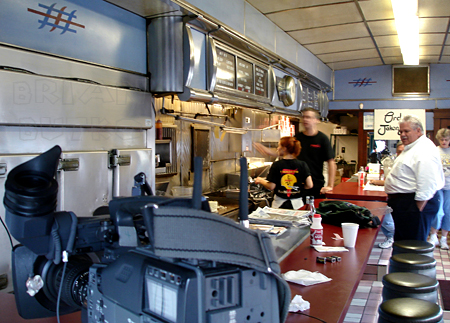
Friday found me with PBS producer Rick Sebak as he filmed around Pittsburgh for his upcoming special, A Ride Along the Lincoln Highway. First up was Peppi’s Diner (known to locals as Scotty’s or Charlie’s) where we talked about the highway and places to see around town.

Then it was on the road to find those places, from the Mullins-made Lincoln statue just down the road in WIlkinsburg …

… to the yellow-brick section of old road in Glenfield.

Camera and sound were handled by Bob Lubomski and Glenn Syska. They do tons of work trying to get the best angle and sound and lots of other things that, when done right, nobody notices. (Same for the crew that will edit the video and sound in a couple months.) Bob and Glenn even climbed up on that overpass to get aerial shots of the road.

Read more of their adventures on Sebak’s blog and tune in two days before Halloween to see the show on your local PBS station.

Early Ford V-8s arrive at LH's Western Terminus

August 6, 2008

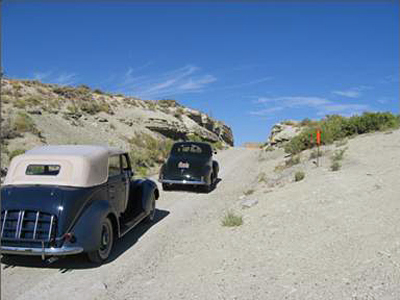
George Garrett and Tom Shields, driving their 1930s Fords across the US on the Lincoln Highway, have reached the Western Terminus in San Francisco. Including some detours to car shows and museum, they traveled 4,446 miles in 20 days (not counting their biggest detour to Detroit). That’s about 222 miles per day. George says they got about 19 miles per gallon at a time when gas was about $4 per gallon. Here are some images from their blog, which has some fun stories of their adventures:

Above two are Ohio.

Hard traveling on the road west of Rock Springs, Wyoming.

The goal is achieved – San Francisco!

New SCAJ; two historic roads conferences in SW

August 5, 2008

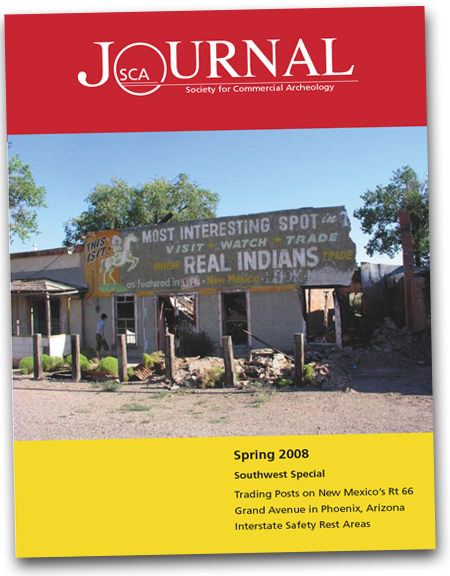
The new Society for Commercial Archeology Journal (which I design) highlights the American Southwest in anticipation of two conferences set for in September. Both events are the same weekend in Albuquerque, New Mexico, near the historic intersection of the 17th-century El Camino Real de Tierra Adentro and US Route 66.

Preserving the Historic Road 2008
September 11-14
www.historicroads.org
The 6th Preserving the Historic Road conference offers a choice of 3 tours or a field session on the 11th, sessions at the historic Kimo Theatre and Hotel Albuquerque on the 12th such as “Reality and Myth-Building on Historic Highways,” “Lodging Challenges Along Historic Highways,” and “Before the Interstate: The Perpetuation of Indigenous Roads.” The 13th will have more sessions on bridges, trail traces, and historic corridors.

Click the logo to enlarge.

Southwest Detours
September 10-13, 2008
www.sca-roadside.org
The SCA’s conference will explore automobile tourism in the southwest, with paper sessions and tours:

Thursday, Sept. 11
Bus Tour along Route 66 to Gallup, NM
The tour to Gallup along Route 66 includes Dead Man’s Curve, neon signs in Grants (“Uranium City USA”), the Continental Divide, trading posts in Gallup, and lunch at the famous 1937 El Rancho Hotel (“Home of the Movie Stars”), built by the brother of movie mogul D.W. Griffith. (includes tour book and lunch)

Friday, Sept. 12
Symposium and Paper Sessions

Saturday, Sept. 13
Bus Tour to Mountainair and Socorro, New Mexico
The old Route 60 tour will include sites spanning over three centuries. It will take us along some of the oldest alignments of Route 66 in south Albuquerque, and include lunch in Mountainair at the Pop Shafer Hotel, Restaurant and Curio Shop, with a tour of Shaffer’s Rancho Bonito. Socorro highlights will include stops at a southwestern trading post, the old plaza, and a roadside produce stand during chili season!

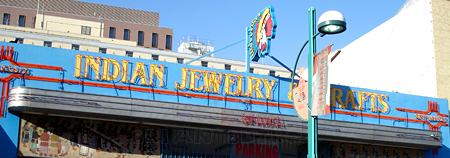
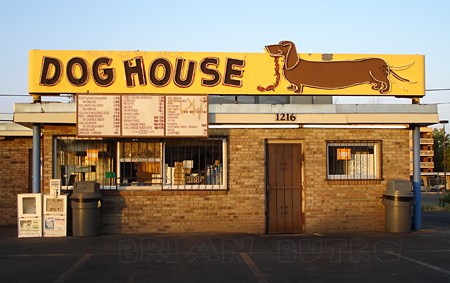
Here are some roadside highlights in town that I snapped early one morning:

Though centered around Route 66, you’ll meet many Lincoln Highway fans and historians, and see amazing roadside attractions, trading posts, and restaurants (the Frontier is a must-stop).

Lessons from a Route 66 motel makeover

August 1, 2008

Businesses along old 2-lanes such as the Lincoln Highway often struggle to compete with chains that locate at Interstate off-ramps, but Ron Warnick reports on his Route 66 News about a non-chain motel in Barstow, California, that has found a way a pretty basic way to attract tourists. The story from the city’s Desert Dispatch notes that a simple image makeover instantly began attracting travelers who otherwise were passing by. For all those independent motels struggling in the face of brand-names that feature oodles of amenities and AAA ratings, it’s proof that business can be improved by attending to the look and cleanliness of a place.

Their current property, the Topper Motel on West Main Street, is popular with people, mostly locals, owner Ken Patel said, needing a room for more than a couple of nights. But tourists running down Route 66 passed right by and rarely stopped to rent rooms for just a night or two.

The Patels’ solution: Renovate the west side of their property, paint it the appealing color of an orange Creamsicle and slap a new name, The Sunset Inn, over the office….

Ken said problems with longer staying customers on the Topper side of the business made him consider ways to bring in shorter-staying out-of-towners. He said the rooms where people stayed for weeks or months at a time were often unkempt, dirty and negatively effected the entire appearance of his motel.

The Sunset looks like a completely different motel from the Topper sitting next to it. The rooms are crisp and clean and the parking lot features a small courtyard and desert landscaping. Day Manager Bill Snyder said the remodel has been so successful with the Sunset that there are plans to give the Topper the same treatment soon.

A story in a 1950s diner industry magazine advised owners to pave their decrepit parking lots. Many diner owners howled at the idea, saying customers were more concerned with the food that the lot. Yes, if you know a restaurant has good food, you’ll overlook the shortcomings, maybe even calling them “charming,” but for those not familiar with a place – as most travelers aren’t – they’ll pass by a run-down motel or restaurant. In the same vein, would you buy a beat-up used car or one that looked cared for?

Missionaries served SLC's municipal auto camp

July 28, 2008

An article by Ardis E. Parshal at keepapitchinin.org discusses the auto camp that sprung up on the west end of Salt Lake City, and Mormon missionary efforts there:

By 1921 it had the usual amenities found in any such western camp. In earlier years [Pioneer S]take leaders had noted the increasing thousands who spent time at the auto camp before passing along, and they realized they had an unusual service opportunity. That summer of 1921 they pitched a large tent at the camp and held church services, both on Sundays and during the week. Meetings were short and casual, and relied on music and the recitations of Sunday School children. The various ward choirs in the stake took turns providing music, and talented instrumental soloists offered their services. Stake officers provided brochures, sold copies of the Book of Mormon, and answered questions. Some 25,000 tourists were served in that first year alone.

In 1922, the project expanded, and stake members build a small chapel, open on one side to face rows of benches in the open air. And word began filtering back from missionaries in the field, that they had been welcomed into the homes of people who had stayed at Salt Lake’s auto camp and changed their opinion of the habits and character of the Mormons.

ABOVE: an image of the auto camp missionaries from the article, which identifies the men.
TOP IMAGE courtesy Russell Rein.

SLC and the 1860s Tabernacle were regular stops for most everyone motoring through Utah. As the author points out, and as seen in period travel journals, many wanted to see what Mormons looked like. Early auto traveler Harriet White Fisher was among those who stopped to see but concluded, “I could find no marks of identification that made them any different from other men in the East.”