This Christmas display, in Marshalltown, Iowa (along the Lincoln Highway) is built annually by Eric Rodemeyer at his home (611 South 7th Avenue) using 14,500 lights, controlled by 96 computer channels, 7 songs in a loop. He also builds a display on the courthouse grounds for the Noon Optimist Club that will play through December 31, 2007 from 5:30 pm – 9 pm Weekdays and till.10:30pm Fri-Sun.
The song is “Christmas Eve Sarajevo”by the Trans-Siberian Orchestra. The basis, especially after a one-minute intro, is the song “Carol of the Bells,” one of my favorite songs, though I prefer it with voices, like this one from an album called Christmas with Monique Danielle, used at a site south of the LH in Lindon, Utah.
The 1886 home of Col. and Mrs. Cody, a long-time Lincoln Highway stop in North Platte, Nebraska, is decorated for an 1880s Christmas. Nightly events include period reenactors, caroling, roasting chestnuts, horse-drawn carriage rides, hot cider, holiday music, the armed services honor tree, and Santa Claus. The 1887 horse barn, log cabin, and other outbuildings are decorated with exterior Christmas lights. The mansion has 18 lighted and decorated trees inside, while the barn has a large lighted and decorated tree, where visitors may make their own ornament to hang.
At Buffalo Bill State Park / Scouts Rest Ranch, 2921 Scouts Rest Ranch Road. Tonight is the last evening so hit the road now! “Christmas at the Cody’s” runs from 5:30-8 p.m.
Jan Shupert-Arick sent a photo from Lincoln Highway members in Churubusco, Indiana, that shows one of their new Historic LH signs. This one is placed on an entrance sign to “Turtle Town.”
Why “Turtle Town”? The Chamber of Commerce has the story here.
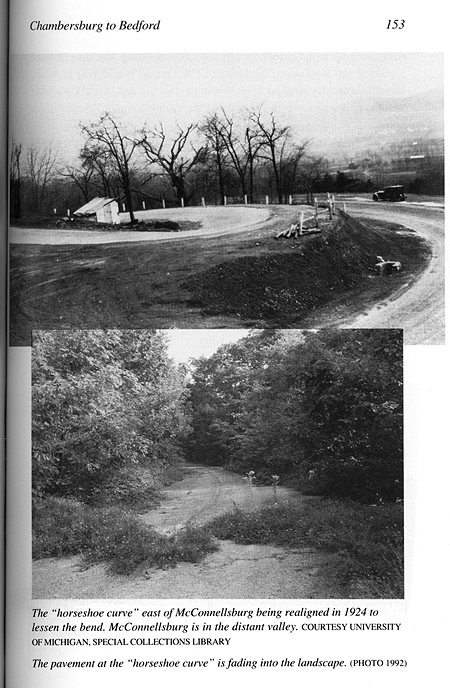
Ken Ruffner wrote me with a question regarding an image in my book The Lincoln Highway: Pennsylvania Travelers Guide. It’s the historic photo on page 153 (1st ed., 1996) of the Horseshoe Curve above McConnellsburg, Pa.
I had said the view is looking west to McConnellsburg, with the new road on the right. Ken wrote, “but then the road on the right is lower than the one on the left when in fact it really is higher on the hill… this photo doesn’t register with me…. could you please help me out with this so I can let it go… a friend of mine and I left the area with more questions than we started out with.”
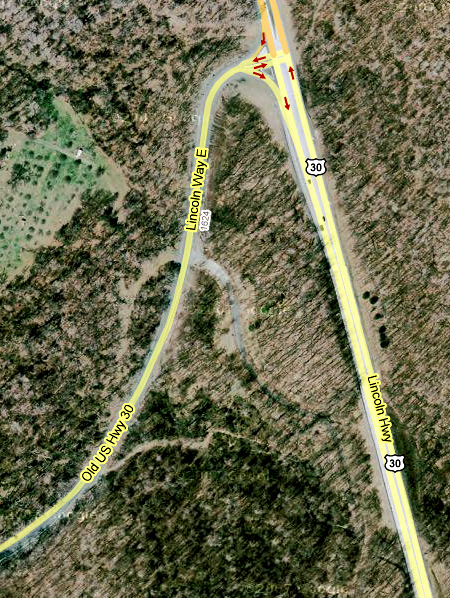
Above is an aerial view showing modern US 30 as a straight line and the old LH/US 30 curving up the mountainside. They still join at a prominent horseshoe curve but I wrote in my book that the photo was along the old curvy road, about where the “y” is in “Lincoln Way E.” I had discerned this by walking the old road, but after Ken inspired me to look at the aerial view, I realized the entire curve survives, though only partially driveable. The “lost” remnant is on the west/left side of Old 30/Lincoln Way E – it’s much more visible in the close-up below.
I see where Ken could be confused, but the new curve was broader and hence closer to the drop off. Look below at my proposed routings: red is the original (we’ll call it 1913 for LH reference), purple is the new (1924) curve. The original (red) road/curve that sat higher would have survived the 1924 reshaping, as seen in the historic photo, but was erased when the current road split the horseshoe about 1970.
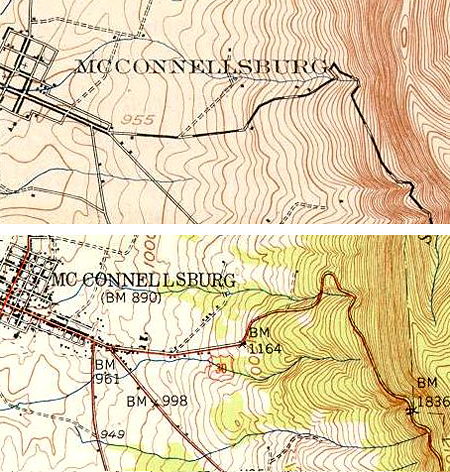
The topo maps show the evolution, the first showing the original curve as a sharp turn, the second showing the broader 1930 revision.
The last mystery is the little road south of all this that likewise has a turnoff to the east. I marked it in blue. Is it an earlier alignment? A detour during construction in 1924? Or 1970? Or was there a house there at some point?
Note about exploring the 1924 alignment — the road in my 1992 photo is blocked and walking it may be trespassing now, though perhaps it’s just blocked to stop traffic. When I walked it back then, it was beautiful and thrilling to be discovering an old alignment. What an eerie feeling to stand where thousands of cars once chugged up the mountain.
Fallon, along the Lincolon Highway in western Nevada, is today celebrating its centennial of becoming an incorporated city. According to the Lahontan Valley News, there was no town at the turn of the century until rancher Mike Fallon sold his land to Warren Williams in 1903, who then began selling lots on what is now the west end of town. The eastern part was established on land owned by John Oats.
“Initially, Fallon was a mining town, and in 1919 the city experienced an oil boom. Growing alfalfa has been and is still one of the most stable income for local farmers. Currently, the valley’s 30,000 farming acres produces an average of 5 tons per acre — 70 percent is shipped out of state.” Mert Domonoske, past mayor of Fallon for 16 years, said when he moved to Fallon in 1948, there were about 2,300 residents, and the only road leading out of town was a two-lane highway. Now “The Oasis of Nevada” has 8,000 citizens.
Smiley Kent moved to Fallon in 1950 after marrying Bob Kent in Elko. Her husband grew up in Fallon and has spent his entire life here. The couple first lived in a home in downtown Fallon, and Maine Street was the place in town where people shopped, Kent said there was not much traffic in the 1950s, and businesses were scattered throughout the city. What she first noticed about Fallon was its peacefulness and all the trees on Williams Avenue. She said Center Street also served as the Lincoln Highway and was the road on which people traveled when leaving town. She said the town always pulled together during tough times, and remembers Mom’s Place at Allen Road and Williams Avenue as the last business on the west side of town. “The town keeps going west,” she said. “The town has expanded so much.”
Events run this evening from 6-8 pm starting when the current mayor and council members arrive at Oats Park by horse-drawn Wells Fargo stagecoach. Festivities will includea bonfire, food, drinks, church bells ringing, musical performances, and singing “Happy Birthday” with a big birthday cake. Just bundle up – freezing temps are predicted all day and week.
I’m still reviewing my Lincoln Highway Companion book maps and so was using Google Maps to check out aerial views of the old stone bridge over Poquessing Creek. If you’re ever northeast of Philadelphia, you must go check it out – a turnpike-era bridge in the woods but within sound of wide boulevards and suburban sprawl.
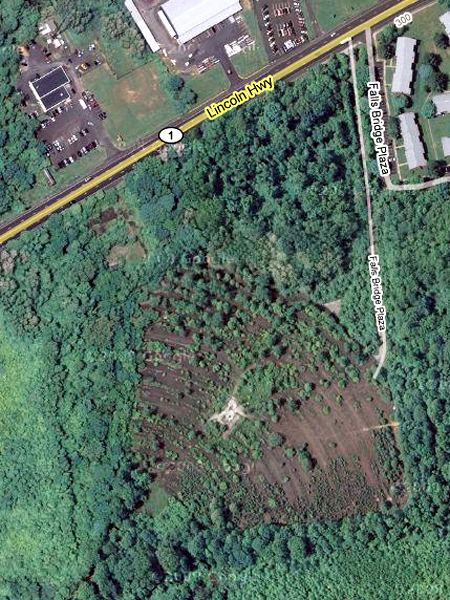
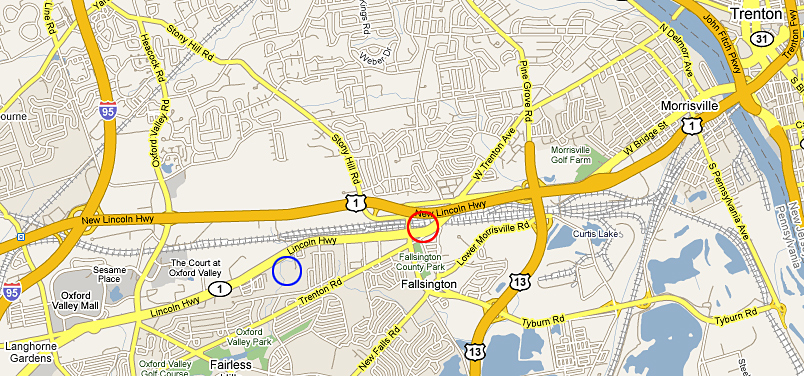
I kept scrolling east towards the NJ border and recognized a couple places I’d been years ago – the US 1 North Drive-In Theater and the original railroad crossing at Fallsington, used by the Lincoln Hghway through 1920. In fact, the entire LH from the Philadelphia line (which the Poquessing Creek Bridge crosses) to Morrisville (at the NJ line) is filled with interesting reroutings, made all the more challenging to discern because so many of the changes were made so many years ago.
The long-closed drive-in amazingly survives but nature is overtaking it. The old crossing can be found by locating the two skinny roads leading to the tracks; I’ve marked the location of the bridge. Both are noted on the map below — click to enlarge it.
More than a half-year after moving and losing track of just about everything, I’m down to the last few boxes to open, and there in one of them was The Lincoln Highway around Chicago by Cynthia Ogorek. The 128-page book was published by Arcadia earlier this year — my review was to be a preview when I started this post in March! Since then many reviews have appeared favorably recapping the highlights. My best compliment about it is that it is unlike other LH books; it is not just a retelling of existing information, it is a grand amalgamation of numerous sources, some familiar to LH fans, others dug out from local archives. The introduction and captions bespeak of a solid familiarity with local history and geography. Although a few images from the LHA collection may be familiar to fans, nearly every page brings new and interesting vintage views.
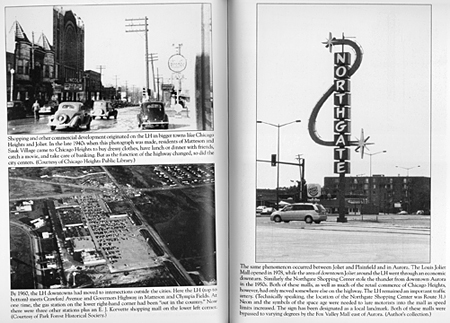
Chapter 1 explores the original route and the people behind its improvement. Chapter 2 is all about the Ideal Section. Chapter 3 highlights roadside businesses, including some great gas station shots. Chapter 4 looks at the connection to the many electric interurban lines that served Chicago. (One of my favorite photos is found here — an aerial view of snowbound motorists astride the Park Forest neighborhood of Lincolnwoods, with an impending development across the road. It is also the source of the photo below that shows the Lincoln Theater in Chicago Heights, a 1960s shopping center in Matteson, and the fabulous Northgate Shopping Center Sign near Aurora — and I’m glad to report that Cynthia says this has been designated a local landmark.) Chapter 5 examines the inevitable bypasses. Chapter 6 reviews recent events, from restoration of the Ideal Section monument to Art Schweitzer’s efforts to document and salvage part part os that section; from Lincoln Highway Lady Lyn Protteau visiting the area to Mad Mac’s March across Illinois.
All of Arcadia Books leave me wanting more — more text, better quality on many photos, a break from the monotonous crammed design — but some authors rise above that to present well-researched, insightful books. This is one of them. $19.95 or $14.95 from Amazon.
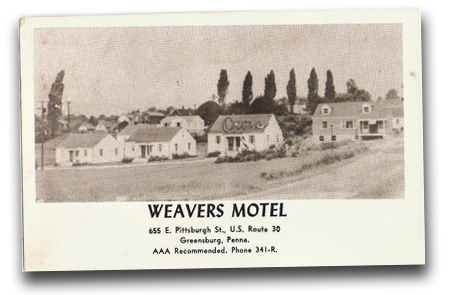
Looking through my computer files today I found this postcard scan of Weaver’s Motel along the Lincoln Highway on the east side of Greensburg, Pa.
When I began researching the highway in Pennsylvania two decades ago a few remnants of this motel remained. Judging by Google Street View, what looks like the main building of the tourist court still survives but that’s it.
Reviewing the Iowa chapter in my forthcoming Lincoln Highway Companion, I often compare my maps to extreme close-ups of the LHA’s excellent CD-based maps based on the DeLorme system. My book has a photo from just east of Grand Junction, Iowa, where 4 bridges cross Beaver Creek. However, I noticed the LHA maps only show 3 roads/bridges there, despite a notation of “4 Bridges.”
So I checked with Bob and Joyce Ausberger, who made the ultimate effort to save the original tiny concrete bridge there by purchasing it and the land around it! They confirmed that the original LH needs to be shown crossing it. “There is still the remains of the road grade. You need to be standing at the right location to see it. It was never more than a graded dirt road, but it’s there. Right now it is covered with brome grass so it probably wouldn’t show up on the DeLorme maps.”
You can see all 4 in the Google Maps aerial view — from top: original LH, railroad, old LH, and US 30. (And note how lucky we are – the aerial views go low-res just a few yards to the west!)
On a sample of the DeLorme map, I’ve drawn in by hand a bright blue line where the original route should be, and a black circle where the bridge is. I’m guessing at where it joins the revised LH/222nd St on the west end but maybe readers can help confirm that.
The author is me, and my part is probably less than a minute long, but if that justifies a Lincoln Highway connection to mention this book, that’s OK. World War II Radio Heroes is the fascinating story of dozens of 60-year-old letters discovered by author Lisa Spahr. They were sent to her family by total strangers to inform her great-grandmother that her son had been captured and was being held as a POW. How did they know?
Lisa explains:
Short-wave radio had held all of the answers. POWs were allowed to state their names and hometowns on the radio, and sometimes relay a short message to their families. Scores of Americans, listening to the German propaganda from so far away, heard my grandfather’s information, and took it upon themselves to write to my great-grandmother. All of these dear people wanted to give my great-grandmother a measure of comfort to know her son was alive.
Lisa’s tale of trying to track down the letter writers is part of the journey, and after I began talking to her about it, she asked if I would read one of the letters for the audio version. We also thought my son Andrew would be perfect to read for Flavius Jankauskas, who is seen on the cover with his Howard 430 radio. He was 16 when he sent Lisa’s family a note and is one of those Lisa was able to locate.
A couple interesting notes: that’s Lisa’s grandparents also pictured on the cover — her grandfather did return safely. And although you might think that cell phones, e-mail, and texting would put a damper on ham radio, there are more than 600,000 operators in the U.S., up from just 51,000 at the dawn of WWII.
The audio book is professionally produced with 3 CDs and bonus tracks. The text is read by Lisa along with 30-some letter readers. The book is available on Amazon or from the author’s site for $15.95 or instantly downloadable as PDF for $19.95. The audio book in a limited run of 400 is $29.95 or can be paired with the book for $40.
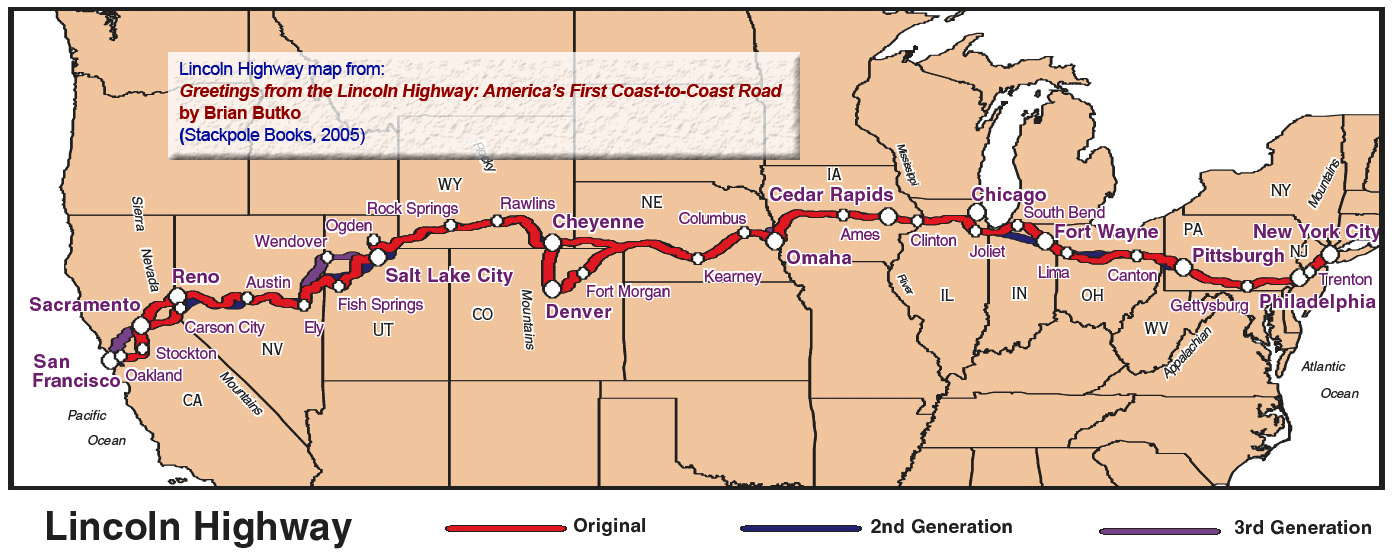
Click the map above for a full-size view of the Lincoln Highway.
Like this blog? You'll LOVE my books!Lincoln Highway Companion features detailed maps and places to eat and stay. Click the book to buy it on Amazon.
Click the Greetings book below to purchase the ultimate guide to the history and route of the Lincoln Highway!
Another fun book! The Ship Hotel: A Grand View along the Lincoln Highway recalls the greatest roadside attraction along the coast-to-coast road.
And for those who LOVE diners, click the book below to purchase our completely updated guide to the history, geography, and food of Pennsylvania's Diners!
 At Buffalo Bill State Park / Scouts Rest Ranch, 2921 Scouts Rest Ranch Road. Tonight is the last evening so hit the road now! “Christmas at the Cody’s” runs from 5:30-8 p.m.









 Lincoln Highway News