Archive for the ‘transportation’ Category

LH cartoon shows Pittsburgh-WV rerouting: why?

August 26, 2008

Fellow author and blogger Jason Togyer writes that while digging up material about his forthcoming book on the G.C. Murphy Company, he spotted this cartoon in the Friday, Oct. 17, 1930, Pittsburgh Sun-Telegraph.

The reference here is to the rerouting of the Lincoln Highway through West Virginia, changing the route west of Pittsburgh, PA. The original routing along the Ohio River to East Liverpool, Ohio, had long been congested and waiting to be bypassed. But that’s the odd thing — the LH came through Pittsburgh in 1913. The LHA board of directors officially changed the route in December 1927 to what was named US 30 through Crafton, Clinton, and Imperial, into through Chester, WV, and across the Ohio River to East Liverpool). So why was a cartoonist welcoming the road to the city in 1930?

Great Race great-grandson gives great talk in IL

August 25, 2008

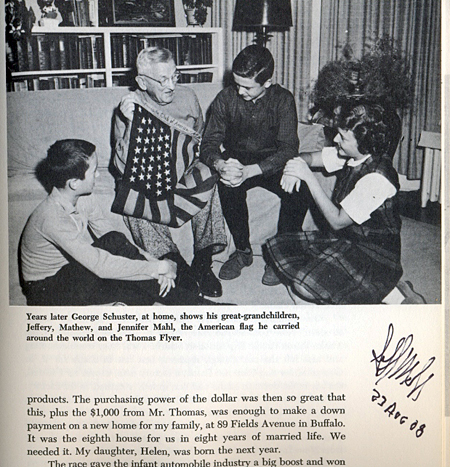
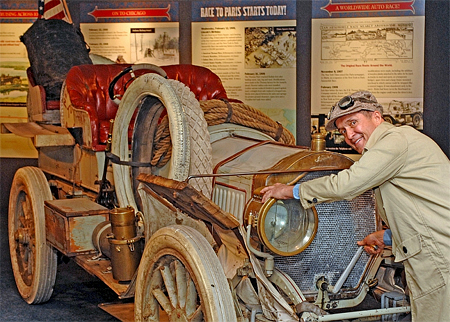
During the Geneva Concours d’Elegance car show this past weekend in Illinois, Jeff Mahr recalled the incredible story of his great-grandfather, George Schuster, winning driver of the 1908 New York to Paris Great Race. His presentation, “Bandits, Guns and Automobiles” recalls the saga as he heard it as a child combined with ongoing research. The race followed much of what became the Lincoln Highway in 1913 from northern Indiana to the Great Salt Lake. Jeff has a web site devoted to the race and his own work, with images such as the one below showing Jeff with the winning Thomas Flyer:

LHA director Kay Shelton attended the talk and sent back a glowing review:

Jeff Mahl got a standing ovation at the Geneva History Center on August 23. He described how he listened to his great-grandpa’s stories. When he was 14 and had to write a history assignment in school, that is when he realized how famous and important his great-grandpa was. Then he really paid attention to all of the stories, and thought they were better than anything on TV at the time. George Schuster lived until he was 99, he still shoveled snow at age 98, and still had a drivers’ license when he was 95.

Then, Mr. Mahl began his talk by putting on a driving jacket and sitting in a chair, and told the story in first person, like he was Schuster himself, with a PowerPoint. Schuster found out the day before the race that his boss wanted him to be in it and had very little preparation. E.R. Thomas chose him because he was a mechanic.

There will be a documentary out sometime in 2009 on the “Greatest Auto Race on Earth.” It will be released in Canada, Germany, France, and the U.S. He is a very nice man and if anyone gets a chance to have him as a speaker I highly recommend him. There was a $25 charge for the ticket — they brought him in conjunction with the very fancy annual auto show Geneva holds (Bentleys, Lamborghinis, Bugattis, Astin Martins, etc.). He signed the 1966 book I found [see below] and told me that it was very rare. His picture is in it as a little boy. He also re-published The Great Automobile Race: New York to Paris (originally published by the Thomas Motor Company) in 1992 with his own introduction. There is no date on the original book but it has to be 1912 or earlier as that is when the Thomas Motor Co. went defunct

I also have the book – an incredible, enjoyable journey:

WY ranch may house turbines, garbage, golf

August 22, 2008

The Wyoming Tribune-Eagle reports that a huge stretch of land west of Cheyenne that includes traces of the Lincoln Highway is being considered for a multitude of projects, from a wind farm to a landfill to a golf course.

The Belvoir Ranch has long included the paths of westward travel, from overland immigrants to fiber optic cable. Then in 2003, the City of Cheyenne bought the land which begins five miles west of town and stretches for 15 miles farther west, with I-80 as its northern boundary.

While some residents see the 18,000-acre purchase as a boondoggle, others see it as acquiring water rights and sites for a landfill, wind turbine farm and recreation. It is also a chance to preserve a microcosm of western cultural history.

Chuck Lanham of the Cheyenne Historic Preservation Board, the guide for a recent ranch tour, pointed out teepee rings at least 140 years old and other archeological features that have yet to be studied….

Ruts across the rolling, shortgrass prairie show the route of the Denver to Ft. Laramie stage line. Other ruts are thought to be Camp Carlin supply wagon tracks to frontier forts. There are vestiges, too, of the old Lincoln Highway, precursor to U.S. Highway 30 and Interstate 80….

Eventually, the early homesteads became part of the huge Warren Livestock Company holdings. F.E. Warren called the main ranch house his “cabin,” complete with tennis courts, pool and a professional horse racing track. Remains are barely visible today.

Because of the 1962 Cuban Missile Crisis, Atlas missiles were installed on what soon became known as the Belvoir Ranch. The above-ground launching facilities were deactivated in 1965, but the concrete structures can be seen south of I-80 at exit 348.

To learn more about the plans, including maps of the proposed developments or photos of the site (as reproduced here), visit http://www.BelvoirRanch.org or call (307) 637-6281.

PA road widening to affect LH & turnpike markers

August 21, 2008

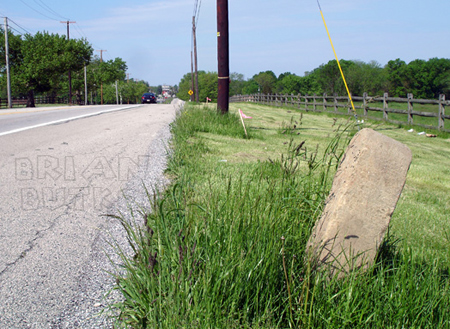
LHA member Bill Spoon called to say the Lincoln Highway is being widened between Gettysburg and New Oxford, Pennsylvania. He worried about a couple markers by the roadside – one a LHA 1928 concrete post, and one a c. 1820 turnpike marker incised with mileages to Gettysburg, York, and Philadelphia.

LHA state director Mindy Crawford contacted the state; Steven A. Moore, Senior Project Manager
for PennDOT Engineering District 8-0, reported back that both are scheduled to be removed, stored, and replaced according to these specifications:

ITEM 9000-0100 – REMOVE AND RESET CONCRETE MARKER
DESCRIPTION – This work is the removing and resetting of existing historic concrete markers.
CONSTRUCTION – Survey and record the existing marker location. Remove marker prior to the start of construction and store in a secure location. Reset marker near the original location as directed after adjacent construction is complete. Care should be taken to avoid damage to the existing markers during removal, storage, and resetting.

It’s good to see highway departments becoming aware of historic resources related to roads themselves.

LH historian & author Franzwa recovering

August 14, 2008

Historian and author Gregory Franzwa has been off the road the past few weeks as he underwent surgery in Salt Lake City for suspected lung cancer. As he relates, on July 29, surgeons “removed a pie-shaped (pumpkin, not lemon meringue) slice from the upper lobe of my right lung” that proved to be malignant but does not require treatment. His wife and road trip companion Kathy is taking care of him – as he says, “she’s in charge of cutting up my Jello.”

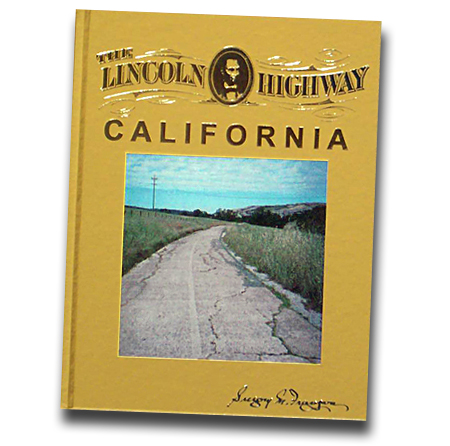
Franzwa was instrumental in founding both the Oregon-California Trails Association and the modern Lincoln Highway Association. His series of state-by-state guidebooks to the Lincoln Highway began with Iowa in 1995; books to the west coast are completed and he is now working on states to the east. His Patrice Press carries many more books he has authored about western trails – and at merely 82, he says he has lots more books to write.

Texaco's 1929 Lincoln Highway ad campaign

August 8, 2008

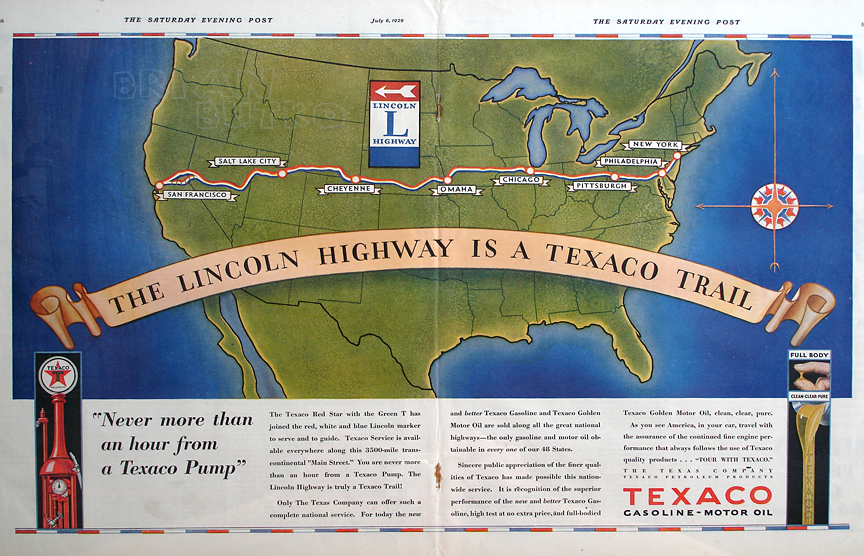
In 1929, Texaco ran an ad campaign centered on the Lincoln Highway. Advertisements ran in their member magazine, little strip maps were distributed, and spreads like this one in the Saturday Evening Post pointed people to the cross-country route. This was a bit odd considering the LHA had ceased active operations the year before, but perhaps that’s why the company chose to honor what it called a “transcontinental “Main Stree,'”

CLICK the map to see it larger.

Lincoln Highway history, the next generation

August 7, 2008

In recent years, the Lincoln Highway is returning to the mainstream. Wildly popular in the 1910s, it endured low name recognition through the 1960s-80s, but is again being embraced by an ever-wider audience. However, as the highway’s history is disseminated and simplified, it is also being generalized into fiction.
I read a blog stating “Interstate 80 derived from the old Lincoln Highway.” And a web site: “Lincoln Highway was the first major highway developed in 1915…. During the 30’s and the 40’s it became Highway 30 and then when Eisenhower promoted the interstate highway system it became Interstate 80.” Perhaps I-80 is descended from the LH in spirit or along its E-W corridor, but those looking for accuracy should disregard the above statements.

Another: “Because it would be built with private donations and not by the government, a friend suggested Fisher call the new road the Abraham Lincoln Highway, a name sure to open the pocketbooks of patriotic Americans.” Not exactly wrong but not necessarily correct.

And: “In the 1920s, the Lincoln Highway, the first transcontinental paved highway, opened to much fanfare…. The old Lincoln Highway was eventually replaced by US 40 and then by Interstate 80.” Nevermind the 40 and 80 missteps, the “first” claim can quickly polarize. Were other transcontinental paths named, marked, and promoted before the LH? Yes. Did they sustain that attention and improvement? No. Choose your side but don’t ignore or dismiss the other.

From a video: “See America First was a new concept in 1920.” Perhaps gaining steam then among motorists, the concept dates to the late 1800s and the phrase itself to at least 1906 when a railroad used it; in fact, The New York Times wrote about the rising trend in 1906.

I thought I recognized some phrasing when a reporter recently wrote, “drivers could find small local diners, quaint cozy cabins, prosperous mom-and-pop shops, Art Deco gas stations and colorful roadside attractions.” Yep, she got her history from a line for my Greetings book press release which you can find on Amazon: “diners, neon movie palaces, Art Deco gas stations, ice cream stands, tourist cabins, and colorful roadside attractions.”

Chambers of commerce and tourism agencies are likewise discovering the Lincoln. That’s good for economic growth and preservation, but the story of the highway becomes a bit more generalized, and inaccurate, with each retelling. A recent news article paraphrased a tourism bureau chief: “Historically, Lincoln Highway has been used as a commercial transportation highway, while Route 66 was created for travel and leisure.” This statement takes some narrow modern preconceptions, puts them in a blender, and projects backwards a history that just isn’t true.

There is debate in Illinois whether towns within the LH’s corridor of influence should be included in economic promotions. How specific should we be in defining the LH’s corridor? Only the marked road? Or within a block or business district? Is Chicago “on” the route? Just how literally do we interpret the Proclamation Route? Do we count LH routes that were only promoted locally, but seriously? How about the Feeder Routes? Are those who take sides aware of the larger picture, where a desire for strict interpretation is more a modern focus than a historical truth?

There were many motivating factors behind the Lincoln Highway, but one of them was certainly scenic tourism. In fact, recreational travel promoted as a patriotic duty was probably more fervent in the teens than the 1920s, when Route 66 was established as one of the many numbered federal highways. Regardless, advocates of any of these highways promoted roads for economic advancement, no matter the source. Perhaps the main difference between the two was the LH and other c. 1913 trails were blazing a path of promoting hard-surfaced roads, while by 1926, the benefits of good roads were a much easier sale.

The Lincoln Highway was the most famous road of its day, and remained a popular name and destination decades later, but 66 finally overshadowed it for many reasons. Bobby Troup wrote an enormously popular song about it in 1946. US 66 became a well-traveled route to the West Coast for those looking for hi-tech jobs after WWII. Todd and Buzz rode to fame on the Route 66 TV show in the 1960s, thereby associating the road with potent imagery and mythology. And then there’s that seductive alliteration of the two numbers.

While the LH has come to embody early travel with images of mud, cabin camps, and Model Ts, the later birth of 66 and its postwar popularity finds it associated more with concrete ribbons, neon signs, and tail-finned cars. The LH had those too — probably more since it’s a third longer — but that imagery was first and wisely latched onto by 66 boosters in the 1980s. Route 66 became the embodiment of simpler, happier times, a symbol for adventure, and it soon became the setting for any ad, commercial, or clothing line that wanted to be retro chic. Places along 66 sometimes embrace the 1950s/Marilyn/car hop nostalgic marketing to the point of overload, but many tourists enjoy exactly that special sense of place, especially strung out over a couple thousand miles.

The Lincoln Highway’s resurgence similarly began in the 1980s, sparked by Drake Hokanson’s book and spread by the national LHA in the 1990s, then entering public forums in recent years as books and magazines have spread the word. While recent restoration efforts on 66 have focused on gas stations and roadside attractions, LH folks are just reaching that point, having first concentrated on saving the infrastructure itself (such as the tiny concrete bridges in Iowa). A quick glance back might give the impression that the LH had a more serious genesis, while 66 was built for fun, but that’s just not the case. The same goes for the other above statements.

For a solid overview of Lincoln Highway history, check out Hokanson’s beautiful The Lincoln Highway: Main Street Across America.

For a recent in-depth look at 66, try Arthur Krim’s Route 66: Iconography of the American Highway.

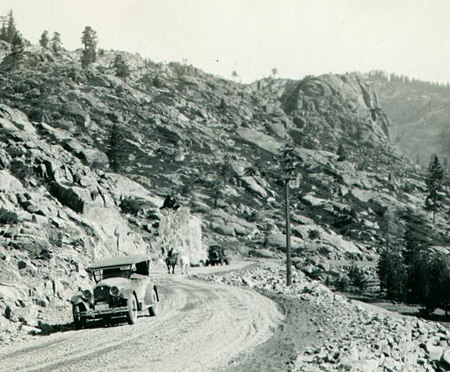
For those who like to do their own research, visit the Special Collections Library at the University of Michigan, which houses the original LHA’s archival materials and photos like the one at top [“New road between Donner Lake and Summit, California” (lhc0135)].

Early Ford V-8s arrive at LH's Western Terminus

August 6, 2008

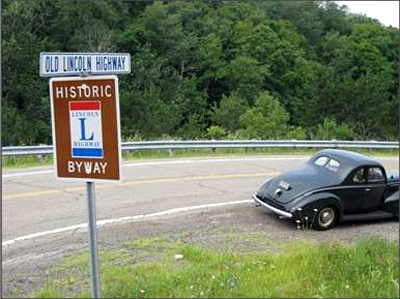
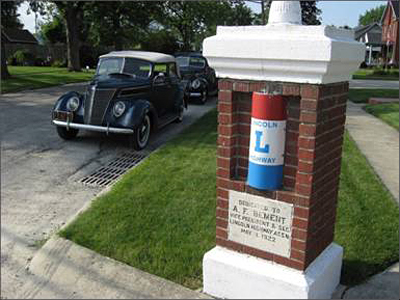
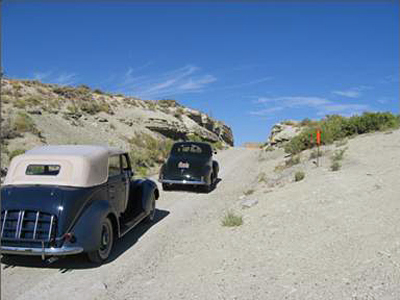
George Garrett and Tom Shields, driving their 1930s Fords across the US on the Lincoln Highway, have reached the Western Terminus in San Francisco. Including some detours to car shows and museum, they traveled 4,446 miles in 20 days (not counting their biggest detour to Detroit). That’s about 222 miles per day. George says they got about 19 miles per gallon at a time when gas was about $4 per gallon. Here are some images from their blog, which has some fun stories of their adventures:

Above two are Ohio.

Hard traveling on the road west of Rock Springs, Wyoming.

The goal is achieved – San Francisco!

New SCAJ; two historic roads conferences in SW

August 5, 2008

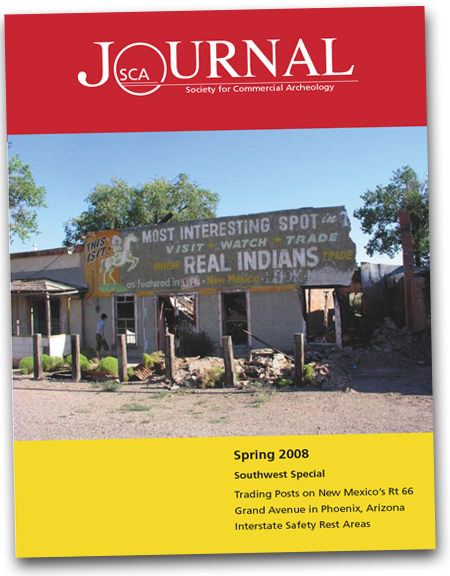
The new Society for Commercial Archeology Journal (which I design) highlights the American Southwest in anticipation of two conferences set for in September. Both events are the same weekend in Albuquerque, New Mexico, near the historic intersection of the 17th-century El Camino Real de Tierra Adentro and US Route 66.

Preserving the Historic Road 2008
September 11-14
www.historicroads.org
The 6th Preserving the Historic Road conference offers a choice of 3 tours or a field session on the 11th, sessions at the historic Kimo Theatre and Hotel Albuquerque on the 12th such as “Reality and Myth-Building on Historic Highways,” “Lodging Challenges Along Historic Highways,” and “Before the Interstate: The Perpetuation of Indigenous Roads.” The 13th will have more sessions on bridges, trail traces, and historic corridors.

Click the logo to enlarge.

Southwest Detours
September 10-13, 2008
www.sca-roadside.org
The SCA’s conference will explore automobile tourism in the southwest, with paper sessions and tours:

Thursday, Sept. 11
Bus Tour along Route 66 to Gallup, NM
The tour to Gallup along Route 66 includes Dead Man’s Curve, neon signs in Grants (“Uranium City USA”), the Continental Divide, trading posts in Gallup, and lunch at the famous 1937 El Rancho Hotel (“Home of the Movie Stars”), built by the brother of movie mogul D.W. Griffith. (includes tour book and lunch)

Friday, Sept. 12
Symposium and Paper Sessions

Saturday, Sept. 13
Bus Tour to Mountainair and Socorro, New Mexico
The old Route 60 tour will include sites spanning over three centuries. It will take us along some of the oldest alignments of Route 66 in south Albuquerque, and include lunch in Mountainair at the Pop Shafer Hotel, Restaurant and Curio Shop, with a tour of Shaffer’s Rancho Bonito. Socorro highlights will include stops at a southwestern trading post, the old plaza, and a roadside produce stand during chili season!

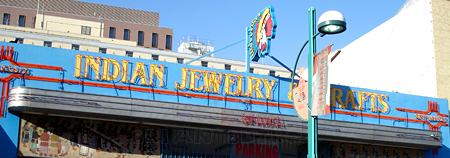
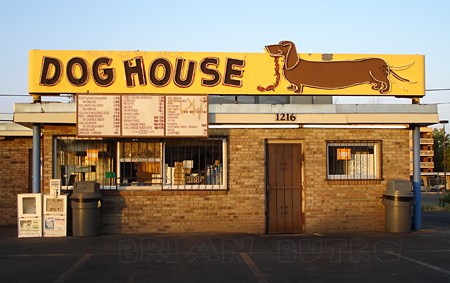
Here are some roadside highlights in town that I snapped early one morning:

Though centered around Route 66, you’ll meet many Lincoln Highway fans and historians, and see amazing roadside attractions, trading posts, and restaurants (the Frontier is a must-stop).

Videos trace Loneliest Road across Nevada

July 31, 2008

YouTube offers many views of US 50 in Nevada, dubbed The Loneliest Road in America, much of which follows the Lincoln Highway. Here are some time-lapse videos, heading west, that show that, if the road is not exactly deserted, it can be lonely.

Ely (look for the Hotel Nevada on the left at 0:42) westward almost to Eureka:

Then westward to Austin (arriving about 2/3 in):

Want those two trips all at once (but kinda fast)?

Since Eureka was lost in the editing of the above, maybe this will make up for it – all I’ll say is “Rawhide” gets sung at the town’s wacky Keyhole bar, right on the Lincoln Highway: