Summer 2009 will be the centennial of the first woman to drive across America, Alice Ramsey. In honor of that groundbreaking event, Emily Anderson and a co-pilot will leave New York City on June 9, 2009, for San Francisco. They’ll follow the same route over 41 days in the same type car as Alice used (a 1909 Maxwell, restored by Emily’s dad), with celebrations along the way. Here’s a 4-minute trailer about the next Alice’s Drive.
Posts Tagged ‘travel’
Film – Recreating Alice Ramsey's 1909 drive
February 2, 20082008 LHA conference info online at two sites
January 31, 2008Fans of historic roads will want to attend the 2008 Lincoln Highway Association conference in Evanston, Wyoming, this June. Conference coordinator Shelly Horne has begun posting info at www.lincolnhighwayconference2008.com about the area and what attendees will see. He will add more in the coming weeks.
Conference registration and art show information can be found at:
www.lincolnhighwayassoc.org/conference/2008
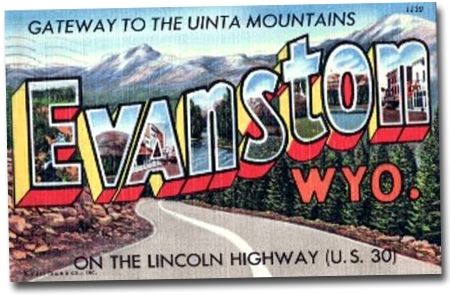
Here is the basic information:
Lincoln Highway Association 16th Annual Conference
“Rails, Trails, and Highway Tales”
Best Western Dunmar Inn, 1601 Harrison Drive, Evanston, WY
Tuesday, June 17 — Welcome Dinner buffet
Wednesday, June 18 — West Tour to Echo Canyon
Thursday, June 19 — Seminars; Awards Banquet
Friday, June 20 — East Tour to Ft. Bridger and Granger; BBQ dinner in tent
Saturday, June 21 — Mountain Man Breakfast at roundhouse, rides on UPRR turntable; annual business meeting
LH Around Chicago book due in March ’08
January 29, 2008The Lincoln Highway Around Chicago by Cynthia L. Ogorek will be published this March 17 as part of Arcadia Books’ Images of America series. The 128-page paperback book will have more than 200 illustrations from Geneva, Illinois, south and eastward to just over the Indiana line at Schererville so that the famous Ideal Section could be included. Early history is augmented by preservation efforts of today.
Price is $19.95 or pre-order from Amazon for $13.59 by clicking here

Restored Colo Motel Reopens in Iowa!
January 26, 2008Closed for 12 years, the Colo Motel has reopened, giving Lincoln Highway tourists a new-style, old-fashioned lodging option in central Iowa. It is part of the Reed/Niland corner complex that includes a cafe and gas station, both also restored. The cafe is operating and is a must-stop itself; the 1920s gas station is for display only but is set to house a country-style store.
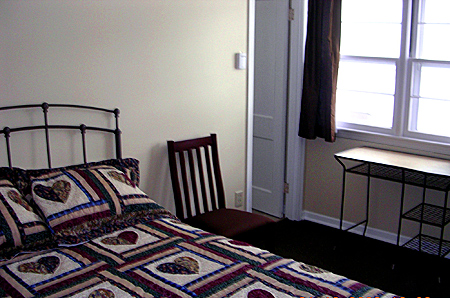
The motel’s six rooms rent for an affordable $49.99 per night or $175 for five consecutive nights. Scott Berka, Colo city clerk, says that other than “waiting for some of the furniture to arrive,” the rooms are complete with cable TV, wireless internet, central air, pillow-top mattresses, and room service from the café. The Colo is on the forefront of restoring mid-century motels for 2-lane tourists, and also gives locals a lodging option for out-of-town guests.

Above: Stuart Huse, one of the owners of Flat-Top Concrete & Construction, the prime contractor for the project, finishes the woodwork. Above photos courtesy Scott Berka.
The roadside one-stop opened about 1920 at the corner of Lincoln Highway and US 65, the old Jefferson Highway, but declined in recent decades as the old road was bypassed. The restoration is a project of Colo Development Group and the City of Colo; it has cost nearly $1 million including $663,000 in grant funding (from the Iowa DOT’s and Federal Highway Administration’s Transportation Enhancement Funding) and about $270,000 in local donations.The one-stop

An article in the Nevada [Iowa] Journal reported on the opening, and quoted Berka and Sandy Wilfong, manager of Niland’s Café and now the Colo Motel. She praised the retro-stryle rooms and appointments such as wrought iron headboards and curtain rods, and quilts on the beds. Come Spring, Wilfong hopes to have a farmers market at the corner on Saturdays.
The motel is at 18 Lincoln Highway in Colo. Reservations are taken through Nilands Cafe: (641) 377-3663. To learn more about the complex, go to the Colo Iowa web page and click Reed/Niland corner at the bottom of the left-hand column.
California LHA gives sign honoring Nut Tree
January 23, 2008During the California Chapter LHA meeting on January 12 at the new Nut Tree complex on I-80 in Vacaville, Fentons Creamery restaurant was presented with a Historic Lincoln Highway sign by chapter president Norm Root. It will be displayed along with artifacts and photos from one of the best-known attractions in California, The Nut Tree.

Above: Jim Braden, general manager of Fentons Creamery, receives a complimentary Historic LH sign from LHA CA chapter president Norm Root. Photo by Gary Kinst
Fentons traces back to 1894, and has been serving the San Francisco Bay Area at 4226 Piedmont Avenue since 1961. This second location opened here in 2007; it resembles a 1940s ice cream parlor with marble counters and tables, retro booths, and Art Deco lighting.
The Nut Tree was founded in 1921 as a fruit stand under the shade of a walnut tree and grew into a complex of restaurants, gift shops, entertainments, a railroad, and even an airplane runway.

Since The Nut Tree closed in 1996, locals have missed it, so redevelopment plans include nods to the attraction. At the free Nut Tree Family Park, the original Nut Tree train winds through the landscape and past the Harvest Express roller coaster, the I-80 Traffic Jammers bumper cars, California Carousel, and other custom kid rides. Click on the map below to download a large PDF version.

The childhood home of The Nut Tree founder, Harbison House, built 1906-07, has been moved 1,000 feet south to the 3.7 acre family park behind the retail complex. It is being preserved by the Vacaville Museum and will include memorabilia showing the history of the Nut Tree and California. The development also includes lodging, resdiences, offices, and even the Nut Tree Bocce Grove, a two-acre park patterned after the grand public gardens of Europe containing 8 international regulation bocce courts. Visit the Vacaville CVB for more about the Nut Tree development.
Another LHA sign dedication is planned for sometime in the next month at the Summit Garage in Altamont.
Art, photo show to debut at LHA's 08 conference
January 22, 2008The 2008 Lincoln Highway Association conference in Evanston, Wyoming, June 17-21, 2008, will feature a new attraction: the Lincoln Highway Art & Photo Show.
Coordinator Kell Brigan, who is also Secretary/Treasurer of LHA’s California Chapter, says “This exhibition is a chance for artists to share their work with conference-goers who also understand the highway’s appeal, and to meet other Lincoln Highway artists and photographers as well.” Below is a plein air watercolor by Brigan herself showing the Lincoln Highway at Adams & Porter roads in Dixon, California, and the town’s water tower.
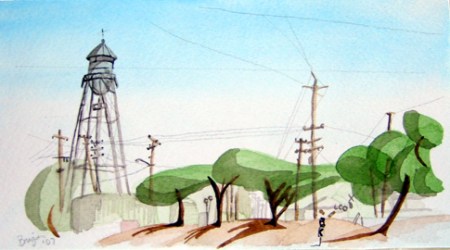
Brigan recalls,
While I was working on the painting (about 10:00 AM on a Sunday in the parking lot of a shop that specializes in maintaining & repairing livestock trucks), a fellow came out of a nearby house (next to a great old building from the ’20s), and said, “OK, I give up. Why, of all things, are you painting the Dixon water tower?!” I explained about painting spots along the highway in California. Turns out his mom, who came by later with the family dog, had helped run one of the “Lincoln Highway Garages” on the same spot in the ’30s.
Visit http://www.lincolnhighwayassoc.org/conference/2008/art_show.shtml for more information and an application, which is due by April 10, 2008. Note that this inaugural show is only an exhibition: no judging or prizes.
Suzie Burger rehabs rare Sacramento gas station
January 17, 2008Just a block from the official route of the Lincoln Highway in Sacramento, Suzie Burger is a new restaurant in an old gas station (see red circle on map below). The double-canopy station at 29th and P streets was previously an Orbit station, but looks like it was probably built as a Phillips 66 in the 1960s (see the Spring 2005 Society for Commercial Archeology Journal for more on their history).

The above photo from Tom Spaulding, as seen on Flickr, shows the station’s two canopies, somewhat rare. Tom has more than 7,000 images on Flickr, and check out Tom’s blog for tons more great photos and info from that region.)
The station was later converted to Tune-up Masters, then closed and declined into a local eyesore. Locals are thrilled with the rehab, though early reviews on the food are mixed (though in fairness, three months is a normal period of adjustment). The building is not listed in any historical register so the new owners are to be commended for saving, reusing, and reviving architectural details. They have other high-end restaurants in the area. The original Suzie’s drive-in at 24th Street decades ago; Benny Ogata, son of the founders of the original, is an investor and was helping cook opening day.

The Sacramento Bee reports that a basic Suzie Burger is $1.95, cheeseburger $2.95, each one served with dill pickle and carrot sticks. Grilled onions, pickled jalapenos, sauerkraut, pastrami, chili, and a fried egg range from 45 cents to $1.95 each. The menu also includes hot dogs, chili, and cheesesteaks Milkshakes and soft-serve cones also are served. The cafe red-and-white color scheme includes “Suzie” caricatures by Sacramento artist Matt Rallens. The Suzie’s website has nothing yet but the address. The map is from the LHA Driving Maps CD, available through the LH Trading Post.
Jean Shepherd visits Little America, 1971
January 11, 2008“You ever wake up sometimes maybe around 3 o’clock in the morning, you look up at the ceiling, the blackness – you feel that terrible urge to see it all, to get on the road. To smell the pine trees, watch all the rivers, see all the skies, climb all the hills….”
Jean Shepherd was a humorist known to millions through books, radio, and live shows, but is best known to modern audiences for co-writing and narrating (as grown-up Ralphie) the 1983 film A Christmas Story. He also had a very popular TV show: Jean Shepherd’s America, produced by WGBH (PBS) Boston, aired 13 shows in 1971 and 13 in 1985. (They’re available on DVD, or learn more here.) This clip, from the last show of the 1971 season, is the final segment and end credits. Jean and his crew are snowbound in Wyoming at Holding’s Little America motel and truck stop, along the Lincoln Highway and I-80. During the 4-minute video, he talks, in his measured prose, about life on the road, and the American urge to keep moving.
81st Anniversary of Federal Highway Numbering
January 2, 2008“Windy City Road Warrior” Dave Clark (author of Exploring Route 66 in Chicagoland and Route 66 in Chicago) posted an interesting story about the 81st anniversary of the federal highway numbering system. Although the highway plan was finalized in November 1926, the public announcement was delayed until January 1, 1927. Clark references a Chicago Tribune article from January 2, “U.S. Marks Ten Main Roads With Route Numbers” that explains the system that has been used ever since for federal highways: east-west route have even numbers, north-south have odd, with lowest numbers in the north and east. The 10 main transcontinental route numbers ended in 0, and the main N-S route numbers ended in 1 or 5. A tentative plan had been submitted to the American Association of State Highway Officials (AASHO) in November 1925, followed by a year of wrangling and revisions. Standardized signage was also adopted.
All this was in response to the growing tangle of named highways and their informal, inconsistent markings. It did not release funds for the highways; the focus was on standardized naming and marking, The only nod to financing upgrades was to “unimproved sections of which will be given priority in improvement,” if and when any were made.

Above: A Gulf map of PA, late 1920s, shows the LH numbered as both US 30 and PA 1. The state numbers were discarded after just a few years. Seen here is from roughly Breezewood to Lancaster.
A map of the plan approved in November 1926 can be seen here. And more about the federal numbering system can be found in “From Names to Numbers: The Origins of the U.S. Numbered Highway System,” a thorough recounting by Richard F. Weingroff, Information Liaison Specialist, Federal Highway Administration.
Though named trails were not banned or eliminated, none of the multi-state ones got a single number, but rather were broken into several numbers. Named highway orgnizations could see that the plan would render their roads obsolete; the LHA grudgingly accepted the plan but asked for consideration of being designated route number 30. It got it for much of the way, originally from Philadelphia to Salt Lake City. Still, as Weingroff writes, LHA president Henry Joy
was so bitter that he wanted to send, but did not, a note to President Coolidge, his Cabinet, and all Members of Congress:
“The Lincoln Highway, a memorial to the martyred Lincoln, now known by the grace of God and the authority of the Government of the United States as Federal Route 1, Federal Route 30, Federal Route 30N, Federal Route 30S, Federal Route 530, Federal Route 40 and Federal Route 50”
The New York Times expressed similar sentiments: “The traveler may shed tears as he drives the Lincoln Highway or dream dreams as he speeds over the Jefferson Highway, but how can he get a ‘kick’ out of 46, 55 or 33 or 21?” Little did they know…!
Wyoming's Lincoln Highway Educational Series
December 31, 2007The Wyoming State Parks and Cultural Resources has produced 20 short educational videos on the Lincoln Highway and posted them on veoh. Each one, typically a half-minute long, looks at a theme by using some facts or stories. The videos mostly use pans of still photos, many from the LHA archives. Click here for the series to start—once you do, they play consecutively, or see them all in outline form here. Here’s a screen capture of the Intro video (with a picture of the LHA’s Henry Joy and Austin Bement stuck in Nebraska):

Unless I’ve missed more of the content, there is no accompanying material on veoh or on the state website to tell how best to use these or what materials were referenced, leaving a gap if they’re for education, and leaving helpful resources uncredited. For example, quotes from Thornton Round about the Rock Springs camp and the sounds while camping at night are likely culled from Gregory Franzwa’s Wyoming book. Or in discussing Navigation, they quote from what is said to be an LHA road guide, but the distinctive “Turn left around the shearing pens” material is actually from a 1913 Packard guide to the road, which is quoted in my Greetings from the Lincoln Highway book.
Here are the episodes:
1) A Brief Introduction – :37
2) What Started It – :38
3) Henry B. Joy – :16
4) The Virginian – :15
5) US Army Convoy – 1:34
6) Rock Springs – 1:07
7) Laramie – :13
8) Road Hazards – :40
9) Plains Hotel – :15
10) Mechanics – :34
11) Wyoming – :42 (though the quote is about western Nebraska)
12) Crash – :29
13) Camp – :16
14) Railroad – :45
15) Church Buttes – :24
16) Navigation – :58
17) Evanston – :23
18) Fences – :50
19) Camping – :17
20) Flat Tire – :19



 Lincoln Highway News