Archive for the ‘travel’ Category

LH historian & author Franzwa recovering

August 14, 2008

Historian and author Gregory Franzwa has been off the road the past few weeks as he underwent surgery in Salt Lake City for suspected lung cancer. As he relates, on July 29, surgeons “removed a pie-shaped (pumpkin, not lemon meringue) slice from the upper lobe of my right lung” that proved to be malignant but does not require treatment. His wife and road trip companion Kathy is taking care of him – as he says, “she’s in charge of cutting up my Jello.”

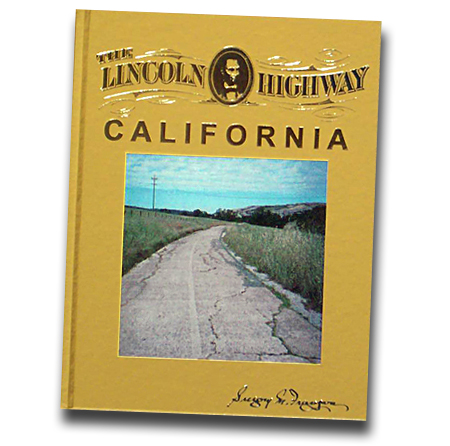
Franzwa was instrumental in founding both the Oregon-California Trails Association and the modern Lincoln Highway Association. His series of state-by-state guidebooks to the Lincoln Highway began with Iowa in 1995; books to the west coast are completed and he is now working on states to the east. His Patrice Press carries many more books he has authored about western trails – and at merely 82, he says he has lots more books to write.

Iowa Motor Tour cruises cross-state to success

August 13, 2008

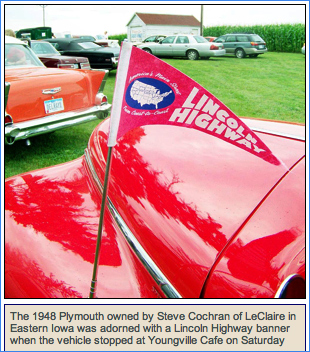
Judging by the glowing follow-up newspaper stores, the 2008 River to River Motor Tour sponsored by the Iowa Lincoln Highway Association was a big success. The 3-day tour started Friday morning in Clinton and crossed the state, ending Sunday afternoon at Missouri Valley. Tour director Jeff LaFollette said there were 55 vehicles and about 110 people in the caravan as it moved west.

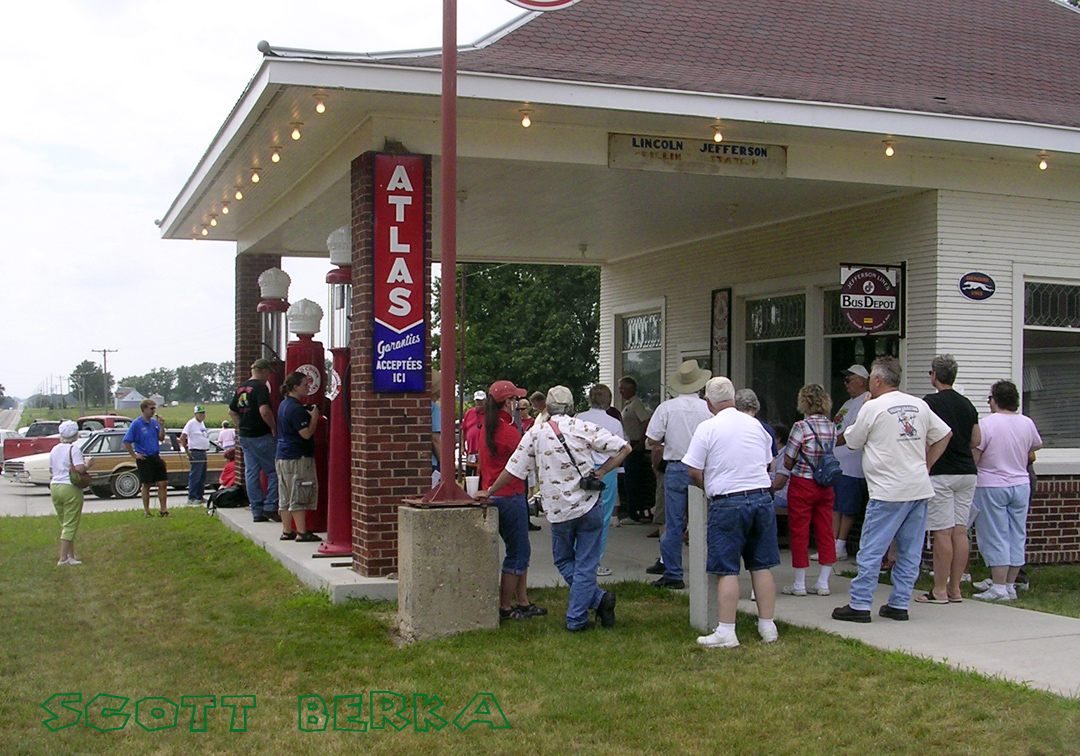
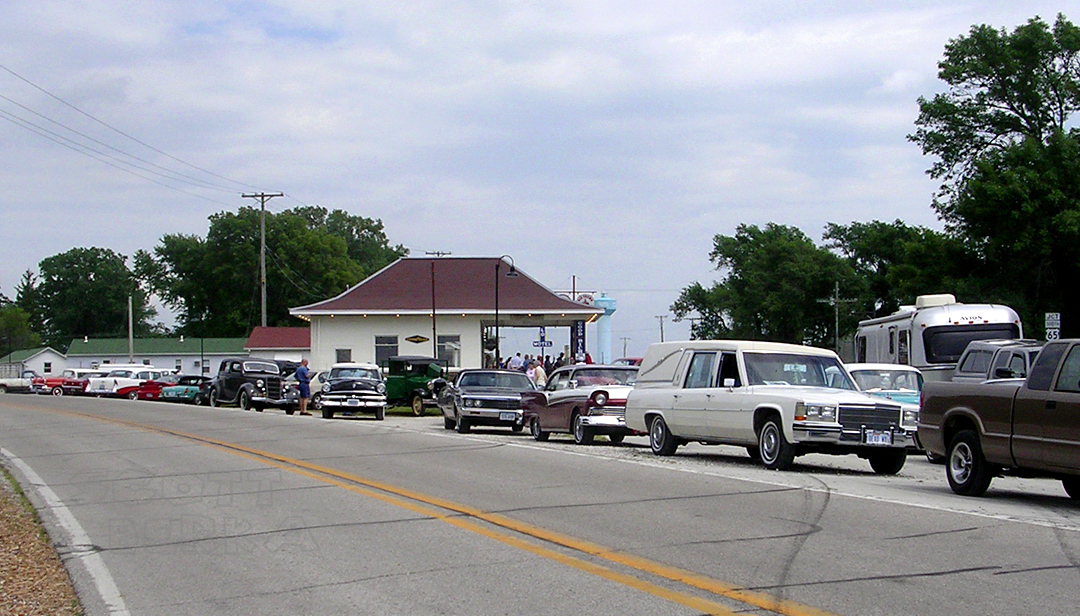
Two photos from Colo City Clerk Scott Berka show tour-goers at Reed/Niland Corners, home to a restored cafe, gas station, and motel. The café had pie and coffee for the travelers on Saturday. The view of the gas station shows LaFollette (in blue shirt) giving instructions by microphone. The second shows the road behind the complex lined with vintage vehicles. CLICK them to see LARGER:

Both The [Ames] Tribune and the Cedar Valley Daily Times ran stories about the tour; here’s a screen shot from CVDT:

Denny visits Terminus on West Coast adventure

August 12, 2008

Well-known roadie Denny Gibson has been cruising down the Pacific Coast this week and passed through San Francisco the past couple days. Like producer Rick Sebak, he stayed overnight at the Pacific Heights Inn and reports it to be good and priced right. Yesterday morning he went in search of the last original 1928 Lincoln Highway concrete post. With a little help from me and Sebak’s blog and video diary, he found it with the surrounding bushes cut back to better reveal the post: “Yep, it’s so much easier that I walked by it twice without seeing it. I was looking for and into shrubs and certainly entertaining anyone who was watching.”

Then he cruised to the nearby Terminus marker, also an LHA concrete post but this one a modern reproduction.

Then it was off to the Cliff House to see where dedicated transcontinetalists really ended their trip – at the ocean, dipping their tires. (With the beach now closed to cars, there was no dipping for Denny’s tires.) Read more about his adventures from this trip, with tons of roadside info and images, at www.dennygibson.com/. (Note, his blog is a couple days behind so no LH mention is posted yet.)

Filming the Lincoln Highway special around town

August 11, 2008

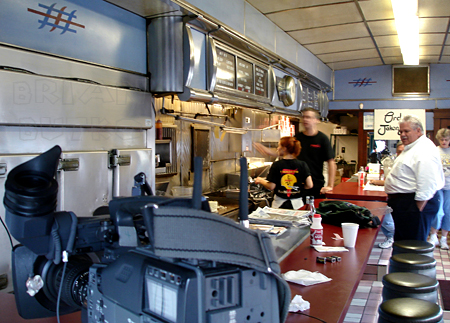
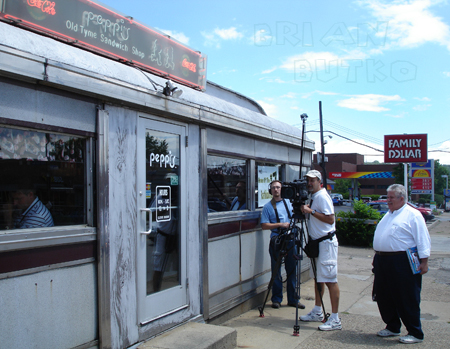
Friday found me with PBS producer Rick Sebak as he filmed around Pittsburgh for his upcoming special, A Ride Along the Lincoln Highway. First up was Peppi’s Diner (known to locals as Scotty’s or Charlie’s) where we talked about the highway and places to see around town.

Then it was on the road to find those places, from the Mullins-made Lincoln statue just down the road in WIlkinsburg …

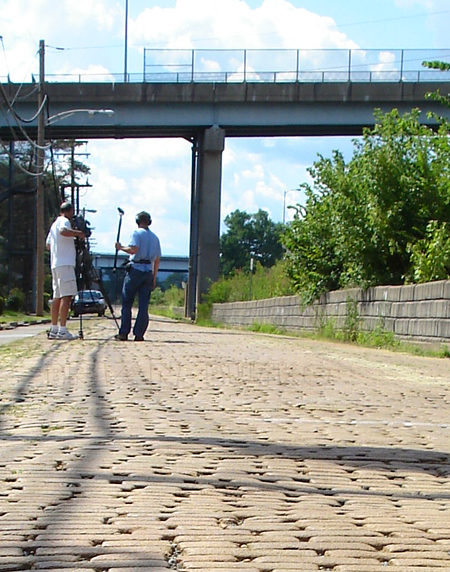
… to the yellow-brick section of old road in Glenfield.

Camera and sound were handled by Bob Lubomski and Glenn Syska. They do tons of work trying to get the best angle and sound and lots of other things that, when done right, nobody notices. (Same for the crew that will edit the video and sound in a couple months.) Bob and Glenn even climbed up on that overpass to get aerial shots of the road.

Read more of their adventures on Sebak’s blog and tune in two days before Halloween to see the show on your local PBS station.

Texaco's 1929 Lincoln Highway ad campaign

August 8, 2008

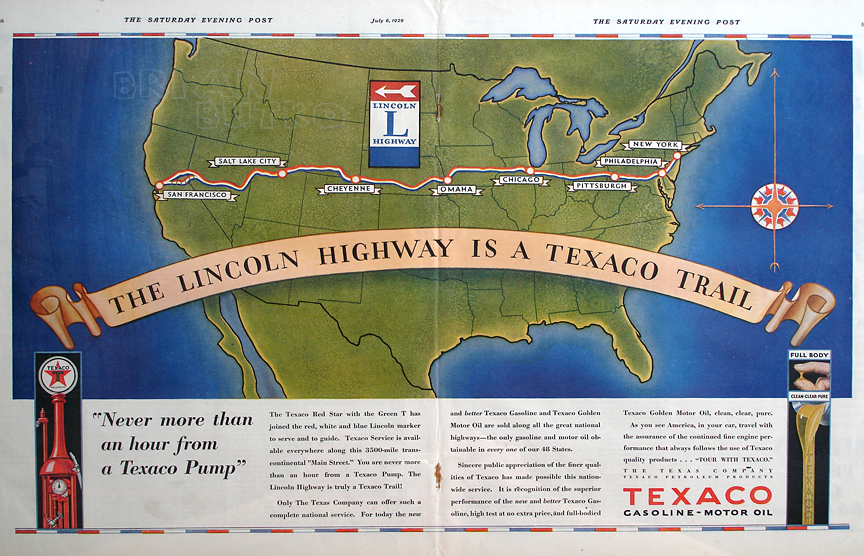
In 1929, Texaco ran an ad campaign centered on the Lincoln Highway. Advertisements ran in their member magazine, little strip maps were distributed, and spreads like this one in the Saturday Evening Post pointed people to the cross-country route. This was a bit odd considering the LHA had ceased active operations the year before, but perhaps that’s why the company chose to honor what it called a “transcontinental “Main Stree,'”

CLICK the map to see it larger.

Lincoln Highway history, the next generation

August 7, 2008

In recent years, the Lincoln Highway is returning to the mainstream. Wildly popular in the 1910s, it endured low name recognition through the 1960s-80s, but is again being embraced by an ever-wider audience. However, as the highway’s history is disseminated and simplified, it is also being generalized into fiction.
I read a blog stating “Interstate 80 derived from the old Lincoln Highway.” And a web site: “Lincoln Highway was the first major highway developed in 1915…. During the 30’s and the 40’s it became Highway 30 and then when Eisenhower promoted the interstate highway system it became Interstate 80.” Perhaps I-80 is descended from the LH in spirit or along its E-W corridor, but those looking for accuracy should disregard the above statements.

Another: “Because it would be built with private donations and not by the government, a friend suggested Fisher call the new road the Abraham Lincoln Highway, a name sure to open the pocketbooks of patriotic Americans.” Not exactly wrong but not necessarily correct.

And: “In the 1920s, the Lincoln Highway, the first transcontinental paved highway, opened to much fanfare…. The old Lincoln Highway was eventually replaced by US 40 and then by Interstate 80.” Nevermind the 40 and 80 missteps, the “first” claim can quickly polarize. Were other transcontinental paths named, marked, and promoted before the LH? Yes. Did they sustain that attention and improvement? No. Choose your side but don’t ignore or dismiss the other.

From a video: “See America First was a new concept in 1920.” Perhaps gaining steam then among motorists, the concept dates to the late 1800s and the phrase itself to at least 1906 when a railroad used it; in fact, The New York Times wrote about the rising trend in 1906.

I thought I recognized some phrasing when a reporter recently wrote, “drivers could find small local diners, quaint cozy cabins, prosperous mom-and-pop shops, Art Deco gas stations and colorful roadside attractions.” Yep, she got her history from a line for my Greetings book press release which you can find on Amazon: “diners, neon movie palaces, Art Deco gas stations, ice cream stands, tourist cabins, and colorful roadside attractions.”

Chambers of commerce and tourism agencies are likewise discovering the Lincoln. That’s good for economic growth and preservation, but the story of the highway becomes a bit more generalized, and inaccurate, with each retelling. A recent news article paraphrased a tourism bureau chief: “Historically, Lincoln Highway has been used as a commercial transportation highway, while Route 66 was created for travel and leisure.” This statement takes some narrow modern preconceptions, puts them in a blender, and projects backwards a history that just isn’t true.

There is debate in Illinois whether towns within the LH’s corridor of influence should be included in economic promotions. How specific should we be in defining the LH’s corridor? Only the marked road? Or within a block or business district? Is Chicago “on” the route? Just how literally do we interpret the Proclamation Route? Do we count LH routes that were only promoted locally, but seriously? How about the Feeder Routes? Are those who take sides aware of the larger picture, where a desire for strict interpretation is more a modern focus than a historical truth?

There were many motivating factors behind the Lincoln Highway, but one of them was certainly scenic tourism. In fact, recreational travel promoted as a patriotic duty was probably more fervent in the teens than the 1920s, when Route 66 was established as one of the many numbered federal highways. Regardless, advocates of any of these highways promoted roads for economic advancement, no matter the source. Perhaps the main difference between the two was the LH and other c. 1913 trails were blazing a path of promoting hard-surfaced roads, while by 1926, the benefits of good roads were a much easier sale.

The Lincoln Highway was the most famous road of its day, and remained a popular name and destination decades later, but 66 finally overshadowed it for many reasons. Bobby Troup wrote an enormously popular song about it in 1946. US 66 became a well-traveled route to the West Coast for those looking for hi-tech jobs after WWII. Todd and Buzz rode to fame on the Route 66 TV show in the 1960s, thereby associating the road with potent imagery and mythology. And then there’s that seductive alliteration of the two numbers.

While the LH has come to embody early travel with images of mud, cabin camps, and Model Ts, the later birth of 66 and its postwar popularity finds it associated more with concrete ribbons, neon signs, and tail-finned cars. The LH had those too — probably more since it’s a third longer — but that imagery was first and wisely latched onto by 66 boosters in the 1980s. Route 66 became the embodiment of simpler, happier times, a symbol for adventure, and it soon became the setting for any ad, commercial, or clothing line that wanted to be retro chic. Places along 66 sometimes embrace the 1950s/Marilyn/car hop nostalgic marketing to the point of overload, but many tourists enjoy exactly that special sense of place, especially strung out over a couple thousand miles.

The Lincoln Highway’s resurgence similarly began in the 1980s, sparked by Drake Hokanson’s book and spread by the national LHA in the 1990s, then entering public forums in recent years as books and magazines have spread the word. While recent restoration efforts on 66 have focused on gas stations and roadside attractions, LH folks are just reaching that point, having first concentrated on saving the infrastructure itself (such as the tiny concrete bridges in Iowa). A quick glance back might give the impression that the LH had a more serious genesis, while 66 was built for fun, but that’s just not the case. The same goes for the other above statements.

For a solid overview of Lincoln Highway history, check out Hokanson’s beautiful The Lincoln Highway: Main Street Across America.

For a recent in-depth look at 66, try Arthur Krim’s Route 66: Iconography of the American Highway.

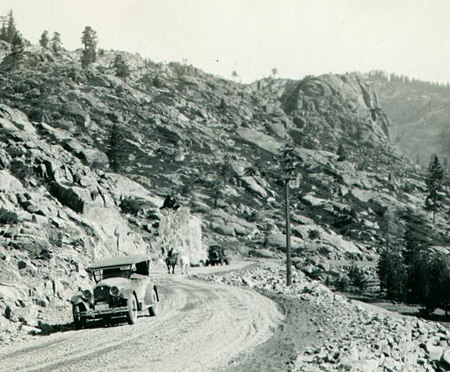
For those who like to do their own research, visit the Special Collections Library at the University of Michigan, which houses the original LHA’s archival materials and photos like the one at top [“New road between Donner Lake and Summit, California” (lhc0135)].

Early Ford V-8s arrive at LH's Western Terminus

August 6, 2008

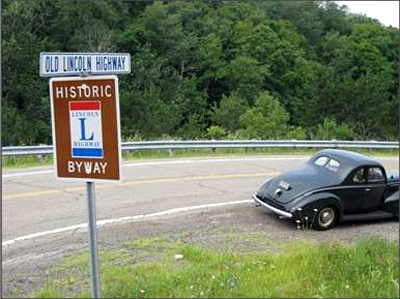
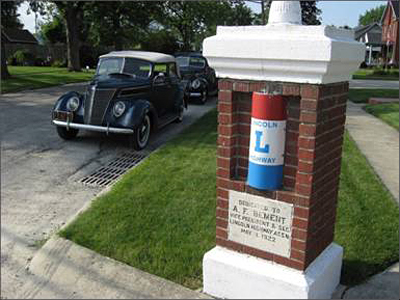
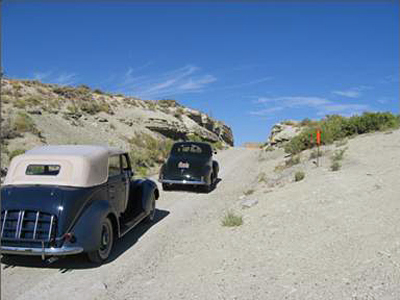
George Garrett and Tom Shields, driving their 1930s Fords across the US on the Lincoln Highway, have reached the Western Terminus in San Francisco. Including some detours to car shows and museum, they traveled 4,446 miles in 20 days (not counting their biggest detour to Detroit). That’s about 222 miles per day. George says they got about 19 miles per gallon at a time when gas was about $4 per gallon. Here are some images from their blog, which has some fun stories of their adventures:

Above two are Ohio.

Hard traveling on the road west of Rock Springs, Wyoming.

The goal is achieved – San Francisco!

New SCAJ; two historic roads conferences in SW

August 5, 2008

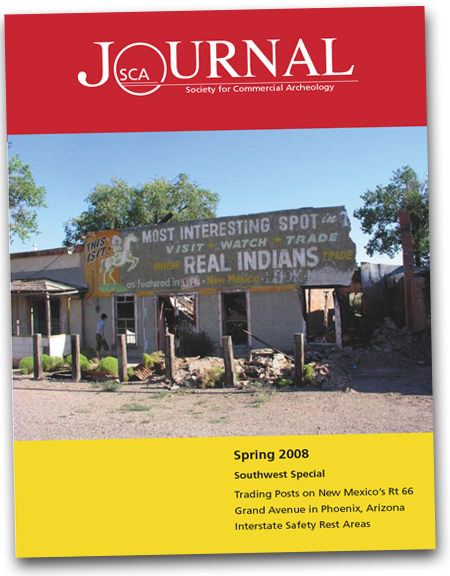
The new Society for Commercial Archeology Journal (which I design) highlights the American Southwest in anticipation of two conferences set for in September. Both events are the same weekend in Albuquerque, New Mexico, near the historic intersection of the 17th-century El Camino Real de Tierra Adentro and US Route 66.

Preserving the Historic Road 2008
September 11-14
www.historicroads.org
The 6th Preserving the Historic Road conference offers a choice of 3 tours or a field session on the 11th, sessions at the historic Kimo Theatre and Hotel Albuquerque on the 12th such as “Reality and Myth-Building on Historic Highways,” “Lodging Challenges Along Historic Highways,” and “Before the Interstate: The Perpetuation of Indigenous Roads.” The 13th will have more sessions on bridges, trail traces, and historic corridors.

Click the logo to enlarge.

Southwest Detours
September 10-13, 2008
www.sca-roadside.org
The SCA’s conference will explore automobile tourism in the southwest, with paper sessions and tours:

Thursday, Sept. 11
Bus Tour along Route 66 to Gallup, NM
The tour to Gallup along Route 66 includes Dead Man’s Curve, neon signs in Grants (“Uranium City USA”), the Continental Divide, trading posts in Gallup, and lunch at the famous 1937 El Rancho Hotel (“Home of the Movie Stars”), built by the brother of movie mogul D.W. Griffith. (includes tour book and lunch)

Friday, Sept. 12
Symposium and Paper Sessions

Saturday, Sept. 13
Bus Tour to Mountainair and Socorro, New Mexico
The old Route 60 tour will include sites spanning over three centuries. It will take us along some of the oldest alignments of Route 66 in south Albuquerque, and include lunch in Mountainair at the Pop Shafer Hotel, Restaurant and Curio Shop, with a tour of Shaffer’s Rancho Bonito. Socorro highlights will include stops at a southwestern trading post, the old plaza, and a roadside produce stand during chili season!

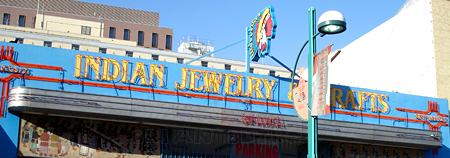
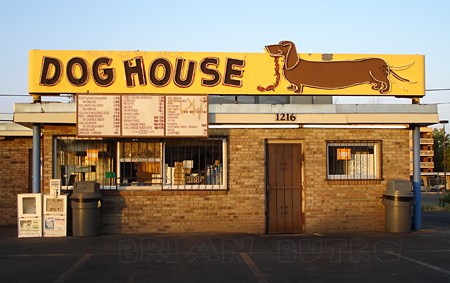
Here are some roadside highlights in town that I snapped early one morning:

Though centered around Route 66, you’ll meet many Lincoln Highway fans and historians, and see amazing roadside attractions, trading posts, and restaurants (the Frontier is a must-stop).

Lessons from a Route 66 motel makeover

August 1, 2008

Businesses along old 2-lanes such as the Lincoln Highway often struggle to compete with chains that locate at Interstate off-ramps, but Ron Warnick reports on his Route 66 News about a non-chain motel in Barstow, California, that has found a way a pretty basic way to attract tourists. The story from the city’s Desert Dispatch notes that a simple image makeover instantly began attracting travelers who otherwise were passing by. For all those independent motels struggling in the face of brand-names that feature oodles of amenities and AAA ratings, it’s proof that business can be improved by attending to the look and cleanliness of a place.

Their current property, the Topper Motel on West Main Street, is popular with people, mostly locals, owner Ken Patel said, needing a room for more than a couple of nights. But tourists running down Route 66 passed right by and rarely stopped to rent rooms for just a night or two.

The Patels’ solution: Renovate the west side of their property, paint it the appealing color of an orange Creamsicle and slap a new name, The Sunset Inn, over the office….

Ken said problems with longer staying customers on the Topper side of the business made him consider ways to bring in shorter-staying out-of-towners. He said the rooms where people stayed for weeks or months at a time were often unkempt, dirty and negatively effected the entire appearance of his motel.

The Sunset looks like a completely different motel from the Topper sitting next to it. The rooms are crisp and clean and the parking lot features a small courtyard and desert landscaping. Day Manager Bill Snyder said the remodel has been so successful with the Sunset that there are plans to give the Topper the same treatment soon.

A story in a 1950s diner industry magazine advised owners to pave their decrepit parking lots. Many diner owners howled at the idea, saying customers were more concerned with the food that the lot. Yes, if you know a restaurant has good food, you’ll overlook the shortcomings, maybe even calling them “charming,” but for those not familiar with a place – as most travelers aren’t – they’ll pass by a run-down motel or restaurant. In the same vein, would you buy a beat-up used car or one that looked cared for?

Videos trace Loneliest Road across Nevada

July 31, 2008

YouTube offers many views of US 50 in Nevada, dubbed The Loneliest Road in America, much of which follows the Lincoln Highway. Here are some time-lapse videos, heading west, that show that, if the road is not exactly deserted, it can be lonely.

Ely (look for the Hotel Nevada on the left at 0:42) westward almost to Eureka:

Then westward to Austin (arriving about 2/3 in):

Want those two trips all at once (but kinda fast)?

Since Eureka was lost in the editing of the above, maybe this will make up for it – all I’ll say is “Rawhide” gets sung at the town’s wacky Keyhole bar, right on the Lincoln Highway: