The crash of United Flight 93 on September 11 changed Somerset County, Pennsylvania, in many ways. The curious instantly began streaming to the site just off the Lincoln Highway/US 30, and entrepreneurs began servicing the visitors. The western of the two access roads from Route 30 crosses an original alignment of the Lincoln. A temporary memorial continues to draw visitors, but the National Park Service has a larger memorial planned.
An article in the Daily American reports that local coal trucks are often involved in accidents, and when the Flight 93 National Memorial opens after 2011, US 30 is expected to carry as many as 400,000 more travelers a year. The Flight 93 National Memorial Corridor Study identified a preferred route to guide visitors to the memorial, which ultimately has to travel Route 30. At two public meetings, locals said the road should be wider, better maintained, and have fewer coal trucks. A traffic engineer said the accidents appear to be “relatively isolated incidents.”
The corridor study concludes that the significant horizontal and vertical curvature of the roadway and the corresponding restrictions on sight distance and the heavy volume of truck traffic make traffic safety a paramount concern. This is especially true for a two-thirds-mile stretch east of the intersection with Old Lincoln Highway, the study reported.
The study counts some 400 vehicles traveling to the site daily, and 900 on weekends. Once the new memorial opens, 400,000 are expected annually before tapering to 230,000.
The entrance will be from a third, more easterly location, where Old Lincoln Highway meets Route 30. The intersection would be reconfigured, probably affecting the remaining buildings from the former Emerald Park tourist camp and tavern. For now, PennDOT is planning improvements east of Stoystown including replacing three bridges, and adding turning lanes at the intersection with Route 403.
Locals responded to the flow of cars by creating yard sales, commemorative objects, and businesses to serve visitors. The photo above shows the Long Vu Motel just west of Reels Corners with a new name and sign promoting it’s connection to 9-11. Adele’s Diner across the road was in the news recently for similarly renaming to the Heritage Highway Restaurant, a nod to the range of history along the Lincoln Highway.
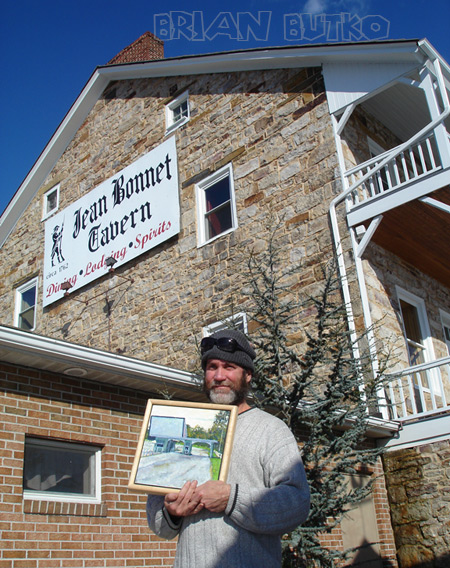
Snow was predicted today but it was clear and bright at I drove the Lincoln Highway to the Jean Bonnet Tavern a few miles west of Bedford, Pa. The 1762 inn is at a fork of two old military paths: Forbes Road (LH/US 30) and Glades Road (PA 31). A 1928 concrete post at the intersection points out how to stay on the Lincoln.
I met Kyle Weaver, editor of my forthcoming Lincoln Highway Companion book. Also spent time with Kevin Kutz, the Lincoln Highway’s leading artist and author of a beautiful book of LH imagery. His artwork of the LH and other roadside attractions can be found in many regional shops. Here he holds his latest, a painting of Haar’s Drive-In Theater in Dillsburg, Pa.
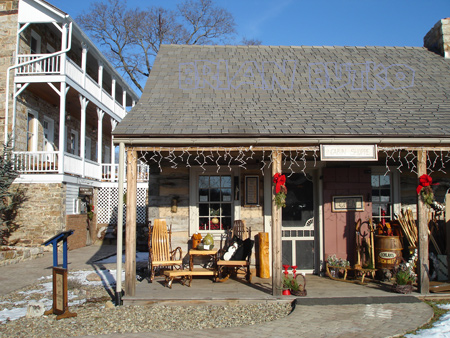
Lunch at the inn was in the bottom-floor dining room. A huge, open fireplace kept the dimly lit room toasty. Afterward we visited the gift shop in a great-looking reconstructed log cabin just a few feet away. They stock lots of locally made products. and many regional books from Stackpole, including my The Lincoln Highway: Pennsylvania Traveler’s Guide. I picked up a jug of local syrup.
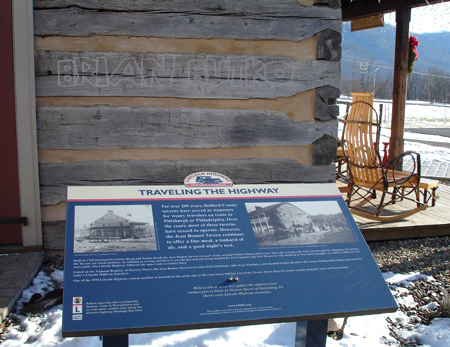
Between the two buildings is a LH interpretive panel courtesy of the LH Heritage Corridor. Next time you’re driving the Lincoln Highway in Pennsylvania, plan to stop by Jean Bonnet for lunch, browsing, and LH history.
Just a block from the official route of the Lincoln Highway in Sacramento, Suzie Burger is a new restaurant in an old gas station (see red circle on map below). The double-canopy station at 29th and P streets was previously an Orbit station, but looks like it was probably built as a Phillips 66 in the 1960s (see the Spring 2005 Society for Commercial Archeology Journal for more on their history).
The station was later converted to Tune-up Masters, then closed and declined into a local eyesore. Locals are thrilled with the rehab, though early reviews on the food are mixed (though in fairness, three months is a normal period of adjustment). The building is not listed in any historical register so the new owners are to be commended for saving, reusing, and reviving architectural details. They have other high-end restaurants in the area. The original Suzie’s drive-in at 24th Street decades ago; Benny Ogata, son of the founders of the original, is an investor and was helping cook opening day.
The Sacramento Beereports that a basic Suzie Burger is $1.95, cheeseburger $2.95, each one served with dill pickle and carrot sticks. Grilled onions, pickled jalapenos, sauerkraut, pastrami, chili, and a fried egg range from 45 cents to $1.95 each. The menu also includes hot dogs, chili, and cheesesteaks Milkshakes and soft-serve cones also are served. The cafe red-and-white color scheme includes “Suzie” caricatures by Sacramento artist Matt Rallens. The Suzie’s website has nothing yet but the address. The map is from the LHA Driving Maps CD, available through the LH Trading Post.
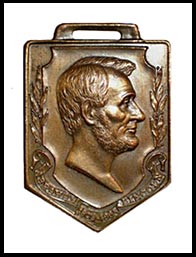
I’ve been working with Lincoln Highway National Museum and Archives director Craig Harmon on a discovery of his: a newspaper in my hometown, the The Pittsburgh Press, held a massive annual contest from 1912-1930 for schoolchildren to write essays about president Lincoln. I’m writing a short piece about his research into the contest, and he continues to dig into the topic from his base in Washington DC.
1928 and 1930 medals from the The Pittsburgh Press contest.
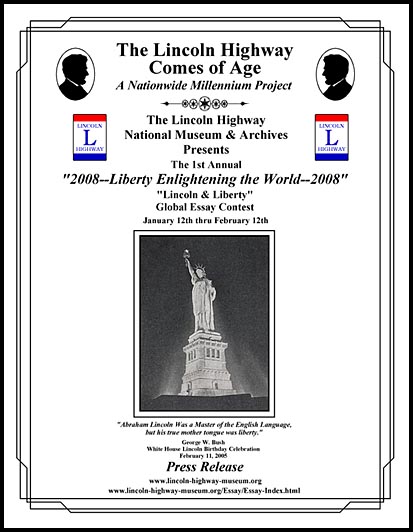
All this talk got Craig thinking, and he’s come up with an even grander plan: a global Lincoln contest sponsored by LHNMA.
Harmon and his vintage fire truck at I-80 exit 184 west of Rawlins, Wyoming, the original site of the Henry Joy memorial.
The contest began January 12 to coincide with the birthday of Carl Fisher, founder of the Lincoln Highway, and inquiries have already come from as far as Korea. There are 6 categories: K-6th grade; 7th-8th; 9th-12th; college students; ages 18 through 59; and ages 60+. Essays should be in English and be no more than 272 words, the number of words in Lincoln’s Gettysburg Address. Entries must be in Word or WordPerfect and e-mailed. Prizes range from Savings Bonds to LHA-stye certificates. Harmon is also looking for donations of prizes or funding to make the event even grander — contact him at prize@lincoln-highway-museum.org if you would like to contribute.
Get complete rules on Harmon’s LHNMA website. Note that LHNMA is now exclusively an online collection of Lincoln info and ephemera.
The front of this postcard says it all – Red Top Diner and Shell Station, Highways 24 & 30 East — City Limits, Fort Wayne, Ind.
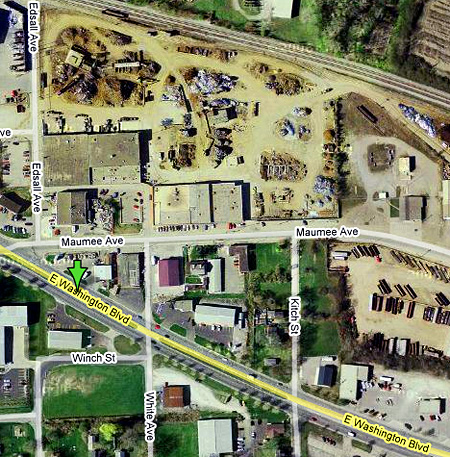
Three train tracks can be seen behind, and the diner looks to be a converted railcar. The automobile is a mid-’30s coupe. Can’t imagine this part of the Lincoln Highway being quite so rural now. Could that be Maumee Avenue right behind the station, and E Washington Blvd in the foreground? The setting looks right and a couple business as seen in this Google aerial view at bottom center and right seem to fit the layout
Anyone know more about Red Top? The picture was taken some 70 years ago, so it’s critical to ask those who might remember before all traces and memories of such places disappear forever.
“You ever wake up sometimes maybe around 3 o’clock in the morning, you look up at the ceiling, the blackness – you feel that terrible urge to see it all, to get on the road. To smell the pine trees, watch all the rivers, see all the skies, climb all the hills….”
Jean Shepherd was a humorist known to millions through books, radio, and live shows, but is best known to modern audiences for co-writing and narrating (as grown-up Ralphie) the 1983 film A Christmas Story. He also had a very popular TV show: Jean Shepherd’s America, produced by WGBH (PBS) Boston, aired 13 shows in 1971 and 13 in 1985. (They’re available on DVD, or learn more here.) This clip, from the last show of the 1971 season, is the final segment and end credits. Jean and his crew are snowbound in Wyoming at Holding’s Little America motel and truck stop, along the Lincoln Highway and I-80. During the 4-minute video, he talks, in his measured prose, about life on the road, and the American urge to keep moving.
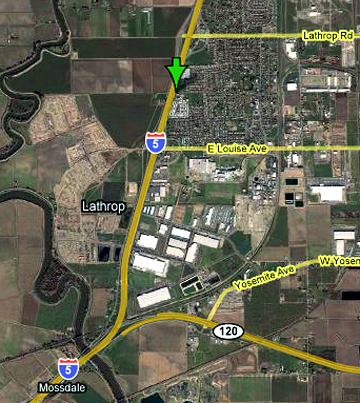
More than 50 officials, friends, and members of the Wiggin Family and Lincoln Highway Association braved chilly temperatures to dedicate a marker that honors both the Lincoln Highway and Wiggin’s Trading Post that opened there in 1924. The ceremony was held Saturday, December 8, 2007, at 15600 S. Harlan Road in Lathrop, California.
Above: At the Lathrop marker dedication, from left to right: Bob Dieterich, James Lin, Gary Kinst, Paul Gilger, Norm Root. Lloyd Johnson, Mike Kaelin, and Carolyn Lignos. The plaques read: (top) Lathrop Sunrise Rotary; (middle) America’s First Coast to Coast Road Established 1913; (bottom) 1924-1967 Site of Original Wiggin’s Trading Post Serving Travelers Along The Lincoln Highway.
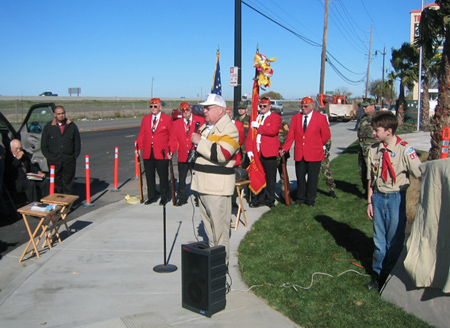
Francis Wiggin’s Granddaughters, Janet and Patti, presented photos to master of ceremonies John Serpa (SEE BELOW), a member of LHA and the Lathrop Sunrise Rotary Club. Marine Corps League Detachment #109 from Modesto presented the colors, and Boy Scout Troup #425 from Lathrop led the singing of the National Anthem and the unveiling of the monument.
A Marine Corps League Certificate of Appreciation for Loyalty and Patriotism was presented by John Treantos, Commandant of #109, to Mr. Dalwinder Dhoot for flying the American flag continuously 24 hours a day, 7 days a week for 14 years at Joe’s Travel Plaza. Dhoot and family own the new Best Western Hotel at the site, and graciously allowed the Rotary to erect the marker. Mr. Dhoot then invited all guests to join the grand opening festivities for the 3-floor, 81-room hotel and provided complimentary food and beverages.Speakers included:Kristy Sayles, Mayor of Lathrop.Norm Root, President, California Chapter of the LHA (SEE BELOW).
Thanks also go to:Gabe Young, cement and engraving of stone monument.Brian Green, Signarama of Tracy.Stephen Dresser, President, Lathrop Sunrise Rotary.Dolores Delgado, Chief of Police, City of Lathrop.Charles Edwards, Boy Scout Troup #425 Leader.Richard Wiggins, Grandson of Francis Wiggins.Mary Kennedy, President, Lathrop Chamber of Commerce.And I again thank Gary Kinst for helping with info and images for this report.
A marker was dedicated Saturday, December 8, along South Harlan Road at Thomsen Street in Lathrop, California, to commemorate the Lincoln Highway and a family business that once occupied the corner. Francis Wiggin opened Wiggin’s Trading Post along the Lincoln Highway south of Stockton in 1924. He carried Gilmore Gasoline, then in 1932, began selling “Indian Head” Gasoline, which he had patented. He also sold Indian souvenirs, learned from his days working with the Buffalo Bill Wild West Show.
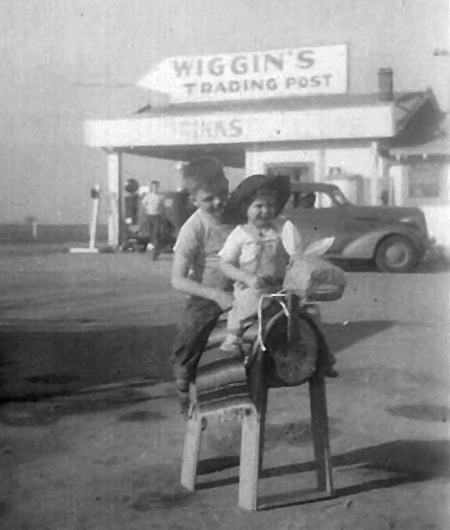
Francis Wiggin’s son Francis Porter Wiggin II and his wife Ruth had seven children: Frank, Paul (b. 1934), Richard (b. 1936), Tom (b. 1940), Janet (b. 1946), Don, and Patti (b. 1955). Above, Wiggin’s grandchildren Janet and Tom ride a play horse/burro in 1949. Near the pumps might be one of their brothers.
Son Francis II joined the business around 1936, and Francis Sr. passed away in 1950. The Trading Post closed in 1967, but grandson Richard operates (but has it for sale) Wiggin’s Trading Post in Chilcoot, California at 94139 Highway 70. Another Wiggin’s Trading Post is said to be in Arizona but the location and owner are not known.
The Lincoln Highway went south from Stockton through Lathrop on what is now Harlan Road on its way to Tracy. I-5 now closely parallels the old road. Information about the ceremony will follow in a separate post. Thanks to Gary Kinst for helping with info and the image.
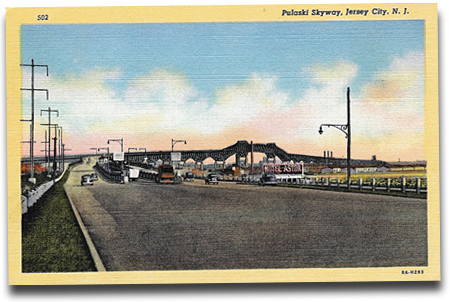
An article in The New York Times examines the current state of the Pulaski Skyway, an overhead road that bypassed part of the Lincoln Highway in northern New Jersey in 1932. The 3-mile-long superhighway, named for Revolutionary War general Casimir Pulaski, was built to handle the traffic resulting from the opening of the Holland Tunnel in 1927. It carries traffic above the region’s heavy industrial and commercial areas. On its first day of operation, 48,611 cars used it; today the average is 85,000 according to the Department of Transportation. The skyway was an engineering marvel when opened in 1938: the American Institute of Steel Construction called it the most beautiful steel bridge, and it still is a grand structure. But its lanes are narrow, and after the tragic collapse of a bridge in Minneapolis that employed the same antiquated design, it’s again being reviewed. All of the 700-such bridges in the US lack a secondary support, “meaning that the failure of just one piece of steel could send them plummeting to the ground.”
NJ Governor Jon S. Corzine says that “instead of spending the $10 million a year now planned to keep the skyway safe and operational, it might be wiser to replace it,” but that would cost $1 billion. The bridge was inspected in spring 2007, but the NJ Department of Transportation, “citing security concerns, refused to release the records of that inspection or discuss whether the findings differed substantially from those of the previous inspection.” Another inspection was ordered after the Minneapolis collapse.
So the most recent data is from a 2004 inspection. On a scale of 0 to 9, with 9 being perfect and 0 requiring a shutdown, the skyway was rated 4 for the physical condition of its structural members and 5 for the physical condition of its piers and other substructure components.
According to the Times, “Those numbers are not dire. But the scores are similar to those assigned to the bridge in Minneapolis. It received a 4 for structure and 6 for substructure during its most recent inspection.” That makes it “structurally deficient” though “not a risk of imminent collapse.”
Although it is 35 years older than the Minneapolis span, it may actually be safer; since less was known about structural support then, more steel was often used than was needed. And because Jersey City banned trucks from the bridge in 1934, it’s taken less of a beating. That’s why officials want to assure drivers not to panic, that there’s plenty of time to plan for repairs or replacement. Let’s hope so.
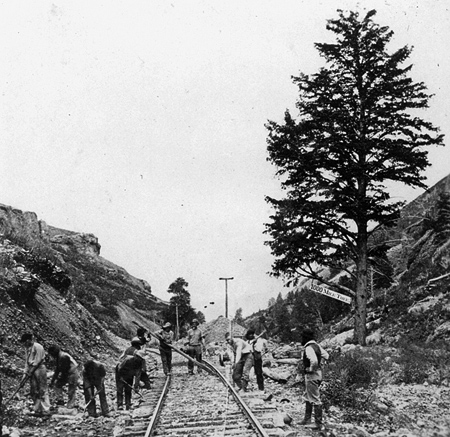
The Lincoln Highway often followed the course of the Transcontinental Railroad out west, mostly in spirit but sometimes atop it. When the railroad was built through Weber Canyon in eastern Utah in 1868-69, workers planted a “1,000 mile tree” to mark the point 1,000 miles west of their starting point of Omaha, Nebraska. I see references occasionally to the tree, and have noticed a couple stereoview cards online. A few photos were taken too, such as this one as the rails are laid in 1869 from the U.S. Geological Survey Photographic Library:
Check out the sign hanging from it!
The Lincoln Highway cut through the canyon some 45 years later, as did I-84 probably 60 years after that. I don’t remember seeing the tree or signs for it, but it is said to still be in Wilhelmina Pass, a mile east of Devils’ Slide. Click on the thumbnail below for a recent view from I-80 (and once there, click the magnifying glass to see the phhoto much larger):
That looks to be the pine tree on the right, next to the white square, which is probably a sign. Surely the tree has been written about by Utah historians or by railroad fans. Can anyone tell us more about it?
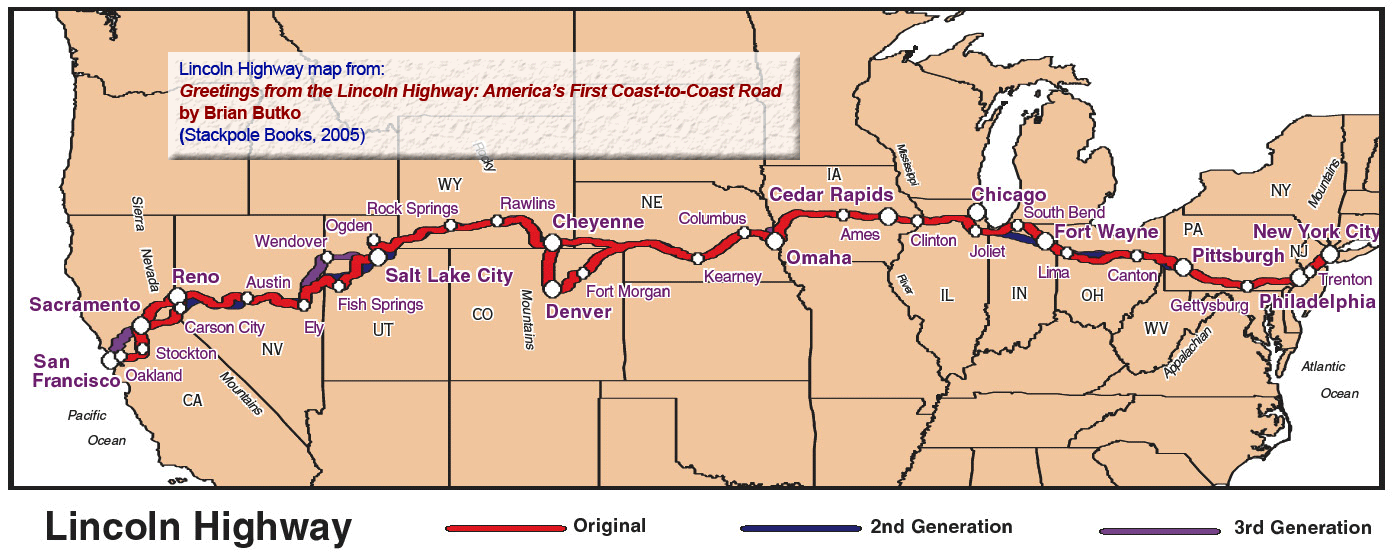
Click the map above for a full-size view of the Lincoln Highway.
Like this blog? You'll LOVE my books!Lincoln Highway Companion features detailed maps and places to eat and stay. Click the book to buy it on Amazon.
Click the Greetings book below to purchase the ultimate guide to the history and route of the Lincoln Highway!
Another fun book! The Ship Hotel: A Grand View along the Lincoln Highway recalls the greatest roadside attraction along the coast-to-coast road.
And for those who LOVE diners, click the book below to purchase our completely updated guide to the history, geography, and food of Pennsylvania's Diners!












 Lincoln Highway News