Posts Tagged ‘highway history’

Lessons from a Route 66 motel makeover

August 1, 2008

Businesses along old 2-lanes such as the Lincoln Highway often struggle to compete with chains that locate at Interstate off-ramps, but Ron Warnick reports on his Route 66 News about a non-chain motel in Barstow, California, that has found a way a pretty basic way to attract tourists. The story from the city’s Desert Dispatch notes that a simple image makeover instantly began attracting travelers who otherwise were passing by. For all those independent motels struggling in the face of brand-names that feature oodles of amenities and AAA ratings, it’s proof that business can be improved by attending to the look and cleanliness of a place.

Their current property, the Topper Motel on West Main Street, is popular with people, mostly locals, owner Ken Patel said, needing a room for more than a couple of nights. But tourists running down Route 66 passed right by and rarely stopped to rent rooms for just a night or two.

The Patels’ solution: Renovate the west side of their property, paint it the appealing color of an orange Creamsicle and slap a new name, The Sunset Inn, over the office….

Ken said problems with longer staying customers on the Topper side of the business made him consider ways to bring in shorter-staying out-of-towners. He said the rooms where people stayed for weeks or months at a time were often unkempt, dirty and negatively effected the entire appearance of his motel.

The Sunset looks like a completely different motel from the Topper sitting next to it. The rooms are crisp and clean and the parking lot features a small courtyard and desert landscaping. Day Manager Bill Snyder said the remodel has been so successful with the Sunset that there are plans to give the Topper the same treatment soon.

A story in a 1950s diner industry magazine advised owners to pave their decrepit parking lots. Many diner owners howled at the idea, saying customers were more concerned with the food that the lot. Yes, if you know a restaurant has good food, you’ll overlook the shortcomings, maybe even calling them “charming,” but for those not familiar with a place – as most travelers aren’t – they’ll pass by a run-down motel or restaurant. In the same vein, would you buy a beat-up used car or one that looked cared for?

Some on-the [gravel] road snaps from Sebak

July 29, 2008

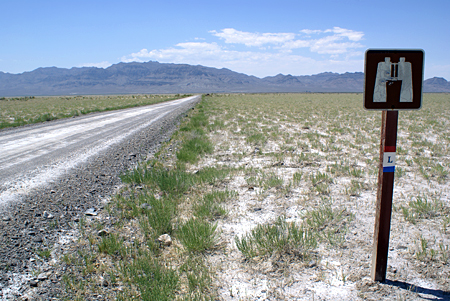
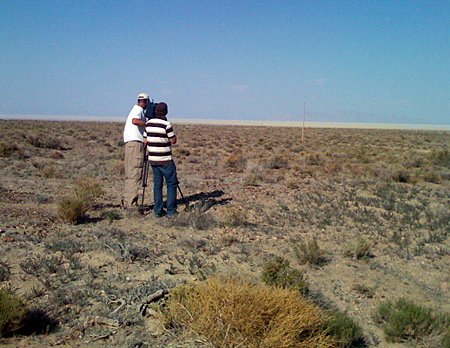
As PBS producer Rick Sebak and crew followed the Lincoln Highway to the Pacific Ocean and back, he snapped lots of photos. Here are a couple from Utah.

And here’s a video clip they made while skirting the Great Salt Desert and Dugway Proving Ground:

Learn more about their travels and the forthcoming show, A Ride Along the Lincoln Highway, on Rick’s blog. Here are some of his other nationally themed shows:

Missionaries served SLC's municipal auto camp

July 28, 2008

An article by Ardis E. Parshal at keepapitchinin.org discusses the auto camp that sprung up on the west end of Salt Lake City, and Mormon missionary efforts there:

By 1921 it had the usual amenities found in any such western camp. In earlier years [Pioneer S]take leaders had noted the increasing thousands who spent time at the auto camp before passing along, and they realized they had an unusual service opportunity. That summer of 1921 they pitched a large tent at the camp and held church services, both on Sundays and during the week. Meetings were short and casual, and relied on music and the recitations of Sunday School children. The various ward choirs in the stake took turns providing music, and talented instrumental soloists offered their services. Stake officers provided brochures, sold copies of the Book of Mormon, and answered questions. Some 25,000 tourists were served in that first year alone.

In 1922, the project expanded, and stake members build a small chapel, open on one side to face rows of benches in the open air. And word began filtering back from missionaries in the field, that they had been welcomed into the homes of people who had stayed at Salt Lake’s auto camp and changed their opinion of the habits and character of the Mormons.

ABOVE: an image of the auto camp missionaries from the article, which identifies the men.
TOP IMAGE courtesy Russell Rein.

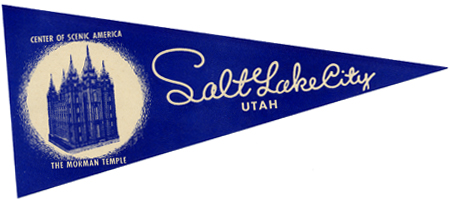
SLC and the 1860s Tabernacle were regular stops for most everyone motoring through Utah. As the author points out, and as seen in period travel journals, many wanted to see what Mormons looked like. Early auto traveler Harriet White Fisher was among those who stopped to see but concluded, “I could find no marks of identification that made them any different from other men in the East.”

Illinois cuts prices for Buy-Way sale supplies

June 30, 2008

The 2008 Lincoln Highway Buy-Way Yard Sale will again stretch from West Virginia through Ohio, Indiana, and Illinois on Thursday, Friday, and Saturday August 7-9 (note only Aug. 8-9 in Illinois). Anyone along the various routings of the Lincoln Highway can have a yard sale and/or business sidewalk sale. In its second year participating, the Illinois Chapter of the LHA has cut the price on yard sale signs and increased the number of free services. Yard sale signs will be $8 and those purchasing a sign who include a street address will be advertised with GPS coordinates and maps. Signs are available at the Lincoln Highway Association National Tourism Headquarters, 136 N. Elm St., Franklin Grove, Illinois, or online. T-shirts prices have been cut too — order them through cafepress.

The Lincoln Highway Buy-Way originated in 2005 in Ohio, Indiana joined in 2006, and Illinois and West Virginia in 2007. This year, Iowa is hosting a Motor Tour across the state, making for activities of nearly 1,000 miles along the road.

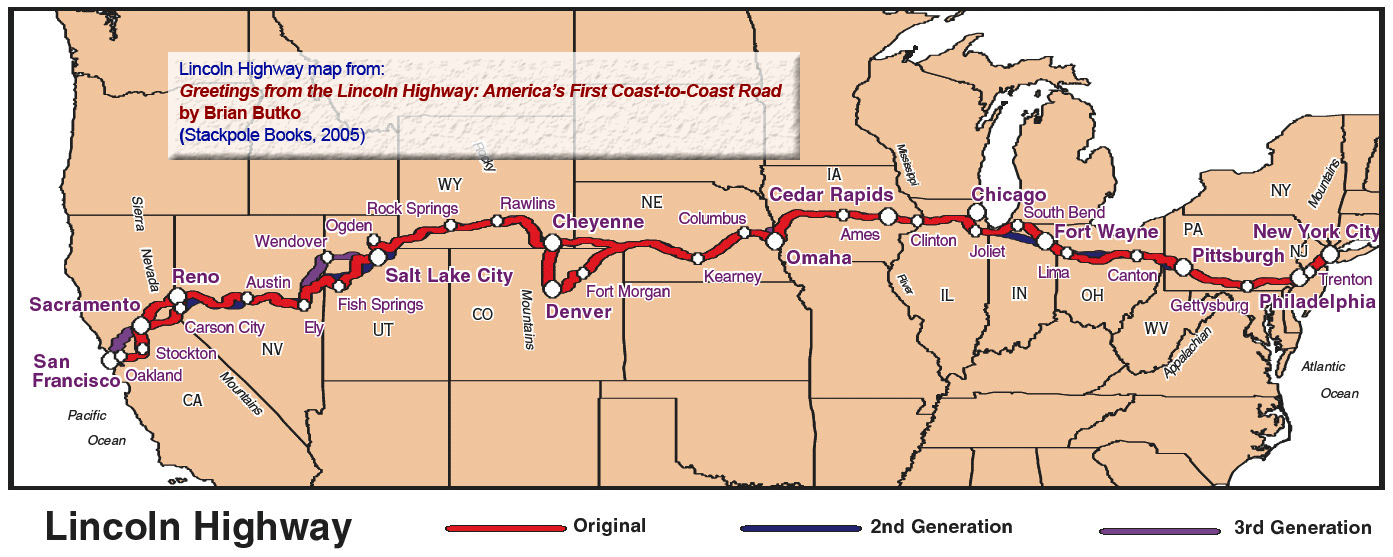
In Illinois, the Lincoln Highway passes through Chicago Heights, Matteson, Frankfort, New Lenox, Joliet, Plainfield, Aurora, Batavia, Geneva, Maple Park, Cortland, DeKalb, Malta, Creston, Rochelle, Ashton, Franklin Grove, Dixon, Sterling, Morrison, and Fulton. For more information, visit the state chapter’s web site or contact State Director Kay Shelton at lincolnhighway2010@yahoo.com, (815) 748-7211, or call the National Tourism Headquarters at (815) 456-3030.

Joy historical sign and conference wrap-up

June 25, 2008

Randy Wagner kindly sent a photo of the new state historical sign marking the original site of the Henry Joy monument. The sign was recently installed just off exit 184 of I-80. The Lincoln Highway runs to its right, and I-80 can be seen heading to the horizon. For more info, see my earlier post.

Also, the Uinta County Herald ran a nice story yesterday about the just-concluded 2008 LHA national conference.

RAGBRAI dry run a fun reading adventure

June 10, 2008

In anticipation of the 36th annual RAGBRAI®, the “Register’s Annual Great Bicycle Ride Across Iowa,” Des Moines Register Editorial Cartoonist (and race host) Brian Duffy has been checking out the route the past week. The yearly week-long bicycle ride through Iowa is sponsored by The Des Moines Register; the 2008 route will follow much of the Lincoln Highway from July 20-26. RAGBRAI® is the longest, largest, and oldest touring bicycle ride in the world. Click HERE to see a list of Duffy’s daily posts. For a map you can zoom in on, plus photos and videos, visit Duffy’s blog (screen shot below):

Although Iowa seems flat to outsiders, this year’s day 2 alone has more than 5,000 feet of climb in its 80-mile length. The end of that day will bring riders their first views of Lincoln Highway and Burma Shave signs just west of Jefferson.

IA_Bike08.gif

RAGBRAI was started in 1973 as a 6-day ride (not a race) across Iowa by two Register columnists; it’s still planned and coordinated by the newspaper. This year will launch from Missouri Valley but not pick up the LH till Jefferson, hit it from Ogden through Boone, again some of it in Ames, Nevada, Colo, and State Center, cross it at points in Le Grand and Tama, then pick it up in Chelsea through Belle Plaine, meet it through Lisbon/Mt. Vernon, and finally cross it at Mechanicsville. The bike route will be nearby or parallel the LH for much of the time, though not always along it.

Sebak on the road again for summer LH video

June 9, 2008

I met Rick Sebak about 1990 as he was preparing to produce a show about roadside attractions in Pennsylvania. We traveled the Lincoln Highway together, and now almost two decades later (seems like two years!) he’s traveling the Lincoln Highway coast-to-coast for an hour-long show to debut later this summer. We’ve also worked together on programs about diners, Isaly’s, and one called Stuff That’s Gone, but we still talk most about the Lincoln Highway and the places we saw back then that are now gone, most notably the Ship Hotel.


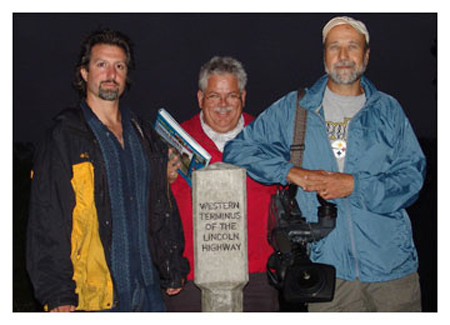
Above: Jarrett, Rick, and Bob at the Western Terminus of the LH.

Last fall Rick and cameraman Bob Lubomski made it to the Pacific and back with Jarrett Buba. This time Rick and Bob are joined in the QED van by sound-and-video man Glenn Syska, who is also helping post their daily blog. They’re leaving early today with a plan of getting as far west ASAP. Of course, that was the plan last time! There’s never enough time or daylight to fit in all the cool places along the way….

The blog for his last long LH trip ended September 1 at San Francisco. Rick just updated it to include the days heading back east — scroll down and you’ll find another entry for that day called No Reservations. Start there and remember the days get more recent as you go up (so the top is the most recent, when they had reached Nebraska). Posts from the trip starting today should start arriving tonight or tomorrow — they have some great stops planned.

Also check out his Video Postcards link, which offer a great daily look at sites along the way.

BTW, note that the web address has changed — it can now be found at http://www.wqed.org/tv/sebak/lincoln_hwy/blog/. So has the name — no longer just Lincoln Highway Postcards, it now carries the name of the show, A Ride Along The Lincoln Highway. You can see when the blog updates by watching the RSS feed on the page in the column to the right.

Tama Iowa's Lincoln Highway Bridge Festival

May 5, 2008

The 29th annual Lincoln Highway Bridge Festival will take place in downtown Tama, Iowa, May 16-18, 2008. Events include the Bill Riley Talent Show and Citizen of the Year award on Friday; on Saturday, the Grand Parade at 10 am followed by Chamber Community BBQ at the Fire Station and free entertainment from 11-3 on the Civic Center Lawn. The 3 day event also features a carnival, petting zoo, Olde Time Engine display, 5K run/walk, and street dance. Contact the Tama Toledo Chamber of Commerce for more info at (641) 484-6661. UPDATE: The regional newspaper now has an article and schedule.

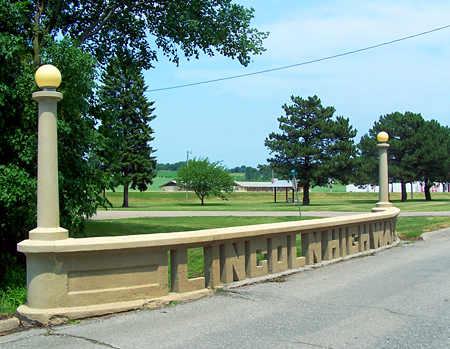
Tama’s Lincoln Highway Bridge is perhaps the most famous bridge along the transcontinental Lincoln Highway. The small concrete span was built in 1915 with the highway’s name in its side rails as a way to show the city’s pride in being located on the coast-to-coast road. It can be found along E 5th Street, though the Lincoln was rerouted to bypass the town in 1926 (current day US 30). It was listed in the National Register of Historic Places in 1978 and restored in 1987. It is also one of the most photographed bridges, though signs ask motorists to not stop to admire it, or to do so from a small adjacent parking lot.

Wallis to talk of Lincoln Highway at Univ Missouri

May 2, 2008

Author Michael Wallis will talk about the Lincoln Highway on May 9 at 3:30 p.m. in the Elmer Ellis Auditorium at the University of Missouri. Wallis is author of The Lincoln Highway: Coast to Coast from Times Square to the Golden Gate along with Route 66: The Mother Road. An MU alumnus, Wallis has previously donated several first editions of his books to the university library.

RSVP is preferred; contact Sheila Voss at vosss@missouri.edu or at (573) 882-9168.

Road trip from 1924 family diary: part 1/4

April 24, 2008

For the next four days, we’ll ride along with a family as they cross the country in 1924. Steve Ellis has graciously sent a transcription from a diary his Aunt Annie kept in 1924. Next month, he’ll retrace her path himself through Illinois, Iowa, and Nebraska, and is looking for help in finding some of the places she mentioned. I hope all you expert roadies out there can help him!

Click to see larger: Annie, Elmer, and Pearl on their 1924 cross-country trip. Pearl was born in Oregon in 1890, married Elmer in 1917, and they moved to Washington. Elmer, Steve’s grandma’s oldest brother, was born in Bathurst, New Brunswick, Canada in 1883. Annie also was born in Bathurst in 1891 and died there in 1992. Photo courtesy Steve Ellis.

“A few years ago, I was given a trip journal of my grandma’s older sister’s 3500-mile trip from New Brunswick, Canada to Tacoma, Washington in 1924. Although Aunt Annie never mentioned the Lincoln Highway per se, she mentioned the route she took, and from Chicago to Salt Lake City it had to be the Lincoln Highway. Actually, since she crossed the border at Detroit and came west from there, she may have been on the Lincoln Highway a bit farther east than Chicago.

“Aunt Annie was about 32 when she took the trip. I knew her only as a senior citizen, but she must have been a going concern at that youthful age. She was very independent and it wouldn’t surprise me if she changed some of those punctures/flat tired to which she so often refers. I’d say she was an archetypcial woman’s libber.

“Aunt Annie gave quite a bit of detail in her journal for an uneducated woman and she frequently mentioned the tourist camps all along the way including several tourist camps along the Lincoln Highway:

Maple Grove tourist camp in Chicago;
Wheatland, Iowa;
Jefferson, Iowa;
Columbus, Nebraska;
Big Springs, Nebraska;
Laramie, Wyoming;
Salt Lake City.

“While it might be difficult to find out where the Maple Grove camp was in Chicago, a place like Wheatland, Big Springs, or Jefferson would likely only have one tourist camp. Those places are not much larger today than they were in 1924!

“In mid-May, I plan to retrace some of Aunt Annie’s trip from Chicago to Big Springs, and I’d like to stop and see things that Aunt Annie and her brother Uncle Elmer and his wife Pearl saw in 1924. I LOVE your book. For example, on page 201, I am certain that Aunt Annie, Uncle Elmer, and Aunt Pearl saw that same sign that you have pictured. Thanks for writing such a comprehensive account of this highway. [Thank YOU Steve, glad you like it! ~BB]

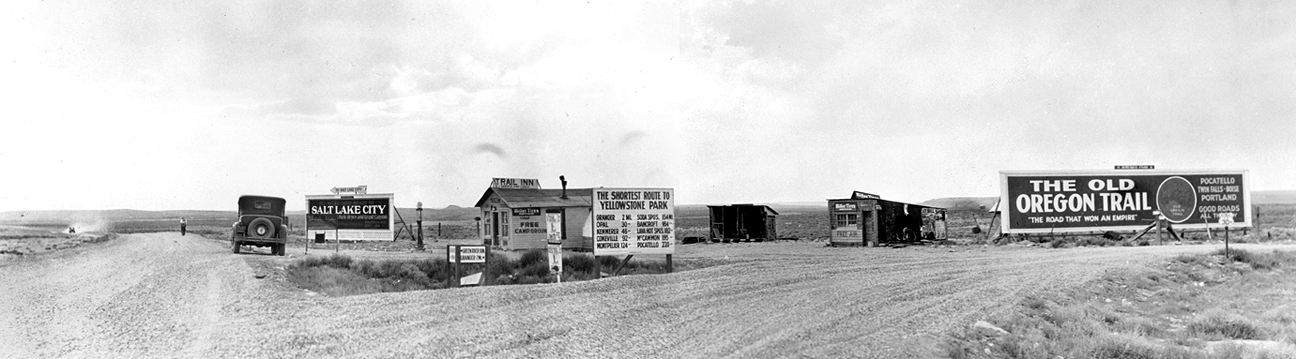
Click to see larger: The photo from my book that Steve refers to, a split in the road at Granger, Wyoming, 1927. It is actually an amalgamation of two images from the University of Michigan’s LHA collection. Photo courtesy UM Special Collections LIbrary.

Sunday, August 17
Left Windsor Camp at 8 a.m. Ferried the Detroit River. Just got started out of city Toledo, Ohio and had another puncture. Pulled into little garage & got it fixed. Drove on to Nash garage. Left car there to be cleaned and gone over. Driver brought us to Brunswick Hotel. Frank Eddy & wife took Aunt Jen & Pearl and I out to see city. Saw Belle Isle, Fords Hospital, the Packard Plant and beautiful homes of millionaires. Had lunch and supper in Eagle Café. Went to bed early.

Aug. 18
Had breakfast in cafeteria across from hotel. Brought car up for us at 8 o’clock. Went down to Nash Garage. Had to put on new tire. Got started at 9:15. Came thru pretty little Mich. town and thru Ann Arbor, the settlement city. Had lunch in camp at Grass Lake. Drove on 79 miles to Chicago & camped in Maple Grove Tourist Camp. Got there after dark.

Anyone know the location or fate of Maple Grove Tourist Camp?

Steve also makes these observations:

“I think Aunt Annie did very well with the place names. To us, this is not too hard, but we must consider Aunt Annie had maybe an eighth grade education and, although she was a relatively young woman at the time, she had not likely been very far from where she was born until then … and they lived not in the small town of Bathurst but in a relatively isolated area several miles out in the country, off the main road, down by the beach. All of these places would be extremely unfamiliar to her.

“The only place where she seemingly made a mistake was shortly after she came over the river from Windsor Ontario to Detroit. Away back then there was no bridge (not until the Ambassador Bridge was built in 1928), and she mentions ferrying the Detroit River. All that is just fine, but the “Toledo Ohio” comment is not consistent with where they should have gone. Yes, Toledo is maybe only 60 miles south of Detroit but, after spending time in Detroit, they headed south and west in Michigan through Ann Arbor. After she mentioned Toledo, she mentioned Fords Hospital, Belle Isle, and the Packard Plant, all places in Detroit. Maybe they went down to get someone in Toledo and came back to Detroit, but I don’t think so.”

TOMORROW: Driving to Utah