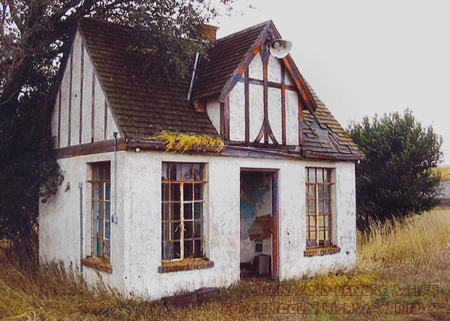
Another interesting shot from John and Lenore Weiss is this distinctive but abandoned gas station located somewhere in the middle of the US – that’s all I’ll say to start since RoadDog guessed the last one pretty quickly! Know where it’s at? Please leave your guesses by clicking Comments below the picture.
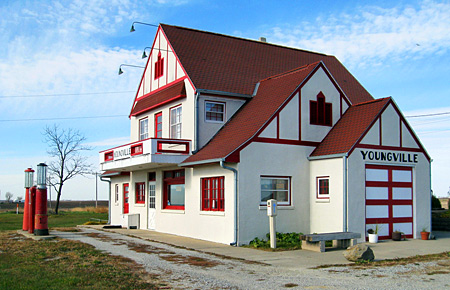
Above: Youngville Station, a beautiful restoration effort on the Lincoln Highway west of Cedar Rapids. When it’s open, visitors will find great pie and a historical display. The photos here show places NOT in the radio tour. Photo courtesy of G. Januska.
Gianofer Fields of Chicago Public Radio has completed her Lincoln Highway tour, but after 5 entries (plus a launch segment), she stopped along the Lincoln only 1 of those 6 days. As she admitted on the third day, ” I’m starting to rethink my whole Lincoln Highway plan. Maybe I should forget my linear route and think of the highway as a springboard.” Here are her topics:
Launch: Burlington’s Crookedest Street
1: Eldon’s American Gothic house
2: Missouri Valley’s Welcome Center and Museum of Religious Arts
3: Elkhorn’s Danish Windmill
4: Amana Colonies
5: Le Claire’s Buffalo Bill Museum
All very interesting, but only #2 is along the Lincoln Highway. What did she miss?
Trying to think of a list as quickly as possible, I came up with:
• Smith Brothers General Store in Clinton
• Cedar Rapids Museum of Art and Grant Wood Studio
• Youngville Station (top photo)
• Lincoln Cafe and Preston’s station in Belle Plaine
• King Tower Cafe (above) and LH bridge in Tama
• Shady Oaks Tree House east of Marshalltown
• Niland’s Cafe in Colo
• Three concrete bridges on the old road near Grand Junction
• Lincoln statue and carillon tower in Jefferson
• Moss markers with Lincoln busts north of Scranton (below)
• Spanish-deco Park Motel in Dennison
• Woodbine’s brick streets and Brick Street Station
• Loess Hills winding road across from Omaha
There’s lots more, from great old signs and garages to wonderful people in the diners and coffee shops along the way. What is your favorite?
On Tuesday, Chicago Public Radio’s Gianofer Fields reported from her LH trip that her reception at the Harrison County Historical Village and Iowa Welcome Center along the Lincoln Highway in western Iowa was not very welcoming. She has even subtitled that day’s entry, “What happens when the welcoming center isn’t so welcoming?”:
FIELDS: Tell me about this place that we are standing in.
HEIM [center employee]: Well, this is the welcome center that we are standing in.
I suppose that I should have taken that massive silence as a sign that the welcome center lady wasn’t in the mood for company. When I saw the old cabin perched on a small hill by the highway; I thought it had, “Stop here roadside attraction,” written all over it. So I did in hopes of learning more about it.
HEIM: Well, it has a wealth of information and antiques in it and it takes about an hour to go through, self guided usually.
Did I just get the bums rush? Clearly, I am on my own.
Above: Half the operational expenses for the village/welcome center are covered by sales in the Iowa Products Store and village admission fees.
I asked center coordinator Kathy Dirks about the two things that seemed to bother Ms. Fields—the lack of enthusiasm and the self-guided tour. Here is her response:
I wish I would have been here and that I could be here everyday to guarantee every person’s experience that steps through our front door would be stellar and involve the highest level of customer service. Unfortunately, it’s not humanly possible because we are open 361 days a year. So on many weekends and other days when I’m unable to be here due to meetings, vacations, etc., we pay some of our volunteers to man the facility. Almost all are elderly because the hours are limited and the pay low due to our limited budget. (My opinion would be almost all of them would be totally intimidated by a surprise microphone interview as well.)…
Not to make any excuses for what happened because there are none, but it can also be somewhat of a challenge to work at this particular facility because of the volume of knowledge the volunteers/workers are expected to know about Iowa – from everything tourism-related, to agriculture, to state laws, to about anything else that could cross your mind. I’ve worked here 13 years and still get questions I’ve never been asked before. I would have hoped though that everyone working here could have answered questions about this facility. I see much more intensive training needs to happen.
Our goal at the Harrison County Historical Village and Welcome Center has always been to supply the best service possible. I believe that on many occasions we do succeed in achieving that goal based on comments from customers and the amount of repeat business we receive. I absolutely hate when it doesn’t happen. Unfortunately, I can’t repeat Gianofer Fields experience here and make everything perfect. I can only learn from it and do whatever possible so it isn’t repeated….
We only offer self-guided tours on a regular basis and state that in our brochure. Unfortunately, we don’t have enough business, nor large enough income, to offer guided tours on a regular basis. The facility sits on 17 acres and the museum is in five different buildings covering about 4 1/2 acres. On many days, we only have one person that works the entire facility – beginning people on museum tours, answering welcome center questions, waiting on people in the gift shop, sweeping the floor, etc. If I had been here by myself, I would not have been able to give Gianofer Fields a guided tour of the museum either without locking the door to the welcome center/gift shop.
It’s obvious Ms. Dirks cares an awful lot about customer satisfaction while struggling with limited staff and resources. And Ms. Fields (who has not responded to my emails, though the station’s Director of Communications did one time) would probably understand these points too if she had known or been told in a more positive manner. Maybe Ms. Fields can return some day and give us all an update.
Waymarking is like a scavenger hunt for interesting places. Using a GPS locator, waymarking not only means marking a location using latitude and longitude coordinates, but categorizing it and adding unique information for others to learn about it. That’s why those of us who only see the results online can still follow along in the fun. There are more than 70 Lincoln Highway markers of all sorts on Waymarking.com, from murals to brick monuments in Ohio, and especially the 1928 concrete posts (originals and reproductions). Waymarkers post an image or two at each location and supply a description. Here are some nice examples, all used with permission.
This marker painted on a pole just east of Central City, Nebraska. was located by plainsdrifter358, aka Barbara and Bill.
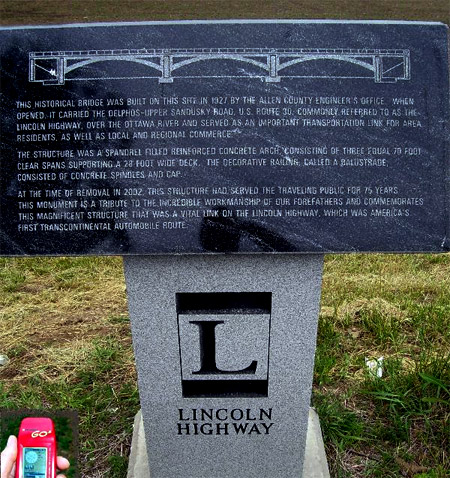
The marker below comemmorates the 1927 concrete bridge that carried the LH/Delphos-Upper Sandusky Road over the Ottawa River near Gomer, Ohio, taken by Stephen Shepherd.
The interesting monument below, probably overlooked by LH fans, was found at 1600 Plainfield Road in Joliet by a member cldisme.
According to the plaque at its base, this
life-size cold cast bronze sculpture of a 1915 Joliet road worker, seated on a hand-cut ceramic mosaic column, represents the historic Lincoln Highway and the birth of our modern day highway system. Also, included in the mosaic is an image of Abraham Lincoln medallion. The sculpture is dedicated to the men and women of the Will-Grundy Counties Building Trades Council and the construction companies of the Contractors Association of Will & Grundy Counties who make our roads possible.
On July 1, 1913, a group of automobile enthusiasts and industry officials led by Carl Fisher, created the Lincoln Highway Association (LHA), “to procure the establishment of a continuous improved highway from the Atlantic to the Pacific, open to the lawful traffic of all description without toll charges” and to be a lasting memorial to our 16 th president, Abraham Lincoln. Prior to the Lincoln Highway, the existing roads were nothing more than dirt paths, which became impossible to traverse even after the lightest rain. There were very few filling stations along the proposed route, few places to eat, and even fewer places to find lodging.
Since highway maps and signage did not exist, a uniform way of marking the highway became a necessity. A design was created that consisted of a concrete post, a blue arrow, and Lincoln’s image on a medallion. On July 8, 1928, the Boy Scouts of America installed the concrete sign posts next to 3,100 miles of roadway at all important turns and junction points from New York to San Francisco.
Check out the site for dozens more Lincoln Highway markers along (and sometimes far from) the road.
The S.S. Grand View Ship Hotel was perhaps the best-known, most-visited landmark along the 3,300+ miles of Lincoln Highway. The famous roadside attraction was 17 miles west of Bedford, Pennsylvania, but unfortunately burned in 2001. With my Lincoln Highway Companion book ready for the editors, I’m starting on my next book, a fun look at the Ship. I first wrote about the Ship in 1989 and have been gathering information, recollections, and photos since then.
People took lots of snapshots there, and though they probably took movies, few of those surface, so it’s exciting to see this rare film from 1972! (Total time 3:32) Roger Shaulis shoots out the back window as they speed east on the Lincoln Highway through the Seven Mile Stretch, passing coal trucks. About 45 seconds in, they arrive at the Ship and go to the deck for the view and some goofing. The family jumps on the Turnpike for the final minute, passing through three tunnels on their way to New Jersey.
A lengthy article on Cindy’s Diner (830 S Harrison St, Fort Wayne) was published Sunday in the Toledo Blade. Anyone traveling the Lincoln Highway in eastern Indiana will want to visit the diner for excellent food and a fun, friendly experience—and a Lincoln Highway logo near the door. Owner John Scheele (below) can always be found cooking for 15 patrons and handing the take-out orders.
After recounting the diner’s history (a 1952 Valentine), the article discusses its clientele:
A large number of the diner’s patrons are regulars – “Probably 85 percent of them we know by their first names,” Cindy said – and they include students, businessmen, cops, lawyers, construction workers, and researchers using the nearby library’s world-class genealogical collection.
Plenty of out-of-towners find their way to Cindy’s, too. A dog-eared guest book has been signed by patrons from every state, as well as foreign countries from China to Iran to South Africa to Russia.
Like the Mystery Photos we sometimes run on weekends, there are likewise lots of postcards that we wonder “whatever happened to that place?” This beautiful linen card from the Curt Teich Company pictures the Country Club Motor Lodge and Coffee Shop, 2665 Parley’s Way, Salt Lake City, Utah. It advertised 55 “strictly modern units” and “Sun Porch and Modern Coffee Shop for Convenience of Guests.” It’s named for The Country Club across the road, one of the West’s oldest courses (founded 1899) and still an elegant, private 18-hole course. Today, housing separates the two just west of the tangle of ramps where I-80, I-215, and UT 186 meet.
This card, postmarked Aug 4, 1949, was sent by a child:
“We got here right today We will be back to Sacramento California soon We are haveing a nice trip so good-by and I will see you soon from Mary Jean”
What’s left at the site today? The phone number is now a private residence. A Yahoo aerial view shows it still there, but you can buy for a condo at the Country Club Ridge subdivision at the same address. Price for #310 is $649,000 for 2,065 sq ft, built 2007. Are we a year too late…?
Friday was the last day for a popular DeKalb intitution. A story in the DeKalb Daily Chronicle recounts the history and good times at Ralph’s News Stand & Trophy House, 664 E. Lincoln Highway. Ralph Seats owned and operated the store from 1952 until his death last year at age 83. It was popular with locals but, as the article explained, “With a small number of street parking spots near the store—and an influx of chain stores offering some, but not all, of the same services as the shop—Ralph’s is yet another signature mom-and-pop style shop to shut its doors.”
Like an old-time general store, Ralph’s carried a bit of everything: “Lock de-icer can be found next to chewing tobacco. Toward the back of the store are rows of cards offering warm praises for birthdays, graduations and other life events. Sitting among chewing gum is an old-fashioned rotary-dial phone with a detachable ear piece connected to a cord … lottery tickets, trophy engraving, Western Union service, tobacco, magazines, newspapers and a tube tester from the years when TVs needed tubes to operate.
Ralph’s first opened in the middle of the 600 block before moving to the corner of Seventh Street and Lincoln Highway. For decades it was open 5 am till midnight. Ralph insisted a big-band radio station be on at all times, which it was—until he left! His widow Doris said it’s hard to close, but “it’s a little more than I can take. It’s sad not having him here. I miss him.”
The black granite used in the Vietnam Veterans Memorial in Washington, D.C., was supplied by a family firm along the Lincoln Highway in Lynwood, Illinois, south of Chicago. According to a recent article in The Times of Munster, Indiana, Rogan Granite (21550 E Lincoln Hwy/US 30, about 1000 feet west of the Indiana border) supplied the granite that carries the names of 58,256 veterans who either died in Vietnam or are listed as prisoners of war or missing in action. Tom Rogan says, “It was a very proud moment for our company and our family…. It was an opportunity for us to show what the region could do in support of our veterans.” The company, with roots back to 1874, was known as Calumet Memorial until 1980, when Tom and brothers Jim and Mick expanded the business.
The article recounts, “As part of the company’s headstone business, Rogan Granite supplied grave markers for veterans in several states. It was during a 1982 trip to Washington—to see which grave marker bids were successful—that Rogan learned of the plans for the memorial.” The bid required black granite because it could polish to a mirrorlike reflective surface and allow etched names to show up as white. The granite actully came from India, was cut and polished in Vermont, and etched in Tennesse, but the Rogan family coordinated the process of providing the 144 panels, each 44 inches wide each, that make up the two walls that are each 246 feet, 9 inches long. The memorial was dedicated on Veterans Day in 1982.
Photo Vietnam Memorial, The Wall, Washington D.C. by ehpien
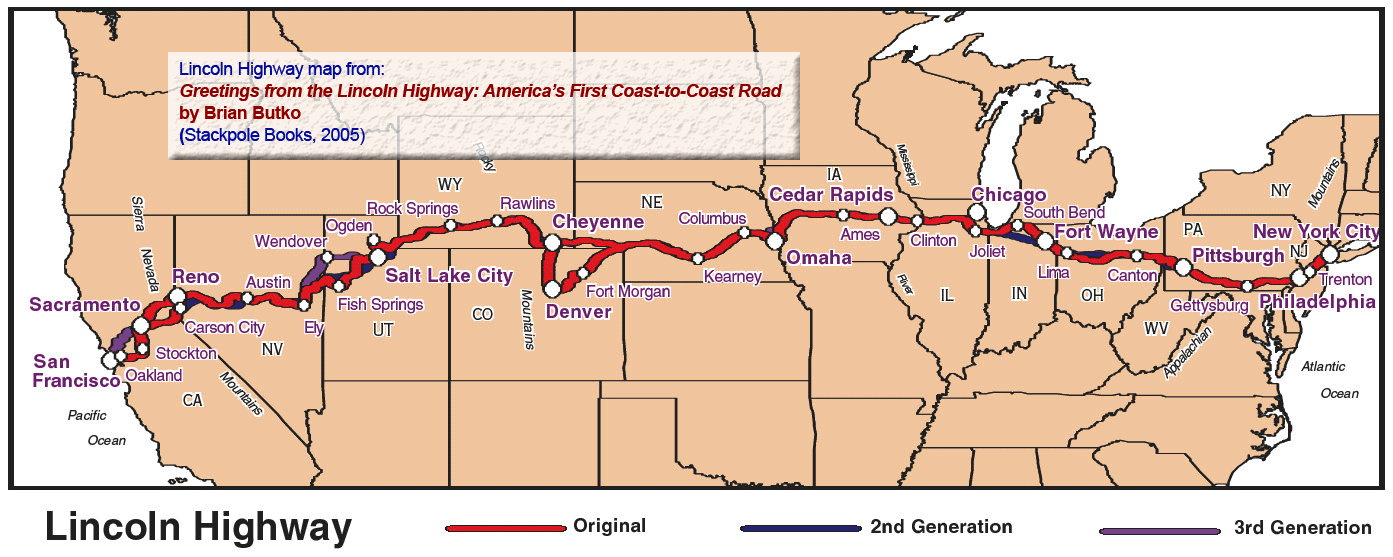
Click the map above for a full-size view of the Lincoln Highway.
Like this blog? You'll LOVE my books!Lincoln Highway Companion features detailed maps and places to eat and stay. Click the book to buy it on Amazon.
Click the Greetings book below to purchase the ultimate guide to the history and route of the Lincoln Highway!
Another fun book! The Ship Hotel: A Grand View along the Lincoln Highway recalls the greatest roadside attraction along the coast-to-coast road.
And for those who LOVE diners, click the book below to purchase our completely updated guide to the history, geography, and food of Pennsylvania's Diners!




 A
A 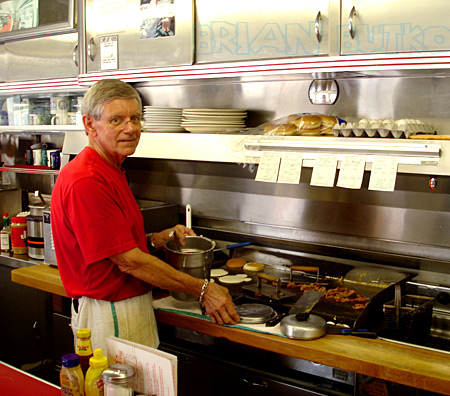




 Lincoln Highway News