Archive for the ‘highways’ Category

Millionaire's Marker Mystery west of Chicago

November 9, 2007

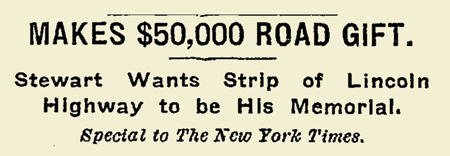
A New York Times story I found from December 1913 reported that 88-year-old John Stewart of Elburn, Illinois, was giving away huge sums of money, including $50,000 to improve the Lincoln Highway. He asked that markers be set at each end of the road section that his donation improved. Were those markers ever placed?
Stewart NYT

Elburn is a small town some 40 miles west of Chicago, and just west of Geneva, nestled between the original Lincoln Highway (still called that but better known as Keslinger Road) and IL 38. A 1921 shortcut connected Keslinger Road to IL 38 via Elburn’s Main Street, and a few years later, Keslinger was bypassed entirely. Though rural, suburbia continues to fan out from Chicago; check out this planning map to see how quickly the landscape is changing.

Stewart was in Europe at the time, but the article was datelined Chicago, so it began as a local story. No wonder—he also gave $100,000 to granddaughter Esther Richards as a wedding present, and to all his grandchildren, he bequeathed his estate valued at $750,000. My favorite inflation calculator says that alone is the equivalent of $15.1 million today!

Stewart 3

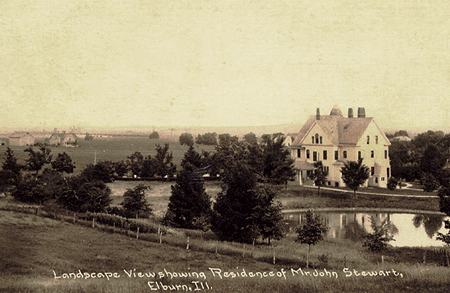
I checked with some town planners and officials, but no one has heard of the markers. What they didn’t say was that the local elementary schoool is named for John Stewart! Or that the town has preserved his mansion!

Stewart 6

The Great Lakes Leadership Campus on IL 47 occupies the Stewart estate. Director Annette Sheehan (who graciously OK’d use of the photos here) says, “To my knowledge, there are no markers bearing his name on Route 38 through Elburn. I don’t know if there ever were—I’ve never heard about any such markers.” The GLLC website says the 15-bedroom Victorian mansion was built in 1897 for John, Martha, and their 5 children. Its lavish appointments like hand-cut lead glass windows, tiled fireplaces, inlaid wood flooring, wooden ceilings, and in all a hundred types of wood led to the home being featured on a 1908 postage stamp. John Stewart served three terms in the state legislature, and interestingly, funded the paving of Elburn’s Main Street.
Stewart 4

I asked Kathleen Dow at the LHA archives at the Special Collections Library, University of Michigan, if Stewart shows up in their holdings. She found nothing in LHA minutes, correspondence (particularly checking the pledges), or brochures of major expenditures and donors. Could it be that, since the LHA never reached its goal of $10 million, pledges didn’t have to be paid? Kathleen replied, “From what I’ve seen in the LHA correspondence, some pledges were contingent on the pledge goal being reached before any checks were cut (many of the donors, or would-be donors, were businessmen, of course). So, yes, I think a number of pledges were never kept. I think there were also some quibbles about businesses, both small and large, pledging 1% of a year’s profit (I believe that’s what was initially solicited).”

So was the $50,000 ever donated? If so, were markers erected in Elburn or elsewhere? Or did the LHA not get the funds because they never reached their $10 million goal?
Indiana Curriculum to Spotlight Lincoln Highway

November 8, 2007

A Lincoln Highway curriculum unit is being prepared by the LHA Indiana chapter. “Indiana’s Historic Lincoln Highway” will offer a complete 2-week course for grades 3 and 4, formatted to Indiana State Standards. Project Leader Joyce Chambers says a team has been working for a year and a half gathering information and creating hands-on activities for topics such as maps, math, art, music, language, and science. Field research is wrapping up for this year as colder weather approaches.

IN_UM concrete
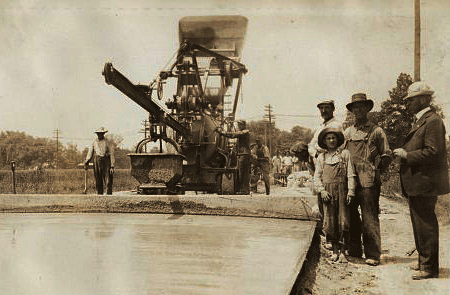
Above: Pouring the last concrete between Osceola and Mishawaka, Indiana. (Univ of Michigan, Special Collections Library, lhc2276)

The kit will likely contain a Teacher’s Guide, Student Booklet, DVD history of the road, possibly some model race cars (a nod to Carl Fisher’s connection to the Indy Speedway), a LH BINGO Game, and images of the road in Indiana, all in a sturdy tote bag. Sections may include Overview, Construction, Bridges, Tollhouses & Mile Markers, Travelers, Accommodations, Workers along the Road, Fun Sheets, Timeline, Lincoln Highway Sites, Glossary, Bibliography, Evaluation, and information on the LHA. The South Bend Community School Corporation’s Print Shop will donate the printing.

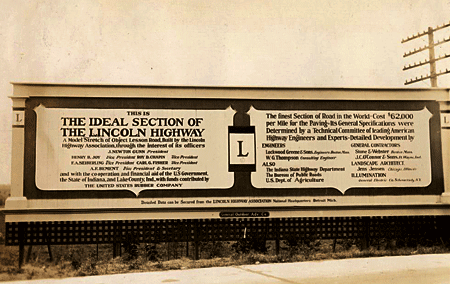
IN_UM_Ideal Sec Above: A billboard on the Lincoln Highway’s famous Ideal Section in western indiana, 1927. (Univ of Michigan, Special Collections Library, lhc2793)
Three or four schools will test a pilot version for the 2008-’09 school year, then it will be evaluated and revised for release in 2009-’10 to public libraries and schools along the LH. Further suggestions will be incorporated into a final version available to all Indiana schools, including homeschoolers and private/parochial. It will be available through “check out” at the Center for History Education Department, where other such kits are stored for teachers. A similar highway-themed curriculum is Traveling the National Road Classroom Activity Program.

A kit and PowerPoint show will be presented at the LHA’s 2008 conference, and a presentation at the ’09 event will include feedback from the test year. It sounds like a solid plan, and a model program for other LH states.

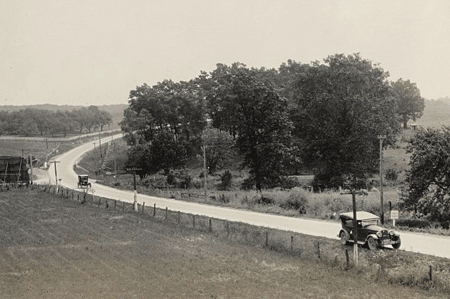
IN_UM_curveAbove: The LHA Packard touring through Indiana, 1925. (Univ of Michigan, Special Collections Library, lhc2313)

For more information, or to make suggestions about content, contact Joyce Chambers at joycechambers47@aol.com (574) 272-5374.

Click the Lincoln Highway Map

November 7, 2007

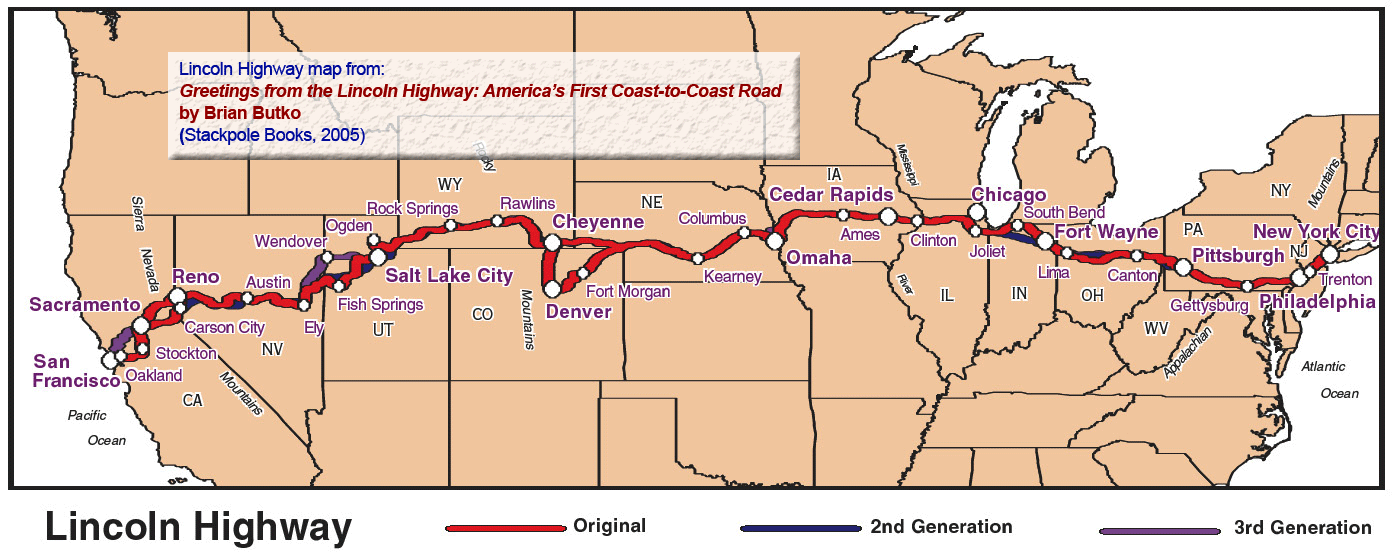
For those not familiar with the route of the Lincoln Highway, I now have a map available based on the one in my Greetings book. Click the thumbnail below or the really tiny one to the right and you’ll get a US map up to 19 inches wide, just like this one:

Butko Greetings LH map - Med

The first generation represents the “Proclamation Route” of 1913. Towns like Trenton, NJ; Marion, OH; and Ogden, UT were quickly removed (though Ogden would later be put back on).

You’ll also see the Colorado Loop, which the LHA soon regretted but nonetheless approved of for two years. Note also that there were two ways around Lake Tahoe in eastern California. West of Sacramento, the 1928 rerouting is being debated of late as to whether the change was officially endorsed by the LHA board. It’s included because that’s where the LHA’s concrete posts went in 1928.

The first tally of the Lincoln Highway’s length was 3,389 miles (including Camden and Marion but not Ogden), though it would always be in flux due to bypasses and realignments. More than a decade later, the now more-famous US Route 66 would run 2,448 miles from Chicago to Los Angeles (though it likewise would vary in length).

DeKalb IL Road Work Continues into 2008

November 6, 2007

An article in DeKalb’s Northern Star, produced by students at Northern Illinois University, reports that reconstruction of the Lincoln Highway downtown will continue through Summer 2008.

Work in the 100 block, including a bridge replacement and an awkward lane shift, has led to more than a dozen accidents in the past half-year. Joe Spika, construction field engineer and DeKalb County area supervisor for IDOT, said the standard merge there should present no problem: “When people obey it, everything works just fine.” The work, nearly half done, will move to the other side of the bridge by Thanksgiving and will continue through at least mid-Summer.

DeKalb, IL
Above: looking east in the 200 block of East Lincoln Highway, DeKalb.

York PA Chip Factory Story Revealed

November 6, 2007

I just received a letter from Shirley Gillespie complimenting my Lincoln Highway: Pennsylvania Traveler’s Guide book but noting that I missed the story of a potato chip factory along the route operated by her family. My text mentions a Frito-Lay plant west of York, PA, off Gillespie Drive, but little did I know that the road name was a key to the plant’s heritage. The El-Ge Potato Chip Company was founded in 1937 by Leonard Gillespie, named for his initials. A story in the January 1982 Snack Food trade journal reported that the 105,000-sq-ft factory, built in 1965, could produce 4 tons of chips per hour. By then, Shirley’s husband Bob, a nephew of the founder, was president. Here’s a picture from the Snack Food profile showing Bob and Shirley at the El-Ge plant:
ElGe Chips

Shirley says the family sold to Southland Corporation in 1984, which kept the name, then a succession of owners led to Frito-Lay’s purchase. I’m glad Shirley wrote and preserved an important part of her life and Lincoln Highway history.

Route 66 Reviews the Lincoln Highway

November 5, 2007

Greetings cover 2Well, not the roads but a Route 66 site and a Lincoln Highway book. Ron Warnick, whose Route 66 News was a prime inspiration for this site, just reviewed my Greetings from the Lincoln Highway, a book 10 years in the making. He was very kind in his praise – check it out or look for the Route 66 News RSS feed in the right-hand column here for regular updates of his posts.

I’m working hard to finish a follow-up book, Lincoln Highway Companion, a glove-compartment-size guide with driving maps and recommendations of places to eat, visit, and stay. And there’s LOTS out there on the Lincoln, more than any book or site could possibly capture, so don’t worry, there’s still endless surprises awaiting those who like to explore off the beaten path.

Hamilton, NV – A Lincoln Highway Ghost Town

November 5, 2007

Ghost towns fascinate most of us, and many books and web sites chart the rise and fall of these once-booming settlements. Rick Pisio (see previous post) captured some amazing views at Hamilton, NV, a mining town on the original Lincoln Highway east of Ely.
NV_Pisio_Hamilton

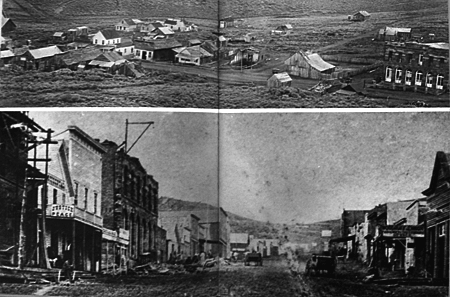
Silver was discovered here in 1868, and within two years, there were more than 13,000 mining claims. Main Street grew to a mile long and the town itself a mile-and-a-half wide, with two banks, two newspapers, post office, courthouse, school system, water and steam company, churches, fire companies, and a hotel considered the state’s most expensive structure. Hamilton even became the first seat of White Pine County. But the ore layer was thin, and folks left as quickly as they had come. An intentional fire in 1873 (for insurance money) destroyed much of the town.

Even though it’s a 10-mile drive from US 50 over bumpy dirt roads, many make the journey, though their visits, and natural weathering, take a noticable toll. Online images show the brick structures crumbling a bit more every year, and soon, little will remain standing.

Two historic views from Ghost Towns: How They Were Born, How They Lived, and How They Died by Tom Robotham (Running Press, 1993) show the Wells Fargo bank as the town’s most prominent structure:
Ghost Towns book

See more of Rick Pisio’s photos from this and other Western ghost towns at rwphotos.

A detailed history of Hamilton is available at White Pine County Nevada History and Genealogy Research site.

For USGS maps on getting there, check The Lincoln Highway: Nevada by Gregory Franzwa and Jess Petersen. The 1913 LH stretches over maps 39-43.

Fan Posts UT-NV Tour on American Road Forum

November 4, 2007

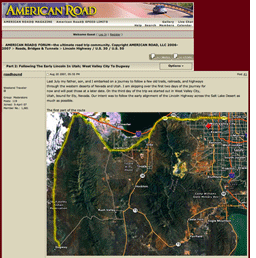
The American Road Forum is a great place to ask questions and get info from roadside experts, including, of course, for the Lincoln Highway. You can browse as a guest, but sign up so you can add your own questions and answers.

In May, Rick Pisio (whose website of impressive photos can be found in my Helpful Links section) asked about driving the LH west from the Pacific, especially the original alignment around the Great Salt Lake Desert. He got some wonderful insights and detailed replies:
http://americanroadmagazine.com/forum/index.php?showtopic=383

Rick made the trip in late July with his father Matt (who turns 70 this month – Pisio on Am Rd Whhappy birthday!) and 14-year-old son Richard, whom he says really enjoyed it: “I talked enough about the history of the roads we traveled and he listened in on the conversations my dad and I had during the trip enough to understand that what we were doing was not your normal vacation. I think he also realizes that opportunities for 3 generations to travel on a trip like we did do not happen that often.” Must have worked – Rick says they hope to take another trip next year.

Rick’s posts to the American Road Forum picked up his journey three days into the trip, starting at West Valley City, Utah, traveling through Skull Valley to the US Army Dugway Proving Ground:
http://americanroadmagazine.com/forum/index.php?showtopic=522 Here’s a view from the start of the trip looking south on the original LH in Skull Valley:
UT_Pisio_SklVly

Four subsequent entries through Utah and across Nevada can be found on the “Lincoln Highway / U.S. 30 / U.S. 50” board:
http://americanroadmagazine.com/forum/index.php?showforum=24

Here’s a view looking east to the Goodyear Cutoff, a contentious shortcut that’s been off-limits for more than a half-century. The sign’s faded lettering reads “Dead End Road, No Trespassing, Government Property.” The short post on the right has the Lincoln Highway logo and “Lincoln Highway” down its length:
UT_Pisio_Gdyr

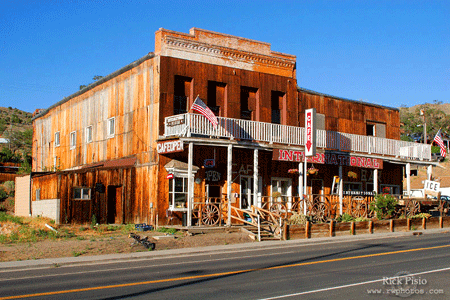
Days later, he captured sunset at the International Cafe in Austin, where they had the last dinner of their trip:
NV_Pisio_IntlCafe

Anyone wanting to make the trip themselves will enjoy Rick’s storytelling and evocative images, plus maps of each day’s journey. All his posted photos, plus some not in the American Road reports, can be found at http://www.rwphotos.com/Scenics/scenicmain.htm

We can’t wait for next year’s trip.

Produce Stands Part of Region's Heritage

November 3, 2007

One of the reasons for making the trip to Gettysburg was to see the sights of Fall along the Lincoln Highway, especially produce stands. Central PA is known for its apples, peaches, cherries, and other farm products, though suburbanization is a looming threat to orchards. On the way home, we stopped to buy some pumpkins, tomatoes, apple butter, and Halloween decorations.

West of Chambersburg is Shatzer’s Fruit Market (2197 Lincoln Way West), founded 1933. Outside is one of the LHHC‘s Pump Parade decorated fiberglass pumps:
PA_Orch3

Relatives of the Shatzer family, Bingham’s Orchard and Market (9823 Lincoln Way West) farther west in St. Thomas has a larger building stocked with cider, jams, and such:
PA_Orch1

PA_Orch2

Nebraska Promotes the Lincoln Hwy with Videos

November 2, 2007

NE Weiss signThe Nebraska Division of Travel and Tourism has produced both a short and long video to promote the Lincoln Highway as a scenic route. The focus is on natural beauty and general history more than auto-era attractions, though there are some nice views of the brick road west of Omaha and Buffalo Bill’s Scouts Rest Ranch in North Platte.

The LH there is now a Nebraska Byway, not to be confused with an American Byway, the name for roads in the National Scenic Byways program, which the LH has only achieved in Illinois. The Nebraska tourism site has general descriptions of 10 such routes here.

More info and photos are available on the site for the Lincoln Highway Scenic and Historic Byway Association, “a grassroots organization that brings together businesses, government tourism entities, and individuals along Highway 30 in Nebraska to work together and promote this stretch of road to tourists.”

The only description online of the Byway program itself is in a Department of Roads brochure detailing highway sign regulations: “The Nebraska Byways Program identifies significant two-lane highways throughout the state that highlight Nebraska’s diverse topography, history, culture, recreational opportunities and landscapes.”

Here is the 29-second video. Other roads in their series get near identical narration:

And here is the 3-minute video:

Thanks to Lenore Weiss for the sign photo.