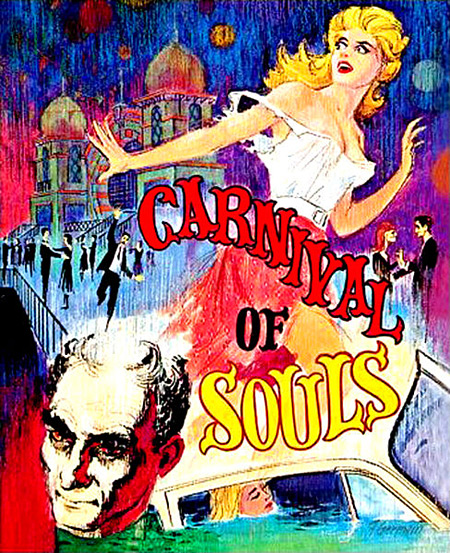
Carnival of Souls, a low-budget horror film directed by Herk Harvey in 1962, never achieved much fame or acclaim, yet it’s become a a cult favorite and is often mentioned as an influence by other filmmakers. It’s theme of a woman caught between life and death was unusual for its time and is cited as a reason that it rises above similar films. For Lincoln Highway fans, it offers a glimpse of Saltair, the famed lakeside bathing resort west of Salt Lake City, opened 1893 and connected to the city by rail. It later became a regular stop for cross-country travelers.
Above: The Moorish domes of Saltair are represented in the Carnival of Souls movie poster.
The lead character, Mary, is in a car wreck and assumed drowned. Instead, she apparently lives, becoming a church organist, but is haunted by a ghostly man. Her journey culminates in a trip to an ominous pavilion, which takes place at Saltair.
The creepiness in Carnival of Souls comes mostly from the dreamlike atmosphere instead of cheap scares or special effects. The pavilion keeps drawing her until she visits it in the climax. This clip, part 11 of 11 on YouTube, features great views of Saltair before it burned again in 1970. The first minute is spent with Mary reflecting, but then she is spooked, screams, and finding herself in her 1960 Chevy, backs out of a garage. At 1:56 we see her driving the approach road to Saltair and seconds later walking through it. About 3:30 ghouls arise from the lake to dance (or at least that’s my amateur interpretation of the action). About 5:50 they begin chasing her – she tried hiding among the support poles underneath. Views of the exterior start at 6:53 and a minute later it returns to the scene of the crash that started the movie and we learn her fate. WARNING: The scares are tame and the pace slow by today’s standards but nonetheless might be unsettling to some.
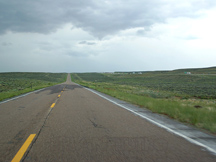
Daily snow the past few weeks has us dreaming of sunny drives along the Lincoln Highway, so here are a couple summertime photos from western Nebraska and western Wyoming. Can you correctly identify either location?
To see them larger, click on each one for a connection to Flickr. Once there, click “All Sizes” above the each image to see them even larger.
A new web site commemorates the 250th anniversary of Forbes Trail, hacked through the forests of Pennsylvania in 1758 during the French and Indian War. General John Forbes led an expedition from Philadelphia over the Allegheny Mountains to capture French-occupied Fort Duquesne, at what later became Pittsburgh. Among the 6,000 British and colonial troops was young George Washington, a 26-year-old colonel with the Virginia troops. The www.forbestrail.org site is a project of French and Indian War 250, the organization spearheading the commemoration of the French and Indian War.
Forbes Trail (also commonly called Forbes Road) was closely followed or paralleled by the Lincoln Highway and US 30 across the state. Only mid-state does it deviate, when the military road jogs north to Carlisle, near Harrisburg. The Lincoln/30 stays south through Gettysburg and Chambersburg.
The web site features seven “gateways” – Philadelphia, Lancaster, Carlisle, Fort Loudoun, Bedford, Ligonier, and Pittsburgh – where visitors can click to learn its connection to the trail and what historical remnants survive.
A long-anticipated book is due in May. Pennsylvania’s Forbes Trail: Gateways and Getaways along the Legendary Route from Philadelphia to Pittsburgh ($18.95) will feature more than 40 themed tours with info on activities, lodging, and dining.
I asked French and Indian War 250 Marketing Director Karen Lightell about the difference between calling it Road and Trail. She said they “chose ‘Forbes Trail’ to avoid confusion because many people see the Forbes Road as extending only from Carlisle to Pittsburgh—i.e., the road the Forbes Expedition actually built. They traveled from Philadelphia on existing roadways. ‘Forbes Trail’ is meant to imply the entire experience ‘today’ of the corridor along the original Forbes route as described in the book.”
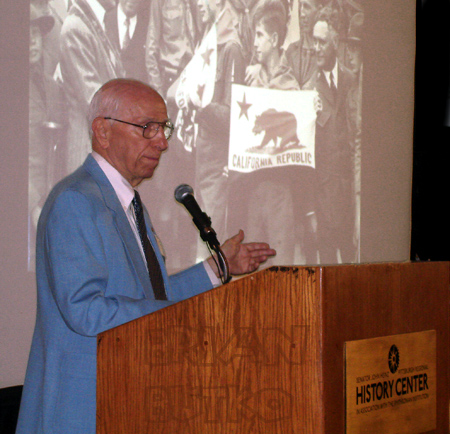
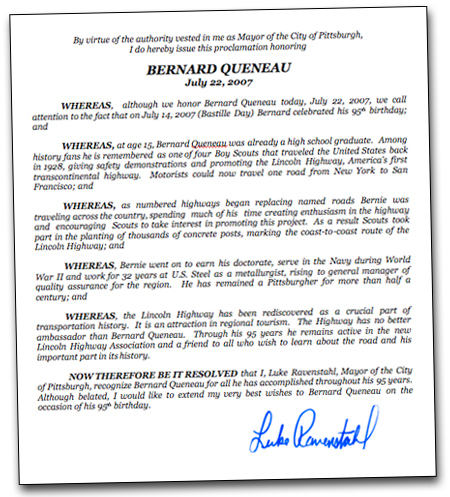
One of the highlights of the Summertime Fun event I arranged last year at the Senator John Heinz History Center was to award Bernie Queneau with a proclamation from the mayor of Pittsburgh. It mentions not only Bernie’s participation in the cross-country safety demonstration tour along the Lincoln Highway in 1928, but also his earning a doctorate, service with the Navy in WWII, and his expertise in metallurgy. He also received a proclamation from the LHA, presented by Rev. John Harman. The occasion for all this was his 95th birthday on July 14 – Bastille Day, Bernie likes to remind us! Also attending was his wife, LHA past president Esther M. Queneau.
Above: Bernie in front of a photo of himself holding a CA flag at the end of the LH, 1928.
Recently, mayor Luke Ravenstahl hosted a ceremony for some of the proclamation recipients, including Bernie. Here’s part of the mayor’s intro to the recent event:
For many years, Pittsburgh Mayors have been recognizing outstanding citizens and organizations by issuing them proclamations.
It is my goal to highlights some of our most unique Pittsburgh citizens and organizations, by presenting their proclamation in person.
It gives me great pleasure to be familiar with all of the important activities Pittsburghers are involved with.
I say it all of the time, but I truly believe that Pittsburgh is America’s most livable City because of its people.
We are people of superb nature, who will always reach out a hand to help others—we are Pittsburgh proud.
Today, I have looked through a number of recently issued proclamations, and it is my pleasure to meet those outstanding individuals, and personally present them with their proclamation.
You can see a video of Proclamation Thursday on the City of Pittsburgh’s Cable Station, channel 13, at 3:00 a.m., 8:30 a.m., 12:30 p.m. and 9:30 p.m. through February and March.
Richard Anderson reports that he and daughter Emily Anderson have produced and posted a new video about the 2009 journey Emily will take commemorating Alice Ramsey’s groundbreaking drive across the US in a rebuilt 1909 Maxwell. LH fans will note Lincoln Highway book state guides author and LHA Forum editor Gregory Franzwa about 50 seconds in and remaining a major voice in the 5:46 video.
Alice was the first woman to drive across the US, following a route that a few years later would be used by the Lincoln Highway in many places (though notably not across the Allegheny Mountains through PA or OH). Emily hopes to follow Alice’s original route as closely as possible, but will deviate somewhat due to roadway changes and the safety concerns.
Learn more at their web site aliceramsey.org about the route, and about a film that Emily’s brother Bengt Anderson is producing about the event and women’s history, Alice’s Drive – Women Who Drove The Century. Richard also reports that the car body is finished and being painted, and that the engine needs only a few parts before being started, they hope in March. The most recent challenge was needing an exhaust manifold; not finding one, Richard modeled and cast one based one a 1908 Maxwell that he owns.
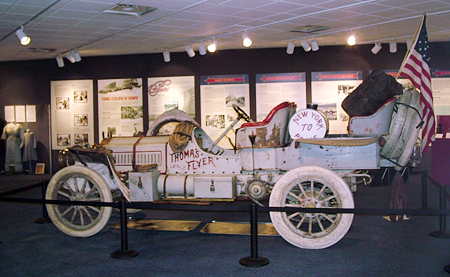
February 12 marked 100 years since the launch of the longest and perhaps craziest auto race ever – around the world from New York to Paris. Six cars (seven more never showed up) departed Times Square, at times following the future Lincoln Highway to San Francisco. The American entry, a 1907 4-cylinder Thomas Flyer roadster, would win, driven most of the way by George Schuster, who would later write about his adventures in The Longest Auto Race. The 1965 comedy The Great Race (Jack Lemmon, Tony Curtiss, Natalie Wood, Peter Falk), loosely based on the race, barely touched on the hardships faced by the real racers.
The 1908 race has been honored with a 14-month exhibit at the National Automobile Museum in Reno, Nevada, a few blocks off the Lincoln Highway. Through next January, visitors can see the 1,400-pound trophy, the American flag carried the whole way, and most impressively, the restored Thomas Flyer (seen above, in a photo courtesy the museum). Then starting May 30, up to 40 teams will again depart New York City for Paris, covering 22,000 miles, though only half of that driven. A summary of the race and exhibit can be found in the San Francisco Chronicle.
Another group is rebuilding a 1908 White and plans to retrace the route and pffering educational programs, but their hopes to launch the February 12 have been delayed.
Schuster never did get paid the $10,000 (he thought was proper for a half-year’s work) by the Thomas company – they said the race had cost them too much already. And The New York Times delayed paying him the $1,000 prize for 60 years. Schuster, then 95, was appreciative but noted that a grand was not worth nearly as much in 1968 as in 1908.
Summer 2009 will be the centennial of the first woman to drive across America, Alice Ramsey. In honor of that groundbreaking event, Emily Anderson and a co-pilot will leave New York City on June 9, 2009, for San Francisco. They’ll follow the same route over 41 days in the same type car as Alice used (a 1909 Maxwell, restored by Emily’s dad), with celebrations along the way. Here’s a 4-minute trailer about the next Alice’s Drive.
An AP story this morning reports that snow has forced the closure of I-80 between Sacramento and Reno, Nevada, where it is parallel to (and often intertwined with) the Lincoln Highway in eastern California. Eastbound I-80 was closed at Colfax (50 miles NE of Sacramento) and westbound traffic was being held at the Nevada state line. Meanwhile, floods, mudslides, and winds are battering southern California.
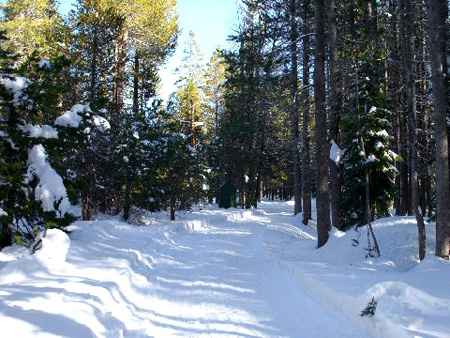
For a calmer take on winter weather, Paul Gilger, Chair of the Lincoln Highway Association National Mapping Committee, sent along these images from brothers Greg and Grant Gassman, members of the California chapter of the LHA. A few weeks ago, they took these photos of the original 1913 alignment through Kingvale up near Donner Pass. The first one is looking east on the 1913 alignment just before it rejoins the 1926 alignment on Donner Pass Road (which does get plowed):
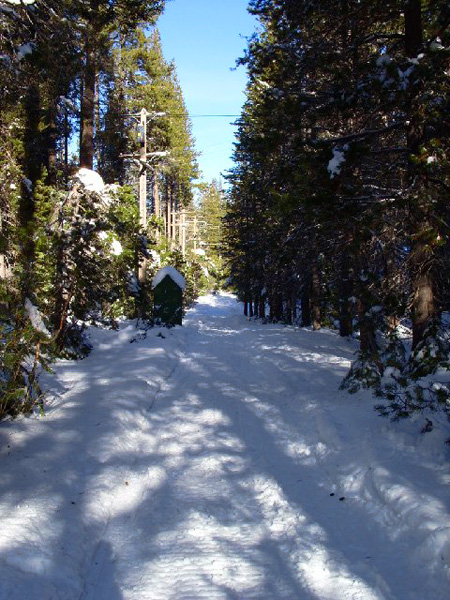
The second photo is just taken a little to the west of the first photo. It’s also looking east on the 1913 alignment:
Closed for 12 years, the Colo Motel has reopened, giving Lincoln Highway tourists a new-style, old-fashioned lodging option in central Iowa. It is part of the Reed/Niland corner complex that includes a cafe and gas station, both also restored. The cafe is operating and is a must-stop itself; the 1920s gas station is for display only but is set to house a country-style store.
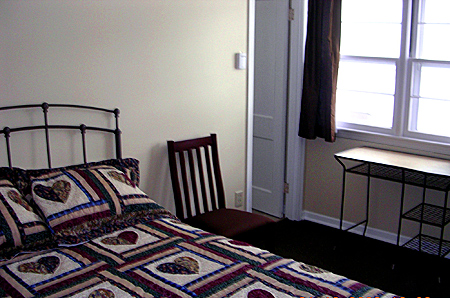
The motel’s six rooms rent for an affordable $49.99 per night or $175 for five consecutive nights. Scott Berka, Colo city clerk, says that other than “waiting for some of the furniture to arrive,” the rooms are complete with cable TV, wireless internet, central air, pillow-top mattresses, and room service from the café. The Colo is on the forefront of restoring mid-century motels for 2-lane tourists, and also gives locals a lodging option for out-of-town guests.
Above: Stuart Huse, one of the owners of Flat-Top Concrete & Construction, the prime contractor for the project, finishes the woodwork. Above photos courtesy Scott Berka.
The roadside one-stop opened about 1920 at the corner of Lincoln Highway and US 65, the old Jefferson Highway, but declined in recent decades as the old road was bypassed. The restoration is a project of Colo Development Group and the City of Colo; it has cost nearly $1 million including $663,000 in grant funding (from the Iowa DOT’s and Federal Highway Administration’s Transportation Enhancement Funding) and about $270,000 in local donations.The one-stop
An article in the Nevada [Iowa] Journal reported on the opening, and quoted Berka and Sandy Wilfong, manager of Niland’s Café and now the Colo Motel. She praised the retro-stryle rooms and appointments such as wrought iron headboards and curtain rods, and quilts on the beds. Come Spring, Wilfong hopes to have a farmers market at the corner on Saturdays.
The motel is at 18 Lincoln Highway in Colo. Reservations are taken through Nilands Cafe: (641) 377-3663. To learn more about the complex, go to the Colo Iowa web page and click Reed/Niland corner at the bottom of the left-hand column.
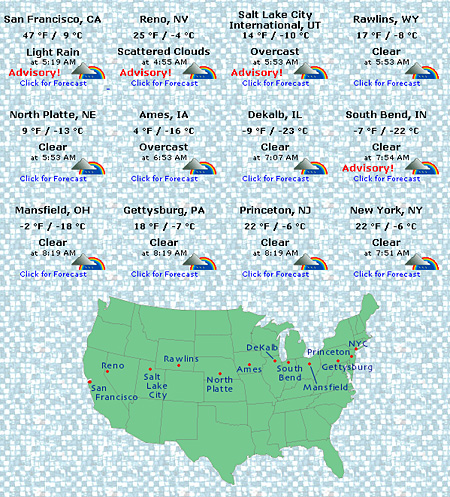
My web site has long had a Lincoln Highway weather map featuring conditions from 12 cities across the country. This morning, as I walked through 7° temperatures in PIttsburgh, I wondered about the rest of the country. As you can see, only San Franciscso can boast of warm temperatures (47°). The rest of the country is 25° or less, with 3 of the 12 cities below zero!
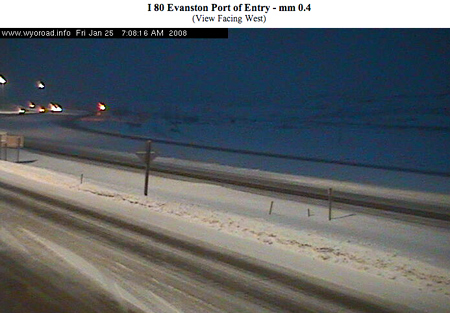
Wyoming DOT has a nice collection of web cams from I-80, which is often parallel to US 30/LH. The roads this morning look pretty clear in the east, but a few, like Evanston at 7 am (seen below), still look slippery:
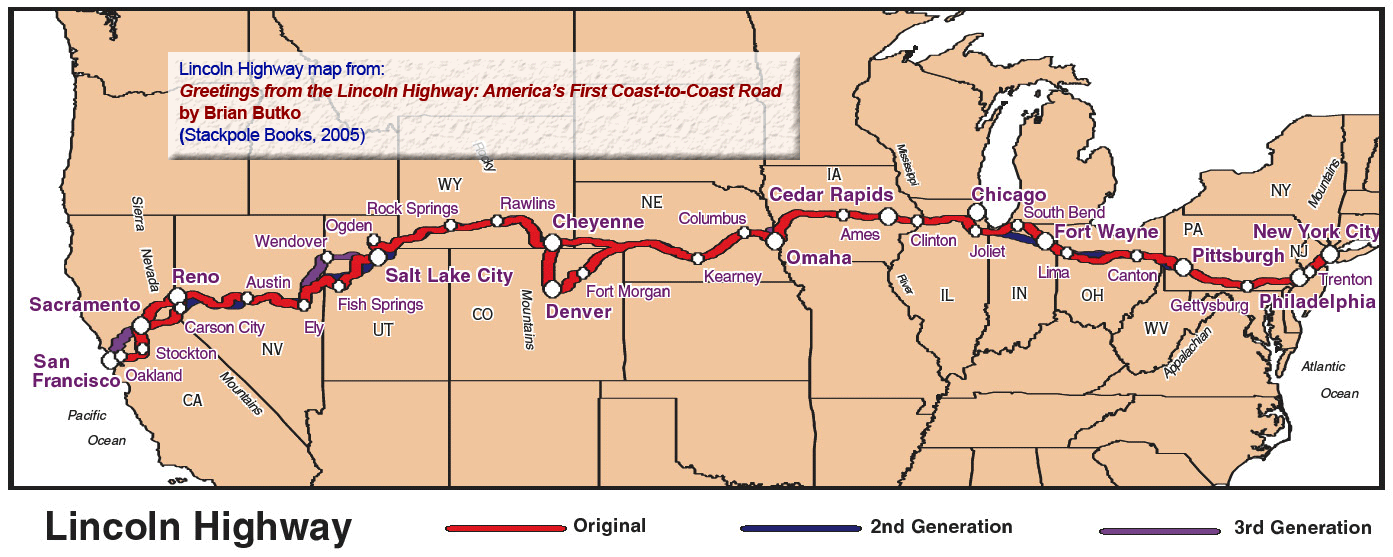
Click the map above for a full-size view of the Lincoln Highway.
Like this blog? You'll LOVE my books!Lincoln Highway Companion features detailed maps and places to eat and stay. Click the book to buy it on Amazon.
Click the Greetings book below to purchase the ultimate guide to the history and route of the Lincoln Highway!
Another fun book! The Ship Hotel: A Grand View along the Lincoln Highway recalls the greatest roadside attraction along the coast-to-coast road.
And for those who LOVE diners, click the book below to purchase our completely updated guide to the history, geography, and food of Pennsylvania's Diners!