Posts Tagged ‘highway history’

New book coming for Lincoln Highway in Indiana

October 14, 2008

LHA Past President Jan Shupert-Arick is working on a book, The Lincoln Highway Across Indiana, to be released by Arcadia Publishing in Spring 2009. She says some of the historical images will also be packaged as postcards, with both arriving in time for next summer’s LHA conference in South Bend. Here are two images from the book – above is the Log Cabin Camp at Benton (currently for sale); below is New Carlisle’s Main Street, now a National Register Historic District.

Video of Ligonier Beach a Lincoln Highway teaser

October 13, 2008

With Rick Sebak’s A Ride Along the Lincoln Highway awaiting its national premier on October 29, LH fans can get a taste for it in other Sebak videos, which often feature LH locations. Here’s a segment from Things That Are Still Here about Ligonier Beach, a 1920 swimming hole just east of Ligonier, Pennsylvania. The cement pool is fed by an artesian well and offers a short sandy beach.

First leg of “Walking America The Lincoln Way”

October 6, 2008

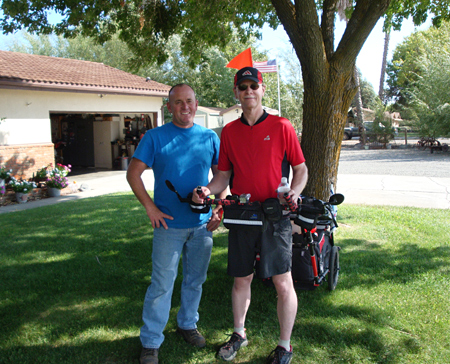
A mentioned in my post of 9/3/08, Dennis Crowley is walking across America on the Lincoln Highway, breaking the trip into manageable segments. He’s completed leg one from San Francisco to Sacramento and sent a round-up for our enjoyment. Now back in Arizona, he writes that “It seems like only yesterday that I first conceived of the idea to walk across America on the Lincoln Highway. Tired muscles, a collection of photos, and a pile of credit card receipts are telling me that the first leg of my walk on the Lincoln Highway is over.” Here’s part one of his note, with more to follow later this week:

After completing a walk across America on Route 66 in 2005 doing another walk was the furthest thing from my mind. Getting back to living a “normal” life was the only thing on my mind and that is precisely what I did, but it would only be short lived. In the spring of 2006 I received a phone call asking me to meet someone who was walking across America. When this man, also named Dennis, arrived at my home he was pulling a wheel barrow with his gear in it. It was quite a novelty to be sure, but it got me thinking. What he had was crude, but he had a good idea and I knew I could improve on it. As I watched him leave in the middle of the night the wheels on his “rig” were not the only ones turning.

Over the course of the next two years I worked with a graphic designer developing a logo, pestered custom bicycle builders for ideas on how to build a lightweight trailer, befriended some folks with the Lincoln Highway Association, planned, strategized, and tossed and turned at night. Before I knew it I was at Lincoln Park in San Francisco strapping myself into the harness of my trailer.

No crowds gathered and no bands played. It was just a quiet beginning, but an encouraging one. Kent Laak and Carlos Toste with the Mountain Hardwear Company showed up to wish me well. They presented me with tent compliments of their company and an acknowledgement of their support. And as representatives of the athletic shoe company Montrail they informed me that they would be providing all the shoes I needed. It would prove to be the sign of how things on this first leg would go.

I am not saying that everything went perfectly, but given the type of undertaking this is I certainly can’t complain. I do wish though that I would have been more attentive with my maps. Thankfully I learned that lesson early on. As I told people along the way, “It’s one thing to have to back track when you are driving and quite another when you are walking.” Soon after leaving the Presidio over looking the Golden Gate Bridge I had a bad feeling that I wasn’t where I was supposed to be. I quickly got on my cell phone and called my niece in Oregon to have her check a map. Sure enough, I was ten blocks south of where I was supposed to be. I turned myself around and made my own contribution to global warming with the continual utterance, “I can’t believe I did that!”

There was also one other “learning experience” as I would prefer to call it that I also have to share. Someone at one point recommended that I install brakes on my trailer. I didn’t think that would ever be necessary. Was I ever wrong! I can’t even begin to tell you how difficult it is to walk down the steepest streets in the world pulling a trailer behind you. My friend Paul Gilger nearly fell out of his chair laughing when I told him about it, but I am feeling much better now. (Grin)

Looking back I wish I had a camcorder mounted to myself as I walked. The attention the trailer got was unbelievable and at times even hysterical. Heads turned, people stared, and some people even pulled over just to ask about it. Of all the comments that were made my favorite was from a man in Berkley who said, “Now that’s manpower!” Because the Lincoln Highway coincides with parts of the Pony Express Trail I affectionately deemed my rig, “The “Manly Express.”

The full story of this first leg will appear on his journal over the next few weeks at www.walkingamessage.com, or visit it to learn more about “Walking America The Lincoln Way.”

Above photos are at Dixon and Fairfield, California.

Blog promotes Utah monument to Carl Fisher

October 1, 2008

Rollin Southwell, aka The Man From Utah, has started a blog to complement his efforts to promote a monument to Lincoln Highway catalyst Carl Fisher. He has been working for the past decade to have the monument erected at Fisher Pass in Utah, 32 miles SW of Tooele. He’s long had a web site that explains that a monument was to be built by the state when the Lincoln Highway was rerouted in 1918 to a straighter path across the Salt Lake Desert.

As Rollin recounts, “Carl G. Fisher donated $25,000.00 to the State of Utah in 1918 to make a short cut on the Transcontinental Lincoln Highway cutting out fifty miles of the worst road conditions then existing on the Lincoln Highway.” He has part of the contract online too:

And Johnson Pass shall hereafter be known as Fisher Pass, or by such other designation as Mr. Carl G. Fisher shall hereafter determine.

Said Seilbering and Fisher are hereby given authority to construct, at their own expense, at the termini of, or at such other places along such sections, suitable markers, monuments or arches for the designation of said respective sections in connection with the work herein referred to.

Rollin says progress is finally being made on permits for the site. He adds, “If anyone has some material about Fisher Pass or the Goodyear Cutoff, feel free to leave it on the blog. We can add it very easy. Photos too. To start getting the blog rolling, we talk about old Betsy and her car connection to Fisher Pass.” Check it out at www.rgsouthwellblog.com/.

Kiosk ready for dedication Oct 11 in New Carlisle

September 24, 2008

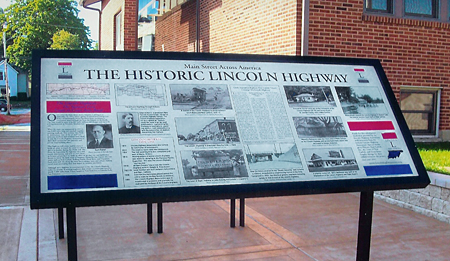
Jan Shupert-Arick sent photos of the new Lincoln Highway Kiosk that will be dedicated on October 11 in downtown New Carlisle at City Hall (the old Carnegie Library) on the Lincoln Highway. This is one of the kiosks that are planned in Indiana, partly funded by an LHA grant awarded in June 2007.

Lots of organizing, editing for highway video

September 9, 2008

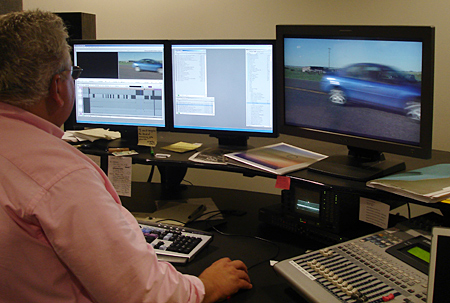
Producing a video is a lot like the books I write — the research is the fun part. The real work is organizing mounds of info into a concise, coherent story for a broad audience. When I visited producer Rick Sebak, he sat next to the tapes for his PBS Lincoln Highway documentary: 99 of them at 40 minutes each! I count 66 hours of raw material that needs boiled down to a 56-minute show. What’s more daunting: that 65/66ths will not be used, or that he still has to watch and consider that material?

Above, Rick reviews the opening sequence and is about to cut the scene with the blue car — too similar to other road shots. Computers let him drag and drop segments of video like magnets on a refrigerator, then editor Kevin Conrad will perform the final splices (all digital of course). We also visited Paula Zetter, who designed the postcards.

I saw about 2/3 of the video and it’s great fun — very colorful and covering a wide variety of people and places. There’s a little from every state on the Lincoln Highway. Along with some basic history, there are markers and monuments, some food stops, and many attractions. Notable landmarks are sprinkled throughout the show too. Intrigued? Tune in Oct 29 at 8 pm AND announcing — repeating Halloween night at 10 pm. These two airings will also be broadcast on PBS-HD, likely the only HD broadcasts of it.

One more note — with a parallel genesis, my Lincoln Highway Companion book will include many of the same highlights when released in the Spring. Rick is just one of dozens of people who contributed their recommendations of places to visit along the route.

Book explores Lincoln Highway in New Jersey

September 4, 2008

Al Pfingstl, LHA NJ Chapter Director, has just completed Sixty-Three Miles of History: The Lincoln Highway in New Jersey. Al says it took him a year to compile, edit, format, and print the book.

“This endeavor was at the urging of my wife, after the passing of my dog ‘Winter’ who was my best friend, research assistant, and traveling partner along the Lincoln Highway. We both traveled on and visited sites as far west as Bedford, PA.”

We’ll let you know when the book, published by Winter Haven Publishing, is available for purchase.

Denny visits Terminus on West Coast adventure

August 12, 2008

Well-known roadie Denny Gibson has been cruising down the Pacific Coast this week and passed through San Francisco the past couple days. Like producer Rick Sebak, he stayed overnight at the Pacific Heights Inn and reports it to be good and priced right. Yesterday morning he went in search of the last original 1928 Lincoln Highway concrete post. With a little help from me and Sebak’s blog and video diary, he found it with the surrounding bushes cut back to better reveal the post: “Yep, it’s so much easier that I walked by it twice without seeing it. I was looking for and into shrubs and certainly entertaining anyone who was watching.”

Then he cruised to the nearby Terminus marker, also an LHA concrete post but this one a modern reproduction.

Then it was off to the Cliff House to see where dedicated transcontinetalists really ended their trip – at the ocean, dipping their tires. (With the beach now closed to cars, there was no dipping for Denny’s tires.) Read more about his adventures from this trip, with tons of roadside info and images, at www.dennygibson.com/. (Note, his blog is a couple days behind so no LH mention is posted yet.)

Texaco's 1929 Lincoln Highway ad campaign

August 8, 2008

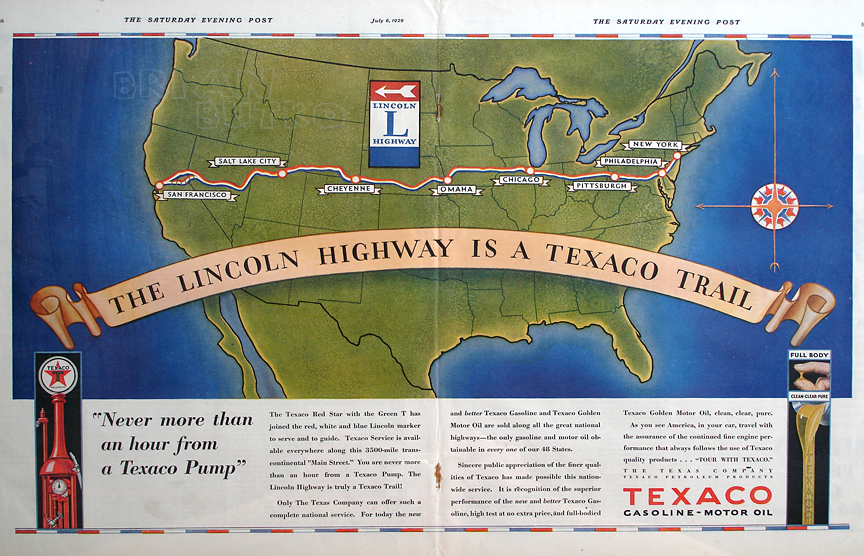
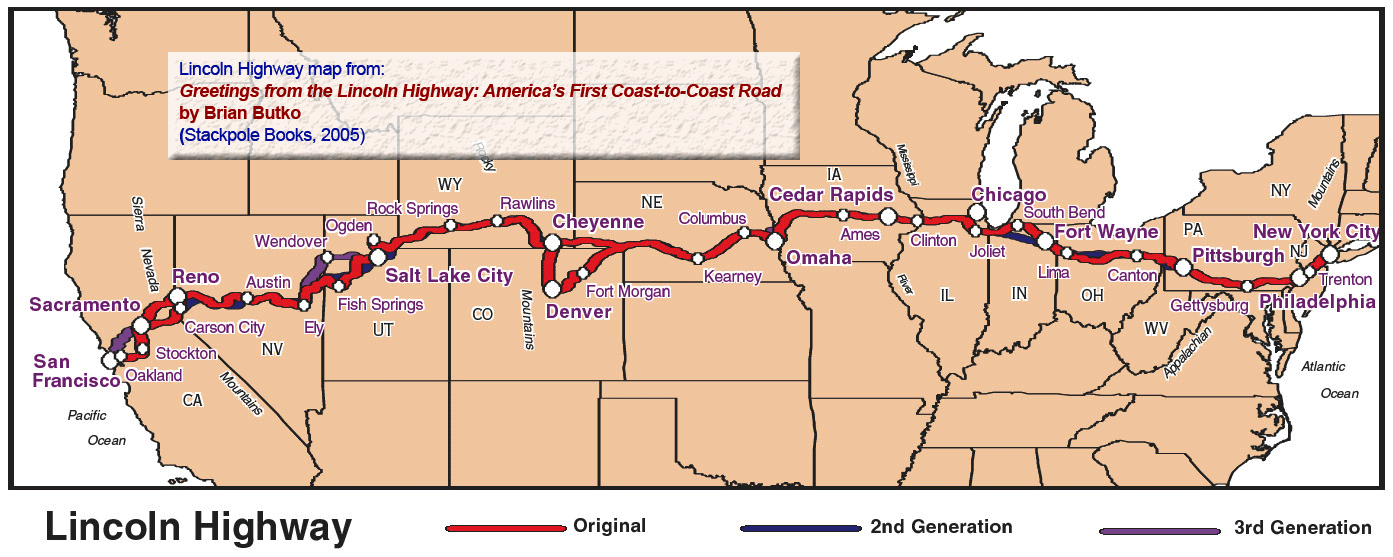
In 1929, Texaco ran an ad campaign centered on the Lincoln Highway. Advertisements ran in their member magazine, little strip maps were distributed, and spreads like this one in the Saturday Evening Post pointed people to the cross-country route. This was a bit odd considering the LHA had ceased active operations the year before, but perhaps that’s why the company chose to honor what it called a “transcontinental “Main Stree,'”

CLICK the map to see it larger.

Lincoln Highway history, the next generation

August 7, 2008

In recent years, the Lincoln Highway is returning to the mainstream. Wildly popular in the 1910s, it endured low name recognition through the 1960s-80s, but is again being embraced by an ever-wider audience. However, as the highway’s history is disseminated and simplified, it is also being generalized into fiction.
I read a blog stating “Interstate 80 derived from the old Lincoln Highway.” And a web site: “Lincoln Highway was the first major highway developed in 1915…. During the 30’s and the 40’s it became Highway 30 and then when Eisenhower promoted the interstate highway system it became Interstate 80.” Perhaps I-80 is descended from the LH in spirit or along its E-W corridor, but those looking for accuracy should disregard the above statements.

Another: “Because it would be built with private donations and not by the government, a friend suggested Fisher call the new road the Abraham Lincoln Highway, a name sure to open the pocketbooks of patriotic Americans.” Not exactly wrong but not necessarily correct.

And: “In the 1920s, the Lincoln Highway, the first transcontinental paved highway, opened to much fanfare…. The old Lincoln Highway was eventually replaced by US 40 and then by Interstate 80.” Nevermind the 40 and 80 missteps, the “first” claim can quickly polarize. Were other transcontinental paths named, marked, and promoted before the LH? Yes. Did they sustain that attention and improvement? No. Choose your side but don’t ignore or dismiss the other.

From a video: “See America First was a new concept in 1920.” Perhaps gaining steam then among motorists, the concept dates to the late 1800s and the phrase itself to at least 1906 when a railroad used it; in fact, The New York Times wrote about the rising trend in 1906.

I thought I recognized some phrasing when a reporter recently wrote, “drivers could find small local diners, quaint cozy cabins, prosperous mom-and-pop shops, Art Deco gas stations and colorful roadside attractions.” Yep, she got her history from a line for my Greetings book press release which you can find on Amazon: “diners, neon movie palaces, Art Deco gas stations, ice cream stands, tourist cabins, and colorful roadside attractions.”

Chambers of commerce and tourism agencies are likewise discovering the Lincoln. That’s good for economic growth and preservation, but the story of the highway becomes a bit more generalized, and inaccurate, with each retelling. A recent news article paraphrased a tourism bureau chief: “Historically, Lincoln Highway has been used as a commercial transportation highway, while Route 66 was created for travel and leisure.” This statement takes some narrow modern preconceptions, puts them in a blender, and projects backwards a history that just isn’t true.

There is debate in Illinois whether towns within the LH’s corridor of influence should be included in economic promotions. How specific should we be in defining the LH’s corridor? Only the marked road? Or within a block or business district? Is Chicago “on” the route? Just how literally do we interpret the Proclamation Route? Do we count LH routes that were only promoted locally, but seriously? How about the Feeder Routes? Are those who take sides aware of the larger picture, where a desire for strict interpretation is more a modern focus than a historical truth?

There were many motivating factors behind the Lincoln Highway, but one of them was certainly scenic tourism. In fact, recreational travel promoted as a patriotic duty was probably more fervent in the teens than the 1920s, when Route 66 was established as one of the many numbered federal highways. Regardless, advocates of any of these highways promoted roads for economic advancement, no matter the source. Perhaps the main difference between the two was the LH and other c. 1913 trails were blazing a path of promoting hard-surfaced roads, while by 1926, the benefits of good roads were a much easier sale.

The Lincoln Highway was the most famous road of its day, and remained a popular name and destination decades later, but 66 finally overshadowed it for many reasons. Bobby Troup wrote an enormously popular song about it in 1946. US 66 became a well-traveled route to the West Coast for those looking for hi-tech jobs after WWII. Todd and Buzz rode to fame on the Route 66 TV show in the 1960s, thereby associating the road with potent imagery and mythology. And then there’s that seductive alliteration of the two numbers.

While the LH has come to embody early travel with images of mud, cabin camps, and Model Ts, the later birth of 66 and its postwar popularity finds it associated more with concrete ribbons, neon signs, and tail-finned cars. The LH had those too — probably more since it’s a third longer — but that imagery was first and wisely latched onto by 66 boosters in the 1980s. Route 66 became the embodiment of simpler, happier times, a symbol for adventure, and it soon became the setting for any ad, commercial, or clothing line that wanted to be retro chic. Places along 66 sometimes embrace the 1950s/Marilyn/car hop nostalgic marketing to the point of overload, but many tourists enjoy exactly that special sense of place, especially strung out over a couple thousand miles.

The Lincoln Highway’s resurgence similarly began in the 1980s, sparked by Drake Hokanson’s book and spread by the national LHA in the 1990s, then entering public forums in recent years as books and magazines have spread the word. While recent restoration efforts on 66 have focused on gas stations and roadside attractions, LH folks are just reaching that point, having first concentrated on saving the infrastructure itself (such as the tiny concrete bridges in Iowa). A quick glance back might give the impression that the LH had a more serious genesis, while 66 was built for fun, but that’s just not the case. The same goes for the other above statements.

For a solid overview of Lincoln Highway history, check out Hokanson’s beautiful The Lincoln Highway: Main Street Across America.

For a recent in-depth look at 66, try Arthur Krim’s Route 66: Iconography of the American Highway.

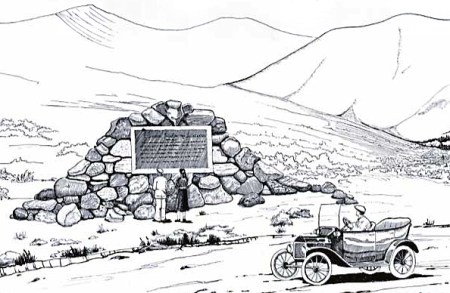
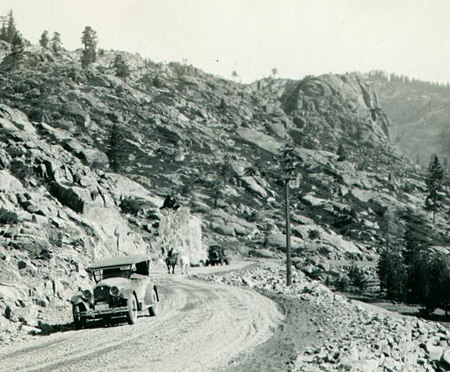
For those who like to do their own research, visit the Special Collections Library at the University of Michigan, which houses the original LHA’s archival materials and photos like the one at top [“New road between Donner Lake and Summit, California” (lhc0135)].